Nov. 30, 2024
Home Sweet Home, Matera, Italy
It was a cold, rainy morning. I had all day to make a two-hour drive from Lecce to Matera. I stayed in my house in Lecce until check-out time at 11:00. I was concerned that my international data had expired, so I went out to check that it was still working. It was. I didn’t want to get stuck without navigation.
 |
| Shopping Mall in Taranto |
Getting out of Lecce was the most difficult driving I had encountered. The Lecce drivers honked if I appeared the least bit cautious. I was glad to escape the city. I drove across fields and vineyards for a couple of hours and then realized I was going to be too early to check in at my AirB&B in Matera. I decided to detour to Taranto for lunch. I followed signs to a shopping mall, having forgotten that it was a Saturday during Christmas shopping season. The mall was packed. I took advantage of the restroom and then grabbed some focaccia with pepperoni and blue cheese.
When I got back to my car and went to restart my navigation, I had no data. I have a Mexican phone, so have to let things expire and then recharge. Unfortunately, I can't do it from my phone because their mobile app won't take my U.S. credit cards. Fortunately, I have a mobile hot spot for such emergencies. Unfortunately, I hadn't used it since our Starlink failed in the Sea of Cortez and the battery was flat. Fortunately, I had a fully charged battery backup. Eventually, I got underway, didn't get lost, and made it to my B&B where I could fire up the computer and buy more international data. The route through Matera was so circuitous that I was almost certain I was driving in circles. Fortunately, I found the place and was only a little bit late for my check-in appointment.
 |
| Sunset Over Matera |
The place I had rented was a bedroom and bath in an apartment that had been converted to a B&B. I was the only person there. It was called Home Sweet Home. It was homey if you were visiting the home of your bachelor uncle. It had everything necessary, but absolutely no charm. Still, it was warm.
I hauled all my luggage upstairs. Then I went for a sunset walk.
 |
| Rock Church in Matera |
The beauty of the location was its proximity to the edge of town. Matera is known for the dwellings and churches carved into the soft tufa stone. My apartment was within walking distance of some of these. By the time I sorted out my phone data, it was 16:00 and I knew I only had an hour before dark. I chose the nearest point of interest and set out on what amounted to a twenty-minute walk. The sun was setting and the rain clouds made for a dramatic sunset. I walked through olive groves until Google Maps told me I had reached my destination. That wasn’t actually the case, but it was too dark to go scrambling around the cliffs looking for caves. I took a couple of pictures and turned around. I got home just before dark and spent the evening working on my blog.
Dec. 1, 2024
Home Sweet Home, Matera, Italy
 |
| Matera Citta |
I came to Matera because my guidebook seemed to think it was the only place worth visiting in Basilicata and I needed somewhere to stop between Lecce and Reggio Calabria. I hadn’t seen too much of interest on my way in and thought it would be similar to what I had seen in Cappadoccia. Boy, was I wrong! The old town of Matera is extensive, so extensive that it stood in for Jerusalem in Mel Gibson’s
The Passion of Christ. It spills down the walls of a steep canyon, originally carved into the stone and then built against it. It’s a warren of houses, shops, restaurants, and churches reaching back into prehistory. I was enchanted.
 |
| The Castle in Matera |
My host prepared me a nice breakfast and then I left the apartment and drove into the center of Matera, hoping I could find a parking space on a wintry Sunday morning. I found street parking near the castle and paid to park until 16:00. My first stop was the park surrounding the castle. The castle was surrounded with construction fencing, so I couldn’t get inside. I started to head for the cathedral but followed signs for other attractions, knowing the cathedral was closed until 12:30.
The first museum I came to was Museo Domenico Ridola. It was the first Sunday of the month, so the state museums were free. Museo Domenico Ridola was mostly an archaeological museum, but it also featured a fossilized whale skeleton discovered at a nearby reservoir. It is believed that the whale became stranded there when the sea level suddenly dropped (or the land rose.) The visit began in an immersive video experience with projections on two walls and a mirror on a third. It was pretty intense.
 |
| Pottery Display for the Vision and Hearing Impaired |
After the whale skeleton, I entered a display of Greek pottery specifically designed for the handicapped. Replicas of the pots were set out for the blind to touch, with information about them set in braille. The videos all featured an interpreter signing for the deaf. I have seen a lot of Greek pottery in my travels. Usually I find it rather ho-hum. This collection was stunning. Never have I seen such large and detailed pieces and they were in excellent condition.
 |
| Amazing Greek Pottery |
 |
| Palazzo Lanfranchi Courtyard |
Down the street a few hundred yards, I came to the Museo di Palazzo Lanfranchi. This was the art museum. The featured exhibit was paintings by Carlos Levi. Levi was forced to flee Italian fascism in the 1930s. He relocated to Paris where he interacted with other well-known artists of his day. Most of his work left me cold, but there was an immense mural about the struggle of Italian peasants painted from memory towards the end of his life that I found very moving. It was impossible to get far enough away from it to even take a panoramic shot. It must have been eighty feet long. The Palazzo Lanfranchi was a gorgeous building and the views of old Matera were artworks themselves.
 |
| View of Matera from the Palazzo Window |
 |
| Partial Carlos Levi Mural |
 |
| Casa Grotta in Matera |
 |
| San Pietro Caveosa |
After the museums, I wandered down the stairs into the old city. Originally, dwellings were hewn out of the soft stone. Early churches were carved the same way. Having visited lots of stone churches in Turkey and even stayed in a cave hotel, I didn’t feel compelled to pay the entrance fee to visit any of the ones in Matera. I was more interested in the later churches, such as San Pietro Caveosa from the fourteenth century. The congregation had originally been located elsewhere during the eighth century, but had relocated to its current location when the Franciscan monks wanted to build a monastery on the old site. The interior was fairly simple but some of the original frescoes remained in one of the chapels. The church has undergone numerous reconfigurations over the centuries, the most recent in the first half of the 20th century. The painted, wooden ceiling was added in the eighteenth century, as was the bell tower. The dramatic stained glass is no doubt relatively recent.
 |
| San Pietro Caveosa Frescoes |
 |
| San Pietro Caveosa Interior |
 |
| Caves Across the Canyon |
 |
| Madonna del Idris |
It was a cloudy day. The light was fantastic, but it never rained. I couldn’t help but take numerous photographs of the city and the rock dwellings on the other side of the canyon. I refrained from walking down to the river below, but did walk to the bottom of the city. One stone outcropping had
 |
| Stairs Back to the Cathedral |
 |
| The Matera Cathedral |
been hollowed out to make a church called Madonna de Idris. I climbed back up the side of the
canyon and made my way to the cathedral. The outside looked like several I had seen recently, but it was only 3.5 euros to enter and there was a museum included, so I decided to check it out. I’m so glad I did. I entered through the chapel of St. Giuseppi, a sort of nativity scene diorama. The floor was cut out so you could see evidence of an earlier, frescoed church. The high altar was all baroque excess and gold, but it was the trompe l’oeille ceilings that really blew my mind. The inlaid marble altar surrounding an earlier frescoe of Mary in the Holy Sacrment Chapel was also exceptional. Every time I thought I had seen enough churches, something new would come along to delight me.
 |
Chapel of San Giuseppi
|
 |
| High Altar in the Matera Cathedral |
 |
| Cathedrak Ceiling |
After the cathedral, I thought I’d check out the Piazza Vittorio Veneto on my way to my car, but I kept spying fantastic architechtural gems and wandered from one to the next. Even the Conservatory of Music was ornate. About 14:00, a cold wind blew up and I decided to stop for lunch. I ate eggplant parmigiana in an outdoor and (mostly) sheltered cafe that was soon overrun by two large groups of noisy Italians. Three teenage kittens begged for food but weren’t interested in socializing.
 |
| Conservatory of Music |
After lunch, I visited the Church and Convent of St. Francis of Assisi, the Church of Purgatory, the former Convent of Santa Lucia alla Fontana, and finally made it to Piazza Vittorio Veneto which was all decked out for Christmas. I was sorry that I wouldn’t be there to see the lights. I tried to visit the Church of San Francesco di Paola, which looked impressive, but there was a funeral mass underway. A very stylish hearse was waiting at the front steps.
 |
| Church of St. Francis of Assisi |
 |
| The Church of Purgatory |
 |
| Santa Lucia alla Fontana |
 |
| Mercedes Hearse |
By this time, it was after 15:30 and very cold. I climbed back up the hill to my car and threaded my way back across modern Matera to my lodging. It was toasty warm in there. I spent the evening trying to make sense of all I had seen, practicing the mandolin, and munching on cold cuts and focaccia. I would be returning the car the next day and would have to consolidate my luggage in order to travel by train again.
Dec. 2, 2024
Casa Blanca B&B, Reggio di Calabria, Italy
 |
| Italian Truck Stop |
I managed to pack all my belongings back into a suitcase and one backpack and was ready to leave just after breakfast. This did require leaving a pair of pants and a pair of shoes that I had never intended to bring home in a donation bin near my lodging,
The drive from Matera to Reggio Calabria was the longest drive I had made in Italy. I left before 10:00 and only stopped long enough to eat a sandwich. There was a lot of road work going on and twice I was unable to follow Google Maps and had to wing it until the software could recalculate. I ate lunch in a roadside turnout for trucks. There were no services, but at least I was off the highway.
The scenery was pretty. I began to see orange groves mixed in with the olives and it grew warmer. From Matera, I drove out of the hills and down to the coast of the Ionian Sea. Then I climbed over a low spot in the Appennines and down to the Tyrrhenian Sea. The area was very mountainous and I passed through many tunnels. As I neared Reggio Calabria it grew warmer, but it also started to rain.
I reached the Reggio Calabria airport about 15:00 and eventually found the rental car agency nearby. I had picked up my car in the pouring rain and had completed the contract without ever seeing the car, which was parked in a lot some distance away. It took me two days to notice a dent in the rear hatch and I never did know if it had been there all along. I was relieved to discover that I was not responsible for the damage. The car had allowed me to explore all the places I wanted to go, but it had also been a tremendous worry, since parking was always difficult. I was relieved to turn it in.
 |
| My Room at the Casa Blanca B&B |
I took a taxi to my B&B in central Reggio Calabria. The 48 stairs to my room were even worse than the ones in Lecce, but the owner carried my suitcase to my room. At first, I couldn’t get the heat to come on and I thought maybe the unit only provided A/C. I was settling in for a cold night when the thing started working about 21:00. Maybe it was on a timer. The compressor sounded like a freight train, but I was finally warm.
Dec. 3, 2024
Casa Blanca B&B, Reggio di Calabria, Italy
 |
| Corso Vittorio Emanuele III |
On the 28th of December, 1908, a magnitude 7.1 earthquake rocked the Strait of Messina and nearly completely destroyed the cities of Messina and Reggio Calabria. More than 75,000 people were killed. As a result, there are not a lot of historic buildings in Reggio Calabria. The only one I saw was the Castello Aragonese, of which only two towers remain. While there is not a lot for tourists to do, Reggio Calabria is a well organized and beautiful city. The main street, Corso Vittorio Emanuele III, stretches along the waterfront for 1.7 kilometers, lined with high end shopping and public buildings. Closer to the water, there are walking and bike paths and mature landscaping.
 |
| Waterfront Path |
 |
| Cathedral in Reggio Calabria |
 |
| Cathedral Interior |
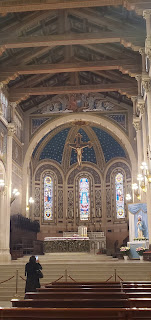
With no real agenda, I left my B&B about 8:30 and just walked for an hour. I stopped into the cathedral, destroyed by the 1908 earthquake and rebuilt in a eclectic style during the 1920s. Then I walked down to the water and was rewarded by a glimpse of snow-covered Mt. Etna across the Straits of Messina in Sicily. (While I would get much closer to Mt. Etna, I would not see the summit again.) I could see ferries plying the strait. The waterfront was lined with the palaces of the rich, now mostly converted into public buildings. The street was landscaped with mature trees, many of which looked decidedly tropical. Snowy Mt. Etna framed by palm trees was quite a juxtaposition.
 |
| Mt. Etna |
 |
| Villa Zerbi |
I got hungry and returned to Corso Vittorio Emanuele III, much of which is a pedestrian mall, and found a bar where I got a cappuccino and a cream filled croissant. Then I walked along the boulevard, eventually reaching the Archaeological Museum, which my guidebook seemed to think was the only reason to visit Reggio Calabria. There was a big, noisy school group waiting to enter the museum, so I decided to wait for them to play through before entering. Instead, I walked over to the port. There didn’t seem to be a marina, but there was a boat yard, as well as a beach where smaller boats were launched and serviced.
 |
| Boat Yard in Reggio Calabria |
 |
| Boat Servicing Beach in Reggio Calabria |
 |
| Archaeological Museum in Reggio Calabria |
I saw no evidence of the school group outside the museum, so I entered. Unfortunately, there were two or three noisy groups inside and I spent my entire visit trying to avoid them. It was actually a pretty interesting museum. I learned that Italy takes its name from the Onotrian king, Italus. The Onotrians were the first non-barbarian inhabitants of Calabria. The area was subsequently colonized by the Greeks, who called it Italia. When the Romans sought to conquer the area in the first century BC, the peoples opposing Rome united under the Italic banner. Gradually, the name spread to include the entire peninsula.
 |
| Greek Horse Head Pot |
I was dawdling on the top floor, waiting for the students to get far enough away for me to hear myself think, when there was an earthquake drill. Everyone in the museum was herded outside where we stood around for 15 minutes until we were allowed back inside. The Greeks founded the first city, Rhegion, on the site of Reggio Calabria. The idea of a town was a Greek innovation, brought to Southern Italy between the 8th and 7th centuries BC. The Greek influence was obvious in the artifacts displayed in the museum. There didn’t appear to be much Roman influence.
 |
| People Mover |
After the museum, I decided to walk down the Corso to the train station. I didn’t get far before it began to sprinkle. It wasn’t bad at first. I stopped to admire a few churches and the covered people movers (not operating) that carried shoppers up a steep hill. It started to rain in earnest about the time I reached the cathedral. I went back to my B&B to eat lunch and read for a couple of hours.
When the sun came out about 14:30, I went back outside. I resumed my trek down the Corso towards the train station. I wanted to verify that I could walk there with my luggage the following day. I got side tracked by signs for the castle and climbed up the hill to look at that. Eventually, I made it to the train station, which was an easy walk downhill from my B&B on wide sidewalks. I checked the train timetable while I was there and then started for home, stopping at a grocery store on the way back. I found some decaffeinated instant coffee and bought a small bottle of heavy cream. I knew it wouldn’t last, but it would at least get me through breakfast. I was desperate for a big cup of coffee with cream.
 |
| The Castle at Reggio Calabria |
I spent the rest of the afternoon and evening reading, munching, practicing the mandolin, and writing.


