Sunday, July 13, 2014

FROM THE MOUNTAINS TO THE AZUERO PENINSULA IN PANAMA


July 6, 2014

It poured all night and was still pouring in the morning.  I didn’t relish the idea of taking boat rides during the deluge, so kept stalling my departure.  Finally, at 11:00, I decided I had to go because I didn’t want to be hiking up the hill to the Lost and Found Lodge in the dark.  When the rain slowed to just a steady fall, I wrapped my duffel in a trash bag and hailed a boatman.  Speeding across the water during a rain required holding my umbrella in front of me like a windscreen.  I couldn’t see where I was going, but at least I wasn’t being pelted with rain.

Buses from Almirante to David Leave from Here
When I got to Bocas, there was a huge crowd of people and luggage waiting to go to Almirante.  The group ahead of me had 14 people.  I couldn’t get on the first boat, but lucked out and got on the second boat because there wasn’t room for the big group.  It was still raining, so we pulled the side curtains down and huddled inside for the half hour ride.  I said a firm, “No!” to the kids who wanted to carry my luggage and headed up the road, looking for the bus terminal.  My guidebook said it was a mere five minute walk from the dock.  A nice gentleman in the house on the corner directed me to the terminal.  The rain had stopped and I picked my way between the puddles to the terminal.  Unfortunately, the bus towards David didn’t leave from the terminal.  That explained why the guidebook said a taxi would charge $5 for the ride to the terminal, even though it was close.  The David terminal was a mile or more away and they were confusing the two terminals.  I walked all the way to the terminal at the crossroads.  Everyone looked at me like I was crazy as I dragged my bag down the highway and a guy on a motorcycle actually said, “You made it!” when he saw me as he pulled into the gas station next to the terminal.

A bus came along shortly after I arrived and they seemed quite familiar with the location of the Lost and Found Lodge.  The bus climbed up through the mountains and then followed the coast for an hour or so before heading up the pass and over the mountain to the reservoir.  After about two and a half hours, we arrived at the road to the Lost and Found Lodge.  The path was billed as a 15 minute walk and really was if you weren’t carrying heavy luggage.  It was straight up a hill so steep that much of it was stairs.  When I hesitated for a moment to be sure I was on the right path, two guys carrying a huge dive bag between them caught up to me.  They had come on the bus from the opposite direction.  By the time we had dragged our ridiculous, heavy luggage all the way to the lodge, we had bonded.  Bret was a guy about my age from Florida and Conner was a young teacher from Alberta.
Lost and Found Dorm Building


The Lost and Found Lodge straggles down a steep hill.  At the top are the bar and the showers.  The restrooms are down in a hollow below the bar.  Further down the hill are the kitchen, office, and common area.  The dorms are below that and my private cabin was quite a way further down the hill below that.  The cabin was one room and a front porch with an incredible view over the mountainside and the valley all the way to David.  The building was constructed of steel framing with concrete board walls and a tin roof.  There was a very comfortable double bed with a nice mosquito net, which wasn’t really necessary for bugs, but did a great job of keeping the leaves and debris produced by the tremendous wind out of my face.  Hammocks were hung all over the place.

Interior of My Cabin at Lost and Found
Dinner was available for $6 and it was chilly enough that a bottle of red wine sounded delightful.  I sipped red wine on the deck until dinner was ready and then hung out for a bit until the sun set.  Happy hour started at 8:00, but I had already consumed half a bottle of wine and was tired from not sleeping well in Bastimentos and my trek up the mountain.  I retired to my cabin, read for a bit, and went to sleep.

July 7, 2014

Since the restroom was about a 200’ climb over a hill from my cabin, it was not something I wanted to do in the middle of the night.  As a result, I was up early.  I took a shower while I was up there.  The first shower I looked into was occupied by a large toad.  The next one only had a large dung beetle, which seemed tame by comparison.  Refreshed from my shower, I boiled a couple of eggs and had eggs, toast and coffee.  After breakfast, a big group of us decided to go swimming at Los Caniglones where a river has cut a channel through limestone cliffs and you can sun on the rocks and then leap into deep water below.  We took a bus down the mountain towards David for 40 minutes or so ($2) to the town of Gualaca.  After visiting the grocery store for provisions, we walked a short distance down the road between the store and the baseball field to the river. Having flung myself off the 148 foot high Tarzan swing in Monteverde, I didn’t feel I had to prove anything by jumping off the highest point.  I settled for a drop of ten feet or so into a deep pool of water that was mixed with hot springs to reach the absolute perfect temperature.  It was cool enough to be refreshing without making your brain freeze.  I swam upstream through the canyon, watched the other jump in, and then floated back down to a spot where it was easier to climb out.  After a couple of repetitions, I was glad to lie on the warm rocks and dry out a bit.  There were a couple of college gymnasts from Colorado who were also there and they were doing impressive flips and twists as they dove into the water.

My Cabin at Lost and Found
Our plan was to take the bus back past the hostel and hike to a waterfall in the afternoon.  We got on the bus, but didn’t get very far before the engine gave out on the bus.  We stopped at a place in the road where we had a fabulous view but, having planned to go canyoning, I had left my camera behind.  We waited for about an hour for a second bus to come and rescue us.  By that time, we decided it was too late to tackle the waterfall hike, so we got off at the stop for the hostel.  Bret, Conner and I stopped for lunch at the restaurant near the beginning of the path.  I had fried mozzarella cheese sticks and a strawberry smoothie for $4.75.  The others had sandwiches, all of which were reasonable and tasty.  We spent the rest of the afternoon hanging out at the hostel and using the WiFi.  I downloaded the novel, The Lost and Found, written by one of the owners and started reading that.  We ate a filling dinner of chicken with rice, lentils, and cucumber salad.  I finished my bottle of wine.  Each night, after dinner, we all went up to visit with Rocky, the tame kinkajou.  Rocky has a large cage and we would all sit on the floor as he crawled around, visiting everyone and occasionally snuggling into someone's lap.
Rocky, the Kinkajou
I went up to the bar for happy hour at 8:00, but only stayed for one drink because the music was kind of obnoxious and it just wasn’t my scene.  I went back to my cabin and read until my phone went spastic and refused to stay on the page I was trying to read.  Once again, I slept like a log, even though the wind was howling and, at times, I feared the roof would blow off.


July 8, 2014

View from My Cabin at Lost and Found
Nature called at about 6:30, so I trekked up to the restrooms.  Unfortunately, I forgot to bring my towel, so had to make the climb a second time in order to take my morning shower.  The official name of my cabin was Ocelot, but I started referring to it as the cardio cabin, since I ended up making that big climb five or six times a day.  I had a leisurely breakfast and a cup of coffee and worked on my blog until the others got moving.  

The Rio d'Oro
Our plan was to tackle the Lost and Found Treasure Hunt that day.  The treasure hunt begins with the first clue, which is located in the center of a maze.  The maze was a jungle of heliconia, ferns, and other rainforest shrubs.  We stumbled around in there until Milan and eventually I found the clue.  We successfully found the second clue without a false step and then set off into the woods in search of the third clue.  I won’t give details here in case any readers plan to visit the Lost and Found Lodge, but I will reveal that our next stop involved a long, steep climb over the ridge to find the third clue and then down to the river where we got stumped.  We tried a couple of different solutions to the riddle, but never did find the clue.  We were starting to get hungry and knew we had to climb back over the hill to get to food, so decided to (at least temporarily in some cases) abandon the treasure hunt and head back to the hostel.
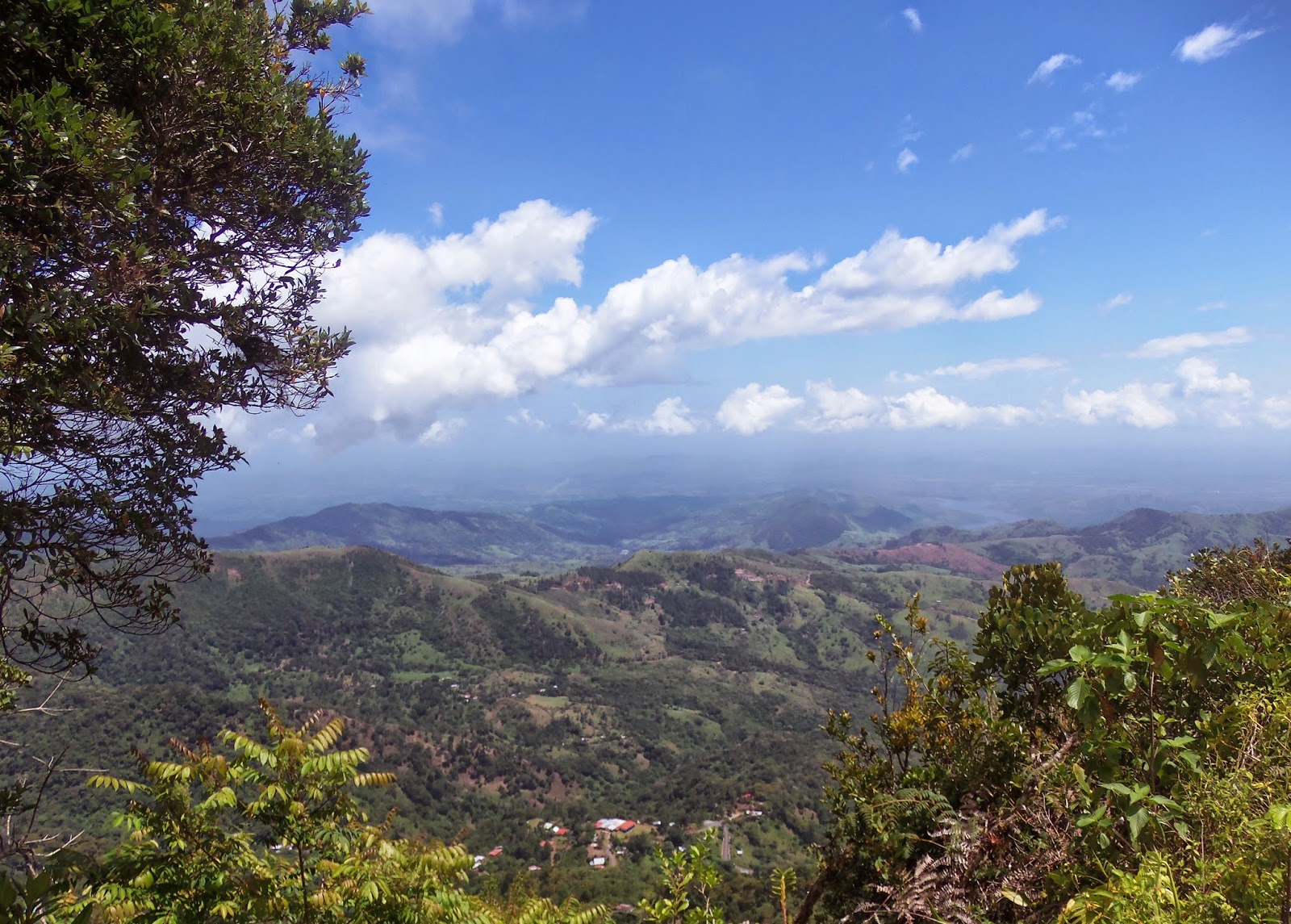

View from Mirador
We climbed back up the steep hill and then took an even steeper detour to the Mirador, which offered a view that made hauling ourselves up there worth the effort.  The land sloped away before us to infinity.  The mountains were very rugged and very green.  Virtually every path was as steep as a staircase and some were more like ladders.  Fortunately, there were lots of trunks, vines, and roots to use as handholds.  After pausing for a bit at the top to enjoy the view, we climbed, jumped, and slipped our way back down the hill to the hostel to eat lunch.  After lunch, I retired to my front porch to write.  Much to my surprise, I actually had decent WiFi coverage down there.  I spent the whole afternoon catching up on my blog and uploading photos and then had another great meal with the gang before heading off to ready myself for an early departure.

July 9, 2014

I got up at six so as to be ready to eat breakfast as soon as the kitchen opened at 7:00.  I downed a couple of slices of peanut butter and toast and got checked out by 7:30.  Then the adventure began.  I had to carry my heavy day pack and big duffel bag half a kilometer down a steep, rocky forest path in the pouring rain.  I couldn’t use my umbrella because I didn’t have enough hands.  Sometimes, I could balance the duffel on my head, which kept the rain off, but I couldn’t go down rocky steps that way because I couldn’t look down with the bag on my head.  I would have to lower the bag, pick my way down the steps, and then hoist the big bag back onto my head.  It was a good thing no one was watching me.  Eventually, I came to the point where there were steep concrete tracks and I was able to use the wheels and cover the duffel with a trash bag.  I had already wrapped everything inside in plastic bags, knowing it was going to get wet.

Once I got down the hill, I crossed the road and stood in the rain to wait for the bus.  After about 15 minutes, a local bus came up the hill, turned around in front of me, and asked if I was going to David.  I said I was going to Chiriqui, which is on the way to David for the long distance buses.  The conductor grunted something and I got on, figuring my chances of getting to Chiriqui were low, but at least I would be out of the rain and could get my bus from David.  I got on about 8:00.  My bus to Santiago was supposed to leave Chiriqui at 9:45, so I figured it would leave David around 9:30.  The long distance bus took about an hour to get to David, so I figured it would work out.  Soon, it became apparent that we were not going to the bus terminal in Chiriqui and that I was not going to make it to David until long after the bus had left.  I resigned myself to having to wait for the 11:15 bus.  Then the magic of Panama buses kicked in.  We got to the David bus station.  My bus stopped and the driver pointed at the minibus parked in front of us and said, “That’s your bus.”  Just as I got my bag out of the luggage compartment, the bus pulled away.  Once again, I figured I would have to wait for the 11:15 bus and started to walk towards the terminal to find the correct gate.  Suddenly, I heard someone yelling at me from across the street.  My bus driver must have flagged down the other driver and told him I wanted to go to Santiago.  He came running across the street and helped me with my bag.  I hadn’t been in David for five minutes before I was on my way.

The trip to Santiago took about two and a half hours.  David was at a much lower elevation than the Lost and Found Lodge or even Boquete, but our route to Santiago continued to descend.  We drove through rolling hills with mixed forest and grassland.  It looked like California in the wintertime, if you didn’t look too closely at the trees.  We saw lots of cattle.  Eventually we started to see signs of urbanization and came to the city of Santiago.  Santiago is the 3rd largest city in Panama and also has a good sized bus terminal.  I got off my bus and started looking around for a bus to Chitre.  A very small man (A midget, maybe?  He wasn’t dwarfish.) Took my bag and offered to help me find my bus.  Usually, I decline such assistance, but this seemed like a good investment.  For a dollar, he took me directly to my bus, which was about to leave.  Once again, I made the transfer in under five minutes and was on my way to Chitre.
Azuero Landscape


Santiago is a university town my bus was filled with high school and college students who had finished class for the day and were on their way home.  It took a little over an hour of driving through suburbs and exurbs to get to Chitre.  Chitre is a good sized town with automobile dealerships, banks, a hospital and a shopping mall.  It had a nice, manageable bus terminal.  Despite all my hiccups earlier in the day, I had arrived half an hour early, thanks to the incredible connections I had made.  I used some of that time to visit an ATM in the bus station.  (An ATM in the bus station!  Panama is so normal.) About 2:10, I wandered out front to look for the best place to wait for my friend, Karen, who was due to pick me up at 2:30.  I walked outside and there was Karen, just getting out of her car.  We looked at each other in shock, each surprised to have found the other so quickly and with so little effort.  I hopped in the car and we set off for Pedasi.

Karen had offered to pick me up in Chitre, to avoid an extra connection, and I didn’t realize that it was an hour and a half drive.  It was very nice of her to come.  We drove for about an hour and then stopped in Las Tablas to have some lunch and watch the Netherlands vs. Argentina World Cup game.  We stopped at a sports bar on the main road through Las Tablas that had several TV screens in an open air bar.  The owner was a friendly guy named Jim from the United States.  We had a nice lunch and watched the first half of the game (score 0-0) before continuing on to Pedasi.  It was time for the game to be over when we reached Pedasi, so we stopped at Smiley’s (owned by an American named John) to check on the score.  The second half had just ended and the score was still 0-0.  Of course, we had to order beers and stay to watch the outcome.  At the end of the 30 minute overtime period, the score was still 0-0.  Both the Netherlands and Argentina was playing aggressive offense, but they both had good defense and no one was able to score.  Argentina finally won 4-3 on penalty kicks and all the Latinos in the bar (and me) were very excited.  The final game was going to be old world (Germany) vs. new world (Argentina), which made it more exciting for everyone.

Pedasi
Pedasi is a town of 1,700 people on the southeast corner of the Azuero Peninsula, which juts out into the Pacific from the Isthmus of Panama.  It is the driest part of Panama, with low rolling hills and lots of grass and cows.  It seems very much like a small town in rural America.  Downtown clusters around the church and the square, but only extends a couple of blocks beyond that in any direction.  There are two gas stations, a couple of grocery stores and a few restaurants along the main road that passes by the downtown area.  Karen lived a sort distance outside of town, along the road that led to Margarita Beach.  She was renting a cute little house that belonged to some people who lived in South Dakota and spent their winters in Panama.  The house had a large wrap around porch, a kitchen/living room, two bedrooms, and a loft room over the bathroom.  The ceilings were high and ceiling fans helped to move hot air out the open windows in the apexes of the roof.  Windows opened on all four sides and every room but the bathroom had ventilation from three directions.  It was a very simple and functional house, but was quite comfortable and easy to maintain.  The house was located in a development that was still in the process of being built.  There was a lot of quiet and open space, but it was far from being isolated.  Karen and I spent the evening drinking Micheladas on the porch and getting to know each other.


July 10, 2014

Karen's House
Margarita Beach
Life in Pedasi was unhurried.  We had a nice breakfast and then went down the road to the beach and walked along the beach for an hour or so.  Karen had an English class to teach at 3:00.  I went into town with here and explored the town while she was in class.  My first stop was the post office because I wanted to mail a postcard to my uncle.  I had bought the postcard in Costa Rica, but never found the post office to mail it.  In Boquete, I managed to buy stamps, but didn’t have the postcard with me at the time.  My bus left before the post office opened the next day and there was no exterior mail drop.  I had been carrying the card around for a week, but hadn’t found a post office in Bocas del Toro or the environs of the Lost and Found.  The tiny post office in Pedasi (one room) had no exterior box, either, so I went in.  I handed the stamped postcard to the clerk and he looked worried.  He refused to accept the card because he wasn’t sure if it cost the same amount to mail a postcard from Pedasi that it did from Boquete.  He asked if I had a phone number where he could call me to tell me the postage.  I didn’t.  I offered to buy more or to use one of the other stamps I had already purchased, but he was not going to accept that postcard until he talked to his supervisor the next morning.  I left, having failed to mail a postcard from Panama.

Church in Pedasi
From the post office, I walked a block to the square.  I took the requisite photos of the church and square and then looked around for something to amuse me.  The one souvenir shop in town was closed.  The ice cream store was closed.  Hardly anyone was around.  It looked like a plague had passed through town.  Finally, I found a cafĂ© that was open, although deserted.  I bought a cookie and a soda and sat reading in the shade until it was time to meet Karen.  We went home and lounged on the porch until dinnertime, when we made an awesome pepperoni and chicken pizza with all kinds of veggies, olives and capers from scratch.  We spent the evening munching pizza and drinking a bottle of red wine.

July 11, 2014

Surfer Cabins at Playa Venao
I got up around 7:00 and ran down to the beach and back, which was only about a mile and a half, but was a nice way to start running again, since my shoes were so worn out that running further would have been hard on my feet.  We had a leisurely morning and then headed out to Playa Venao, which is a short distance west along the southern edge of the Azuero Peninsula.  Playa Venao is a beautiful, sandy beach that is frequented by surfers.  There were a couple of small hotels along the beach and a few homes scattered along the cliffs and through the hills overlooking the water.  More development was coming, but it was still fairly sleepy.  On the way there, Karen took me to see the beachfront apartment she would be renting in the fall.  It was a furnished one bedroom apartment in a three unit building with a big porch overlooking the ocean.  The rent was $500/mo. 
Playa Venao


Rocky Inlet at Playa Venao
We walked along the beach to the rocky outcroppings at the eastern edge and then back to a restaurant where we sat in the shade drinking Squirt from glass bottles and admiring the palm thatched roof.    When we had cooled off, we headed towards home, stopping to visit a couple of Americans who were living nearby where Karen was going to housesit.  They had a nice, airy house with a small pool overlooking a pretty garden and the ocean.  We had to be careful not to park under the mango and coconut trees in the front yard, for fear of falling fruit denting the car.


We had a date to meet some friends of Karen’s for dinner at a new restaurant outside of Pedasi called La Huerta.  “Huerta” means “garden” and this restaurant raised all their own produce in a big garden out behind the dining area.  We wandered through the garden, identifying vegetables, while we waited for Karen’s friends.  Her friends, Lolita and Robert, had invited some other Americans and soon we had a table of twelve people.  Karen’s neighbors were at the next table with some other foreigners and it soon seemed like every expat in Pedasi was in that restaurant.  Marcia, the chef, was lovely and welcoming and the food was delectable.  I had the special, which was two skewers each of beef, chicken and shrimp, served with salad, yucca and plantain chips, and grilled yams.  It was a healthy feast for $12 and everything was tasty and lovingly prepared.  I enjoyed chatting with Karen’s friends and acquaintances living in Panama.  It was nice to spend an evening with people who weren’t young enough to be my children, although the experiences of people who move to Panama and live in nice, new homes are definitely different from those you meet traveling by sailboat or backpacking through Central America.  Some were definitely considering venturing further outside of their comfort zones, while others were content with their comfortable lives.  I could certainly see the attraction of living there, but wondered if I would ever be content living in one place permanently.  I would have been quite content to stay for at least several months, however, and filed that option away for a future when I might have time for that.

After dinner, we went back to Smiley’s to listen to the band for a short while.  The band was playing a nice variety of reggae, blues and classic rock.  Mostly, they were quite good, although one of the guitarists sang off key and made us cringe.  We left when the band took a break after a rousing rendition of Sweet Home Alabama.

July 12, 2014


Karen's Kitchen
Living Room
I had originally intended to leave on Saturday, but had become so terminally relaxed that I decided to stay another day.  Karen slept in while I got up, cleaned the kitchen and did some writing.  Once Karen was up, I cooked a big breakfast and we chatted until she needed to go to meet with her friends’ property manager about her housesitting gig.  I stayed behind to catch up on my blog.  I spent most of the afternoon writing and uploading photos.  When Karen came home, I made drunken chicken for dinner (chicken and chorizo with tequila and orange juice.)  Panamanian chorizo bore almost no resemblance to real chorizo, so it turned out a bit strangely. We had a nice dinner, anyway, and enjoyed a bottle of wine. It had been wonderful to spend time in a real home after traveling for so long and to make a new friend.  It was kind of hard to tear myself away, but I needed to get to Panama City and start work on preparations for the remainder of my trip.

Guest Room


Tuesday, July 8, 2014

BAHIA DRAKE TO PANAMA

June 30, 2014

Gordo
The boat back to Sierpe left at 7:00 am, so I got another early start.  The howler monkeys were in full cry before 5:00 am, anyway, so it wasn’t as if I were in danger of over sleeping.  I got up, took a cold shower, and joined the guys for breakfast by 6:00.  Larry and his friends were also going back to civilization and his friend, John, offered to give me a ride back to Palmar Norte where I could catch a bus to Neilly.  It was early, so the surf wasn’t too big and our only real excitement on the way back was surfing one really big wave over the bar.  Getting in was a lot easier than getting out.  The mangrove forest along the Sierpe River was very tall.  There were lots of little waterways in which one could take refuge during a bad storm.  We saw one large turtle sunning on a log.  Aside from Larry, John and Arnoldo, we also had Celso with us because he had a badly injured finger and needed to see a doctor and the camp dog, Gordo, who needed to see a vet about a big cyst on his tail.  We were quite the motley crew.  Somehow, we managed to pack all of us and our luggage into John’s RAV4.  Gordo had to ride in the trunk where he burrowed his 100 pound bulk behind the luggage until he was almost invisible.

Bus Terminal in Neilly
The guys dropped me off at the bank, where I needed to withdraw $500 to show at the Panamanian border.  I had also had to buy a plane ticket I had no intention of using because they required a plane ticket out of the country before they would let travelers enter.  I bought a fully refundable ticket so I could cash it in later.  I bought a ticket to Neilly from a booth in the back of the Panaderia (bakery) for about $1.25 and waited an hour for the next bus.  The bus to Neilly was very popular.  The luggage compartment was full, so I had to sit on the steps up to the rear seats so as to keep my bag from tumbling out the rear door when we stopped.  The aisle was completely full of standees.  It was a nice, comfortable bus, but it was packed like a chicken bus and stayed that way all the way to Neilly.  I took the bus all the way to the terminal in Neilly and then switched to another bus going to Paso Canoas, which is where the road crosses into Panama.  That bus cost about 75 cents.  There was an old man in a security guard uniform playing blues on a Spanish guitar in the line and then on the bus ride to Paso Canoas.  It was the first time I had heard blues in months and I really enjoyed it, even though it sounded like he was singing John Lee Hooker tunes badly translated into Spanish.


I arrived at the border during the lunch hour.  For the first time, no one tried to “help” me cross the border.  I had to wait half an hour or so for the bank to open after lunch before I could exchange my remaining colones and pay my $7.00 exit fee.  Panama uses U.S. dollars, but the coins are a mixture of U.S. coins and balboas, which have the same value and are used interchangeably.  They use a lot of one balboa coins instead of the one dollar coins that were used in El Salvador. Once I had my receipt for the departure tax, it was quick to get my passport stamped.  It poured down rain during that whole process, but had fortunately stopped by the time I needed to walk across the border.  I just had to dodge the puddles.  Panamanian immigration wasn’t bad, either.  I had been told I would have to pay $5 for a tourist card, but only had to pay $1 for some sort of sticker in my passport and then show the immigration agent my $500 and a copy of my airline reservation confirmation.  He really wanted a printed copy, but allowed me to show him the PDF file I had saved on my laptop, since I hadn’t had a printer with me at the tent camp.  During the process of crossing the border, I had observed a woman helping an old, blind man with his paperwork and walking him across to Panama where he had someone waiting for him.  While we were standing in line at Panamanian immigration, I told her that it had been nice of her to do that and we started up a conversation.  She was living in Panama in a town called Pedasi, gave me a card, and offered to host me for a visit.  I had no idea where she was located at the time, but told her I would see how that worked into my plans.  I walked a short distance further and easily located a minibus headed to David.

The minibus to David was perhaps the nicest bus I had yet encountered.  It was plush and comfortable and almost over air conditioned.  I even enjoyed waiting for the bus to fill.  As soon as the bus was filled, we headed off for David.  The first thing I noticed about Panama was that the highways were much better than in Costa Rica.  What had been a two lane asphalt road, suddenly became a four lane concrete freeway.  Everything in Panama seemed much more permanent.  The bus shelters looked institutional, instead of looking like something that the neighborhood people had erected to keep themselves out of the rain.  I saw the first pedestrian overpasses I had seen since Mexico.  Despite the exotic vegetation, I suddenly felt like I was traveling through rural America instead of a third world nation.  The road to David climbed gradually.  David is the second largest city in Panama.  It sprawled over a large area, but was not particularly dense.  It did not sport high rises like Panama City.  It did, however, have a large bus terminal that stretched for two blocks.  The conductor on my bus wasn’t particularly warm, but he did make sure I got delivered to a spot in the terminal where I had only to walk through the building to the other side to catch my bus to Boquete.  The ride cost me $2.10.
The Road to Boquete

The bus to Boquete was a different story.  I found myself back on a yellow chicken bus.  There were a few other tourists on the bus and they tossed our luggage in the back.  I grabbed a seat where I could keep an eye on my bag, although that probably wasn’t necessary and no one else did.  The road to Boquete was good, although not the super highway that the Interamericana had been.  It climbed sharply up into the mountains.  Boquete lies in a valley on the side of Panama’s only volcano.  As we climbed, the jungle thinned and we passed through pastures dotted with trees.  Foreigners had transplanted pine trees to the valley to make it seem more like home.  Bananas were a common crop.  Boquete was named one of the four best places to retire and was experiencing a growth spurt.  It was still a small town, but condos were popping up on the outskirts.  It was raining most of the way from David to Boquete (about half an hour, frequent bus service) and the mountains were shrouded in clouds.  The best part of Boquete was the temperature.  They call Boquete the city of eternal spring because it is always a mild temperature and always green. 

The Palacios Hostel
When I got off the bus, I had some trouble orienting myself as the buses from David do not stop at the bus terminal and seemed to have stopped at a different place than was indicated on my map.  I walked around the block, trying to find a street sign so I could determine where to look for my hostel.  Just as I encountered a street sign and had turned on my phone to look at my map, the owner of a hostel across the street approached me and asked if I was looking for a room.  I clearly was, so I agreed to take a look.  The Palacios Hostel was adequate and, at $20 for a private room with bath, the price was right.  The owner and his wife, Francisco and Jeanette, were very eager to please.  They had two WiFi networks and really wanted to provide good coverage, but the signal still didn’t reach into my room.  I had to hang out the door to send texts.  This would have been fine, as there was seating in the common area, if I hadn’t been exhausted from traveling all day after two mornings of being awakened by howler monkeys at 4:30 am.  I had an appointment with my cousin, Ronda, to discuss the possibility of her joining me.  She wasn’t available until later that evening and I had to postpone our Skype call because I couldn’t stay awake.  One of the reasons I was so tired was that I hadn’t eaten all day.  As soon as I got settled, I went out in search of food.  The institution in Boquete is Sabroson, a cafeteria style restaurant with three locations.  They served a variety of local dishes at reasonable prices.  It was good to be back in the land of affordable food.  I had a large plate of barbecued turkey, rice, beans, plantains and salad for $4.75.  It was more than I could eat and I left the rice.  After dinner, I worked on my blog for a bit, but I kept falling asleep, so I gave up and went to bed about 9:00.

July 1, 2014

I tried to sleep in without much success, although I did sleep an hour longer than I thought I had because I hadn’t realized that Panama was in a different time zone than Costa Rica.  I only realized something was amiss when I saw the World Cup games were scheduled an hour later than they had been the day before.  Laundry was a priority, so I dropped my clothes off at the laundry and went to a cafĂ© to have a latte and use the WiFi.  The latte was great, but the cafĂ© the hostel owner had recommended didn’t actually have WiFi.  I managed to pirate a signal from the fire station next door, but it was slow.  My computer wouldn’t connect at all.  Having failed at doing any research on travel to Columbia, I decided to visit a local travel agent.  I talked to a couple, but they didn’t really handle anything except local tours and shuttles to Bocas del Toro.  I did sign up for a hike the following morning to make one last attempt at seeing a quetzal and a horseback ride in the afternoon.  I had an hour before it was time to go riding, which was just enough time to collect my laundry, change my clothes, grab something to eat and return to the tour operator.  The laundry had a very interesting plumbing system instead of using the usual washing machine water lines, the owner had run a 1” PVC pipe above the row of washers.  Above each washer was a “T” with a ball valve protruding from it.  When it was time to fill the washer, he just opened the valve.  I guess it was faster that way and he didn’t need to worry about burst water lines.  He did a big load of laundry for three dollars, which was a record low.

Me on Janero
We went horse-back riding in a place called Caldera, which was back down the mountain towards David.  My horse’s name was Janero.  He didn’t give me much trouble, although getting him to move above a crawl was a challenge.  The other people in our group had trouble keeping their horses from eating and turning in circles, but Janero knew who was boss.  He had the roughest gallop I had ever experienced.  I kept looking down to make sure he wasn’t bucking.  The other horses went even slower.  I think he just didn’t want to leave them.  My reins were short, so I had nothing to use to inspire him to move faster.  We rode up and down some very steep, muddy hills for an hour or so.  It wasn’t much of a ride, but the scenery was nice and it was good to know I could still sit a horse.  After the ride, we went to the local hot springs and sat in a hot pool for a bit.  Then we went down and cooled off in the river.  There were hot springs at the edge of the river and the guide and I sat in the warm sand at the edge of the river and chatted about the state of national parks in Panama for half an hour or so.  It was late afternoon by the time we left and we heard the goatherd calling his goats.  They bleated in response.  It was cute.  We had to keep our clothes close to where we were swimming so the goats wouldn’t eat them.


It was dark by the time we got back.  I went to a local beer garden/restaurant near the park for dinner because they had good WiFi.  Service in Panama is notorious for being slow.  They actually weren’t too bad about taking my order and bringing my food, although I never did get a chance to order a second beer and they closed before I ever got the check, even though I had asked for it.  I finally had to go to the bar and wave money at them.  At least no one hurried me out, so I got to catch up on my email and Facebook.

July 2, 2014

I tried the Kotowa Coffee House on Wednesday morning, but they didn’t have WiFi, either.  The place was packed.  I could sort of understand why they wanted to hurry people along.  Boquete has a shopping plaza called Establos (Stables) Plaza which is full of tourism related businesses and a Spanish school.  It is a good place to find package deals on tours and public restrooms, but the shuttles to Bocas del Toro from the travel agent associated with the Mamallena Hostel off the Central Park are cheaper.  I had just enough time to run to the post office to buy stamps before I was due to go hiking.

The Elusive Quetzal
Glasswing Butterfly
I met up with my tour guide, Pat from Panama Pathfinders, and two other hikers at 8:30.  A driver took us to the trailhead for the Quetzales trail.  You can take a taxi to the trailhead and do the hike on your own, but if you have your heart set on seeing a quetzal, it is worth hiring a guide.  The Quetzales trail goes generally uphill, but only gains about 400 feet.  It involved crossing several streams on narrow metal bridges and some scrambling over downed trees, but wasn’t a difficult hike.  We stalked along through cloud forest, looking for quetzals.  The forest wasn’t as spectacular as the cloud forest in Monteverde, Costa Rica, but had plenty of aguacatillos (a tiny species of avocado) that quetzals like to eat.  There were also some old growth cedar trees, which I found interesting because they had small compound leaves instead of needles like the cedars in the USA.  One exceptionally large one was estimated to be 850 years old.  We did see one female quetzal on the way up, although she was in shadow with her back to us and quite a distance away.  I had been hoping to see a quetzal since Guatemala, where they are the national bird, and wasn’t satisfied with that
sighting.  Perhaps more interesting than that quetzal, was the glass wing butterfly that we saw.  Pat said it was the world’s rarest butterfly.  It was certainly different.  The wings were actually transparent.
Waterfall at the End of the Quetzal Trail

The path eventually ended at a tall waterfall.  Scrambling up to the base of the waterfall was the hardest part of the hike.  We spent a short time there, enjoying the scenery and looking for quetzals, and then headed back down.  On the way down, we saw two more female quetzals.  I never did get a photo of one, but Pat did.  The second one, at least, I was able to see clearly.  I finally felt like I had seen at least a female quetzal, although I hadn’t seen a male with a spectacular long tail.  Pat told me that they had started migrating to the Caribbean side, so I hoped I might still get to see one over there.  We all felt like walking some more when we got to the trailhead, so we kept walking down the valley until our ride came along.

I really wanted to find decent backpack to replace my now shredded duffel bag, so I went to the local department store.  They had some very nice small packs, but nothing big enough to hold my belongings.  They also had some decent running shoes, but not in any size larger than 7.5.  My attempt at shopping was a dismal failure.  I continued up the road and walked to the top of the town, which was very pretty.  There were lovely homes and a nice hotel and spa up there.  I ate a chicken Caesar salad at an Argentinian restaurant up there that had decent WiFi.  Panamanian restaurants are notorious for bad service.  I felt as if they provided WiFi to keep the customers happy while the waiters refused to make eye contact.  I sat there for a good two hours before I could get the check and I was the only person there.
Boquete


July 3, 2014

Reservoir
I needed to be at my shuttle at 7:30, so I just munched a couple of granola bars for breakfast and headed out.  I was there on time, but there were several stragglers.  We didn’t actually leave until about 8:15, even though the scheduled departure time was 8:00.  I figured that wasn’t bad for Latin America although, in all fairness, we had been waiting for Canadians.  We headed off down the mountain towards David and then took a short cut across to the highway between David and Bocas, where we started to ascend once again.  It was somewhat clearer than it had been when I arrived, but I still couldn’t see the top of Volcan Baru, the only volcano in Panama, but a pretty good sized one at nearly 11,000 feet.  We climbed for a couple of hours.  The two lane road was mostly pretty smooth, except for some major pot holes that were big enough to warrant driving around.  After a couple of hours, we crossed a pass and dropped down to a reservoir that powered a hydroelectric plant.  We stopped at the visitor center to use the restrooms.  When I was walking back from the hot springs with Eric, our guide, the day before, he had told me that the rivers used to be much wilder before the government built a lot of damns to generate power.

From the reservoir, we wound our way back down the mountain for another hour and a half to the ramshackle village of Almirante.  There was nothing attractive about Almirante.  The shore was lined with large warehouses, probably left over from Chiquita Banana days, and scruffy docks serviced by water taxis.  The shuttle parked just up the hill from the docks and we had to be vigilant when they unloaded our luggage to avoid having it swept away by local youths demanding tips for carrying it 50 yards.  These same youths followed us all the way to the boat house.  At first, I thought they actually worked on the boats and were just trying to pick up some extra cash.  This belief was dispelled when one of them demanded a tip for putting my bag on the boat.
Water Taxi to Bocas del Toro

The water taxis to Bocas del Toro town were packed with passengers, but they did require all of us to don life jackets, which somehow did not make me feel safer.  The ride took a half an hour or so.  Our fare had been included in the price of the shuttle, but I believe that they charged $6 for the service.  The waters on the first half of the journey were sheltered and smooth.  The second half was more exciting, but still nothing compared to the boat rides to and from Corcovado.  At the Bocas end of the trip, luggage carrying boys were replaced by taxi drivers waiting to take people to their hotels.  I was headed for the island of Bastimentos, so I just walked to the next dock to wait for another boat.  I waited for 10 or 15 minutes until there were enough people to make the trip worthwhile and then we headed off on another 10 minute boat ride, past the island of Careneros where Columbus once careened his ship, and on to the village of Old Bank on Bastimentos.

Old Bank
Old Bank is a West Indian settlement left over from the heyday of banana farming in the early 20th century.  It is very picaresque, but crumbling.  Tourism has arrived, but has yet to benefit the infrastructure.  The town has only a (mostly) concrete footpath for a main street.  Houses and hostels straggle up the hill and restaurants and hostels occupy numerous docks jutting into the bay.  Three grocery stores are operated by Chinese families, one of which my host told me would, “try to steal from you,” which I took to mean that they charged excessive prices.  The occupants spoke a local dialect of a mixture of Spanish and English overlaid with a thick West Indian accent that baffled me completely and left me wondering whether it was best to speak English or Spanish when addressing them. 


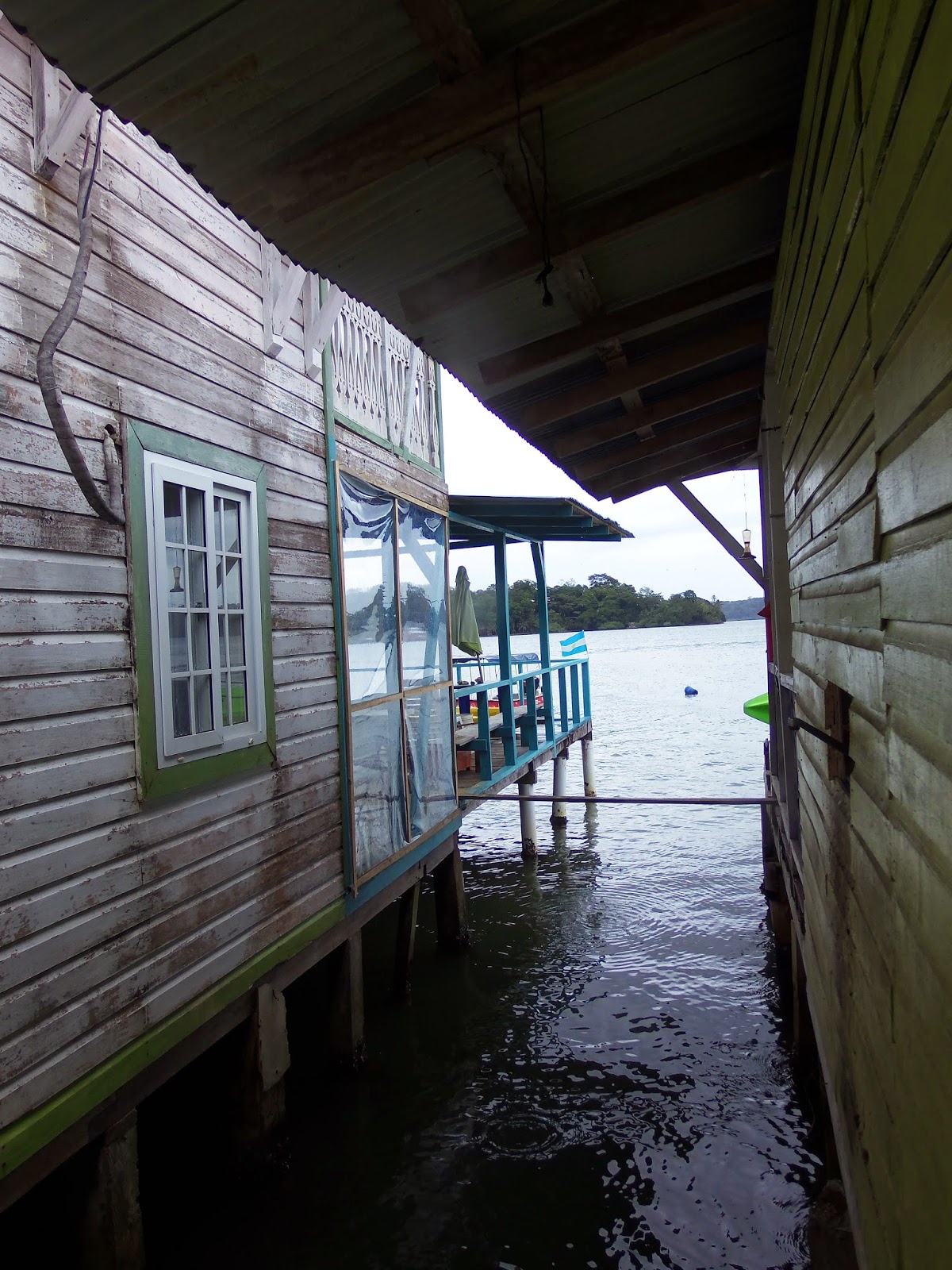
Larry, the owner of Corcovado Adventures Tent Camp, had recommended the Jaguar Hostel where he and his daughter had once stayed.  My boatman brought me to their dock where I was greeted by the Jaguar himself, a friendly schoolteacher and musician of about my age who ran the hostel with his wife and daughters.  The hostel was built on a dock over the waters of the inlet.  The floorboards had gaps between them where one could see (and hear) the water sloshing below.  Seven rooms opened off a central corridor.  A large covered porch swung with hammocks contained a tidy kitchen and some tables and chairs.  It was a great place to relax and enjoy the view.  I had the entire place to myself for $20 a night.

My Room at the Jaguar Hostel
It was raining when I arrived, so I lounged in a hammock for a bit.  One of the daughters pulled a router with a cellular chip in it from out of her backpack and she shared her excellent internet connection with me while she did her homework or whatever teenagers do with their computers.  Finally, I got hungry enough to tear myself away from the internet.  It had stopped raining and I set out in search of food.  I heard loud music issuing from the restaurant called Roots, so figured they must be open.  They were hosting a children’s birthday party in the main part of the restaurant, but welcomed me to take a place further out on the dock.  Six dollars bought me a plate of tasty chicken, gallo pinto, and salad.  Beer was a dollar.  I could have drunk excessively in Panama if it weren’t for the fact that it was impossible to attract the attention of a waiter or waitress to order a second drink.  They invariably vanished after serving the food and I always had to ask someone for help when it came time to pay.  This was no exception, although the owners were quite occupied serving hors d’oeuvres and drinks to their numerous guests, so I didn’t blame them as much.  I had a good time watching the kids enjoy the party and soaking up the scenery.  After a couple of hours, when it looked like it might start raining again, I asked the owner if there was someone I could pay.  I found it interesting that he summoned one of the women instead of handling it himself.  I had to wait a while longer for my change, although that may have been because they were rummaging through everyone’s pockets and purses to locate it.  Only in Costa Rica and boquete had I ever seen a business with a proper bank of change.

I stopped at one of the local grocery stores on my way back to buy some beer and snacks for dinner.  Having eaten lunch at 3:30, I knew I wasn’t going to be up for another restaurant meal.  I lay in a hammock, drinking a beer and trying to read, although I kept dozing off.  I lay there, soaking up the ambiance, until it got dark.  The owner locked the front gate, said goodbye, and left for the evening.  I retired to my room to read, but soon fell asleep again.  Several days of poor sleep in noisy Boquete (and two beers) had caught up with me.  I slept until morning, waking only long enough to undress and turn out the lights about 11:00 pm.

July 4, 2014

Kids on the Public Dock
It was the waves crashing into the shore under my bed that woke me about 6:00 am.  I lounged in bed until just before 7:00 and then picked up my phone to look at the electronic version of my Lonely Planet guide, but got sucked into a novel and ended up reading until nearly 8:00.  When last I had checked the weather, it was supposed to be sunny in the morning and I hoped to go to the beach.  Having failed to write the night before, I took my laptop out to the picnic table on the porch to catch up on the previous days adventures while I ate some granola bars for breakfast.  A group of small children was waiting for the water taxi on the next dock over.  All the boys were dressed identically in navy blue trousers and white shirts with suspenders and matching white hats with blue bands.  They looked like a miniature barbershop quartet or something.  The little girls sported fancy dresses with full skirts.  I snuck a couple of photos.  Despite the encouraging weather report from the day before, it was overcast and even rained a bit while I was eating breakfast.

I hung out for a bit and then headed out for the beach about 10:30 when it looked like the rain had passed.  The path to Wizard’s beach headed uphill from the main sidewalk near the right hand side of town.  I had been warned not to take anything of value to the beach as there had been thefts and even muggings on the path.  I could see how it could happen.  The path wound upward along what appeared to be people’s front walkways until it passed out of the town and into the jungle.  It wasn’t really very far, but took a half an hour to get there because it was so muddy that I had to plan where to put each foot.  Once the path left the town, it was pretty lonely.  A robber could disappear into the jungle easily.  I didn’t see anyone except a lot of big black ants that bit if I didn’t walk fast enough to keep them from climbing up my ankles.  The path went up to the spine of the island and then down to the beach on the other side.  It was really a shame that I couldn’t bring my camera because Wizard’s Beach was one of the prettiest beaches I have ever seen.  It was like having Manuel Antonio all to myself.  There was a crescent of fine golden sand with shady trees arching over the strand.  The water was turquoise blue and the Caribbean stretched endlessly before me.  I was the only person there.

The tide was very high, which kept me from walking further to the right for fear I couldn’t get back.  I chose a spot under a tree and sat there trying to build a sand castle and watching the crabs scuttle sideways along the beach and dig holes in which to hide.  The crabs were the same color as the sand and looked almost transparent.  Only their eye stalks stood out against the background.  When the tide threatened to wet my towel, I moved uphill and lay in the sun for half an hour.  The temperature was perfect.  It was warm in the sun, but not so hot that I couldn’t cool off by wading into the surf and then sitting in the shade.  Being alone, I didn’t dare swim because the area was known for strong currents.  After sunning, I walked all the way to the left side of the beach where the sand met a rocky point.  The beach was actually pretty clean, but I picked up what plastic I found on the way back.  I was a Girl Scout once upon a time and was trained to always leave a place cleaner than I found it.  Bastimentos is trying to overcome the cultural propensity to leave trash everywhere.  There are frequent trash cans (although they are often overflowing) and signs reminding people that tourists don’t like litter.  My hostel separated their garbage, which led me to believe that there was some sort of recycling program on the island.  Unfortunately, there were still piles of refuse in some places.  I couldn’t help thinking that if everyone left Bastimentos (and everywhere else) a little bit cleaner than they found it, the litter problem would soon be eradicated.  Maybe that is one thing that tourists could do to actually improve the environment for a change. 

I was sandy and sweaty after my walk and getting hungry, so I headed back over the hill when I got back to the path.  One couple had arrived during my walk, but the beach was still largely deserted.  I picked my way back through the mud, which was slightly improved after a few hours of hot sun.  After returning to the hostel and washing the mud and sand off of my lower extremities, I ate a can of Vienna sausages and some crackers for lunch while I chatted with the owner for a while.  My only complaint about Bastimentos in the low season is that there were so few tourists that the restaurants weren’t really open.  It didn’t seem right to demand that they drop whatever else they were doing to cook a cheap meal for me.  The owner left about 2:30 to be sure he didn’t miss the Brazil vs. Columbia game.  I was sorry that there wasn’t an open bar with a TV where I could watch.  I read for a while and then went out to buy some groceries for dinner.  Even the Chinese grocers were watching the game, so I got to see that Brazil was winning.  The whole town cheered when they missed a point because of a foul.  You would have though Columbia had scored a goal.  Unfortunately, they did not and Brazil won 2-1.

The Jaguar's Neighbor
I spent a lazy afternoon, reading and drinking beer in my hammock in the shade.  Just before dark, the owner brought the router back for me so that I could have internet for the evening.  Once he locked the front gate, it really did feel like I had the whole house to myself.  I lay in the hammock, surfing the web on my phone until 9:30 or so and then retired to my room to watch Netflix in bed in case I fell asleep.    Unfortunately, there was not much chance of that happening, even though I had consumed a few beers, because the neighbors were running their heat pump air conditioner and the sound of water splashing back into the bay and the humming of the blower drove me nearly to distraction.  There must have been some Americans in the area, because there was the intermittent sound of fireworks being lit for the 4th of July.  It was after 1:00 am before I could get to sleep, even with ear plugs.


July 5, 2014

Despite the late night the night before, I was up by 7:30.  It was a beautiful, sunny morning and I enjoyed eating breakfast on the porch and writing for a while.  I planned to go to Bocas later in the day, but didn’t expect to like it well enough to want to hang out for long, so planned to spend a lazy morning on the porch.
About 1:00, I walked out to the end of the pier to hail a water taxi.  One appeared almost immediately.  We circled the bay for a few minutes, picking up additional passengers, and then made the crossing to Bocas.  It was a beautiful, sunny afternoon and everything looked like a Caribbean postcard.  I got off at the Bocas del Toro Hotel and started walking towards the main part of town.  Before long, I came to a nice looking restaurant with a great view and I stopped there for lunch.  I hadn’t eaten anything but snacks for two days and was ready for a real meal.  I had a nice BBQ hamburger with grilled onions and fries.  The service was much better than normal and I managed to get out of there within an hour.

Crazy Tico Fans
The restaurant didn’t have a television, so I walked towards town, looking for a sports bar where I could watch the Costa Rica vs. Holland game.  (The name of the country may be the Netherlands everywhere else, but in Latin America it is Holland and its inhabitants are Hollandeses.)  I walked all the way through town to the ferry dock, looking for an ATM so I could pull out enough money to buy a Panamanian cell phone.  I didn’t find one.  Having taken a survey of the town, I decided that the place to be for the game was El Pirata, a waterfront bar that was packed with folks wearing Costa Rica jerseys and chanting, “Ticos, ticos!”  I forced my way through the crowd by the door and actually found a bar stool.  It took me almost until halftime to order a beer, but that was fine since I didn’t really want to drink that much.  The place was a zoo.  They were having a devil of a time producing enough cold beer and waiters were running around with ice buckets full of beer, trying to keep the fans well oiled.


The game was a repeat of the game with Greece.  Costa Rica hardly tried to score, but they had such a great defense that Holland couldn’t score, either, although they took shot after shot.  Every time the Costa Rican goalie, Navas, made some heroic save, the crowd went wild.  The score at halftime was 0-0.  The second half of the game was no different and the game went into overtime.  Things started to get tense.  The bar was running out of beer and was down to serving cans.  After another half an hour of play, the score was still 0-0.  Everyone breathed a sigh of relief and got ready for the penalty kicks.  Unfortunately, the Dutch goalie managed to stop two of the Costa Rican kicks and they ultimately lost 4-3.  That was very disappointing, but most of the crowd just seemed to be proud that they had at least made it to the quarter finals.  Semi-finals would be between Brazil and Germany and Holland and Argentina.
Final Score

I had somehow managed to pay during the break before the penalty kicks, so left as soon as the game was over.  The weather was still nice, but it was starting to get late, since the game had gone on so long.  The first boatman I tried wanted $10 (instead of the usual $1.50) to take me to Bastimentos.  I finally found the Bastimentos guy and managed to make a hair raising crossing (We got air off of every wave.) for a mere twice the normal rate.

I spent the evening on the porch in my hammock watching Netflix until my battery got low and I had to retreat to my room.  Shortly thereafter, a thunderstorm hit, bringing with it a deluge.  The sound of the rain drowned out any possible noise from the neighbor’s air conditioner, but the thunder and the shuddering of the house every time the owner’s boat slammed into the dock kept me awake until very late, anyway.

Wednesday, July 2, 2014

CORCOVADO NATIONAL PARK – “THE MOST BIOLOGICALLY INTENSE PLACE ON EARTH”

June 28, 2014

Catching the 4:45 AM bus out of Dominical gave, “getting up early,” a new meaning.  I had been unable to find anyone to pay at the Piramys Beachfront Hostel the day before, so I put my money and my key in an envelope and tossed it through the window of the reception area.  I hoped they didn’t think I was trying to skip out without paying, but they would have had no way to track me if I had because no one ever took my name when I arrived.  It was definitely the most laid back place I had ever stayed.  I tiptoed out of the hostel at 4:30 AM and dragged my bag up the road to the bus stop.  The bus had parked overnight on the dirt road through the middle of Dominical.  It was a little bit late getting started and I was relieved when it finally got moving.  The bus went all the way through to Neilly and I figured I would eventually be taking it the rest of the way after my detour to Corcovado.

Water Taxi Dock in Sierpe
We left Dominical and followed the coast to Uvita.  We drove past palm groves and rice paddies.  We made a circuit through Ciudad Cortez and finally stopped in Palmar Norte, were I got off about 7:00.  The first taxi driver who approached me wanted $20 to take me to Sierpe.  I told him I would wait for the bus at 8:00.  The next taxi driver only wanted $5, so I caved in and let him drive me.  The roads to Sierpe weren’t bad, but you had to know where you were going because Sierpe was way out in the country.  All the boats that take people to Bahia Drake and the Osa Peninsula leave from Sierpe.  At this time of year, they leave at 11:30.  I got to Sierpe about 7:30, so I had plenty of time to wait.  There was a restaurant by the river’s edge and I had coffee and breakfast and hung out, reading and using the WiFi until the boats arrived.

The boat ride from Sierpe to the Corcovado Tent Camp turned out to be much more interesting than expected.  We saw a crocodile almost immediately.  A family from Toronto with three children were sharing my boat and the kids had a blast looking for crocodiles as we made our way down the Sierpe River through a tangle of islands, waterways, and mangroves.  Our boat was a launch with a panga hull and a 250 hp motor on the back.  We were hauling, but the ride still took an hour.  Eventually, we reached the mouth of the river at Bahia Drake and the mangroves gave way to rocky shore interspersed with pretty little beaches.  We dropped a couple of people off at lodges on the river and then headed over the bar and out into the ocean.  The waves going over the bar were large and we got air a couple of times.  It was an “E” ticket ride for sure.  We crossed Bahia Drake and landed at the town to let off a large group of passengers.  Bahia Drake looked like a nice anchorage and I saw a few cruising boats on hooks there.  There was a town for provisions and a good beach to land a dinghy.  The scenery wasn’t too shabby, either.
My Tent at Corcovado Adventures Tent Camp

Observation Platform
Beach Near the Tent Camp
                                                                                                                            We continued past the town and out around a point before landing at the Cordovado Adventures Tent Camp.  The tents were pitched on platforms and had big oilcloth rain flies over them.  There was a large pavilion housing the dining hall with showers and bathrooms up the hill behind that.  Behind the bathrooms, a path led up a steep hill and then across a hanging bridge to a platform anchored to a tree, 70 feet above the ground.  The platform had a lovely view of the creek and surrounding trees and gave one an opportunity to observe the wildlife in the canopy. The camp was fairly empty, so I got a tent right on the beach with a nice view.  I saw a scarlet macaw almost immediately.  Lunch was served shortly after we arrived and then I went for a walk along the coast to the Rio Claro.  I saw a troop of capuchin monkeys before I even got out of the camp.  
Troop of Capuchin Monkeys Playing

Capuchin Monkey
Further along the path, I saw spider monkeys.  The spider monkeys are the rarest type of monkey.  All four kinds of monkey found in Costa Rica (squirrel, capuchin, spider and howler) are found in Corcovado.  At high tide, the path was sometimes under water, so it took some time to determine where I was going.  I trudged across lots of pretty little beaches, dashing across creeks when the waves receded.  I saw several more scarlet macaws and a troop of capuchin monkeys who were having a wonderful time playing on a water pipe that was strung across a small valley.  They were chasing each other and wrestling, swinging from vines and then running along the pipe.  I watched them for a long time, but couldn’t get a decent picture because they were in constant motion.  I got to the Rio Claro just after 4:00.  At hide tide, I would have had to swim across, so I elected to turn around and head back before it got dark.  Coming back, the pathway was just seething with tiny hermit crabs wearing multi-hued shells.  It was impossible to walk without crushing some of them, but I did my best to avoid them.  By the time I got back, I was exhausted.  I took a nap until dinner, lying in a hammock watching the bats come out at dusk until I fell asleep.  Thankfully, there were no mosquitoes.
Hermit Crabs
 Dinner was served family style and it was nice to talk to the other guests.  The owner, his friend and the family from Toronto had spent the afternoon fishing, so we had fresh sashimi, ceviche and grilled fish for dinner.  I had plenty to eat even though I passed on eating the rice, corn salad and pasta salad.  I didn’t quite have enough willpower to pass on the homemade bread, however.  It was moist and delicious.  By 8:00, everyone was tired and ready to head for bed.  We had to get up early the next day to go to Corcovado National Park.

June 29, 2014

Breakfast was at 5:30 and we waded out to the boat at 6:30 for the hour long boat ride from the camp to www.corcovado.com, info@corcovado.com, 866-498-0824 from the US, 506-8386-2296 from Costa Rica, VHF Channel 11) and either meet them off the shore of the camp or have the tour pick you up in the fine anchorage at Bahia Drake.  Tour boats originate from there, anyway.  The owner of the camp is an American who has lived in Costa Rica for decades.  His name is Larry and he was very receptive to the idea of working with cruisers.  He also offered to arrange the delivery of provisions from Sierpe, since he frequently has things delivered for the camp.  Celso and Antonio, who run the camp when Larry isn’t around, are also very helpful.  There are other lodges in Bahia Drake who cater to yachties, but they charge higher prices and could not possibly be more helpful.  The tours would be the same, in any case.
Wading Ashore at Corcovado National Park
Corcovado National Park.  The waves were pretty large, so we had a wild ride.  The water was clear and blue and we stopped twice to observe two different kinds of dolphins that we encountered along the way.  Our boatman backed his panga in to shore to let us off and then beached the boat on the flat, smooth rocks of the shore as the tide went out.  Cruisers could probably anchor off of Corcovado National Park and come ashore in a dinghy, but getting back to the boat through the surf would be hazardous.  It would be much better to arrange a tour through Corcovado Adventures Tent Camp.

Coati
Our guide’s name was Roy.  After donning our hiking shoes, we walked along the beach until we reached the Rio Claro.  I counted at least three Rio Claros in that part of the world, so it could be confusing.  On the way, we saw lots of different kinds of birds and a coati. A crocodile slipped into the river just as we arrived, so we didn’t really get to see much of him, but there were a pair of tiger herons courting and making a huge racket.  We made a U-turn at the river and walked back through the forest.  We saw lots of spider monkeys and squirrel monkeys and a purple throated mountain gem (hummingbird) sitting on her nest.  Kites followed the troops of monkeys, scooping us the insects the monkeys disturbed as they foraged through the trees.  

Tiger Herons Courting
Spider Monkey with Baby
Purple Throated Mountain Gem
Roy was looking for a tapir to show us.  When we returned to where the boat was beached, the captain mentioned that he had seen one on the beach a half an hour before.  Roy and I went off following the tapir tracks through the sand, while the family with kids trailed behind, distracted by the ocean and a profusion of hermit crabs.  At times, the whole beach seemed to be moving.  We followed the tapir tracks and
eventually came upon him sleeping in the shade.  Tapirs are the largest wild land mammals in Central America.  He did not seem to be took terribly bothered by us as we crept close and took pictures of him.
Tapir
Sirena Station
After seeing our tapir, we headed in the opposite direction and walked through the forest to the Sirena Station.  The Sirena station is located at the end of a grassy airstrip near the Rio Sirena .  It was a sprawling affair, with a number of decks and buildings connected by raised walkways.  It was possible to pitch a tent on the decks and camp there.  The park is 43 kilometers across.  Most people who hike across spend two nights camping along the way.  We saw a small caiman in a drainage ditch across the runway.  Monkeys
Black Iguana Enjoying the Beach
were swinging in the trees at the edge of the clearing as we sat on the deck and ate our lunches.  We kept hearing howler monkeys, but never did see them.  We didn’t see any peccaries, either, although we did see their tracks.  Roy nearly stepped on a seven foot tropical bird eating snake that I fortunately saw and frantically pointed out.  I wasn’t familiar with that type of snake and only knew that there were lots of poisonous ones around.  Fortunately, he wasn’t dangerous and Roy didn’t quite step on him.  Shortly thereafter, we came across another tapir escaping the heat of the day by lying in a wallow of cool mud.  We walked back to the boat along a beautiful beach.  The sun came out and the water turned a gorgeous turquoise as we sped back to the camp.  We got back just in time to watch the World Cup soccer match between Costa Rica and Greece.


Larry, the owner of the camp, had a couple of his buddies visiting from the city.  Once the family headed off to the beach, I was the only remaining guest.  Larry invited me to watch the game with them at his place, since he had the only television.  Costa Rica had never before made it to the second round at the World Cup and everyone was ecstatic.  It was really fun to watch with them.  The game was a real nailbiter, too.  Costa Rica scored the first goal and it looked like they were going to win until Greece got a goal and tied them in the last few minutes.  Since the second round of games was not a series like the first round, there had to be a winner.  They were forced to play two more 15 minute periods.  No one managed to score a goal during that time.  Greece really should have won.  They took shot after shot, while the Costa Rican team did very little, but the Costa Rican goalie, Navas, was so wonderful that he blocked every shot.  After another half an hour, the game was still tied.  Then each team got five penalty kicks.  Costa Rica made all five of theirs, but Navas managed to block one of the Greek shots.  Costa Rica won to advance to the quarter finals.  Everyone went nuts.  I was sorry that I wouldn’t be in Costa Rica to watch the next game.