Sunday, August 3, 2014

MEDELLIN TO CALI – COFFEE, PALMS & SALSA

July 31, 2014

Pereira
Even though I had only slept for about four hours, I knew I had a long journey ahead of me, so got up at 6:00 am.  I slipped out of the hostel and caught a taxi to the southern bus terminal (6000 pesos) in time to catch the 7:30 bus to Armenia.  The bus went up and over the mountains opposite the ones I had crossed to reach Medellin and then headed through the Zona Cafetera (coffee growing region) to the city of Pereira.  Pereira was a much larger place than I had expected.  It sported many tall buildings.  The coffee business was clearly thriving.  An hour past Pereira, we finally came to the end of the line in Armenia.  Armenia was a smaller city, but they had a nice bus terminal.  I needed to walk all the way to the opposite end of the terminal and then outside and across a parking lot to catch a minibus to Salento.  Everyone there was very nice to me.  A security guard told me how to find my bus, a food vendor told me that Salento was a magical place, and the bus driver interrupted his break to open the luggage compartment so I didn’t have to stand around with my pack on my back.


Hostal La Floresta
Salento Square and Church
Salento lies 24 kilometers up a valley outside of Armenia.  I finally reached there about 4:00 in the afternoon.  Salento was a cute little mountain town with lots of hostels and restaurants and a small central square in front of the church.  A street of souvenir shops led uphill to a flight of stairs up to Alto de la Cruz, a lookout with views of both Salento and the Cocora Valley.  I had made a reservation at Hostel La Floresta, which turned out to be several blocks outside of the center on the other side of a pedestrian bridge which spanned a deep ravine.  I was exhausted from the bus ride and lack of sleep, so it was a chore to lug my pack several blocks down a steep hill and then back up to the hostel.  La Floresta lacked charm, but the staff was friendly and helpful and the WiFi was strong, if not overly speedy.  There was a nice garden area in the back with hammocks and a campground with its own kitchen and restrooms.


Bridge to La Floresta
  After dropping my bags, I walked back up the hill to the grocery store to buy food for breakfast, beer, and a picnic lunch for the following day’s hike.  I returned to the hostel and lay in a hammock, reading and drinking beer, until it started to get chilly.  I surfed the web for a couple of hours and then went out and ate lasagna at Los Urrea Trattoria, just off the main square.  When I got back, I wanted to work on my blog, but was too tired to write.  I uploaded photos for an hour or so and then went to sleep fairly early.


August 1 2014

Local Transport in Cocora Valley
Fearing that it might get hot later in the day, I got up at the crack of dawn and was in the town square, ready to take a jeep to Cocora, by 7:30 am.  Local transportation in the Cocora Valley is by Willys jeep.  They pack three people in the front seat, six more onto two seats facing each other across the back, and as many as possible standing on the tailgate.  We had eleven people in our jeep when we left.  We drove over the hill into the Cocora Valley and then up the valley to the village of Cocora.  Cocora consisted of a few houses, shops, and roadside restaurants strung along a barely two lane road between cow pastures.  The whole valley was intensely green.  The pastures were covered in Bermuda grass and looked like golf courses.  The jeep let us off just shy of the blue gate that led to the trailhead.
Beginning of the Trail


Suspension Bridge Jungle Style
Being alone, I struck up a conversation with another couple of hikers.  The first couple I talked to were from Brazil and Russia, respectively, although they lived in Berkeley.  They weren’t too friendly, so I left them behind and followed a couple of other Russians who didn’t appear to speak and languages I understood.  Soon, I passed them, too.  The path led through pastures and they entered a narrow, forested canyon with a stream running through it and began to climb more steeply.  The track crossed the river repeatedly on wobbly suspension bridges or log bridges with a cable strung across as a handrail.  I followed the path upward for almost 5 kilometers until I reached the Acaime Natural Preserve and Hummingbird House. 

Hummingbird House
Long-Tailed Sylph


View from Overlook
                                                                                                          The preserve was the brainchild of a local leader who wanted to preserve the natural environment.  The preserve maintained the trails (and bridges.)  There is a 5000 peso entrance fee (about $3.50), but I had no trouble contributing to the maintenance of the nice pathways.  For my money, I got a drink at the Hummingbird House.  The building was constructed on the side of a steep hill and had a kitchen and covered eating area surrounded by hummingbird feeders.  Several varieties of hummingbirds were in evidence, including purple throated woodstars and another iridescent blue green one with a long tail like a miniature quetzal called a long-tailed sylph.  I chatted for a few minutes with the keeper of the preserve about the spectacled bears that live in Colombia.  These bears are the only bears in South America.  They look and act much like black bears except for a white mask around their eyes.  Unfortunately, I never saw one.  Soon, another group of hikers arrived and I struck up a conversation with them.  The group consisted of one Italian, one American, one Filipina, two Colombians and a girl from Luxembourg.  They were fun a friendly and we all left together to climb the rest of the way up the mountain to the overlook on the top of the ridge.

Friendly Golden Lab
The ranger who lived at the overlook must have loved flowers because the buildings of the ranger station were surrounded with colorful blooms.  There were two friendly golden labs and a tiny black Chihuahua who was determined to sleep on top of the bigger dogs.  Despite being the oldest in the party by at least 20 years, I got to the top first and hung out with the dogs until the others arrived.  The view was fantastic and the weather was perfect.  I could have stayed there all afternoon, but we still had over five kilometers to hike back to Cocora.

Forest of Wax Palms
Once we regrouped at the top and everyone had a chance to have his or her picture taken, we set off downhill to walk through the forest of wax palms that were the reason for the whole outing.  Wax palms are the national tree of Colombia.  They grow to a height of up to 60 meters and have tall, thin trunks with just a pouf of broad, leafy fronds at the top.  They are really rather bizarre looking when you come across a group of them, as they grow widely spaced and just don’t look real.  The palms are endangered because people cut them down to use their leaves for Palm Sunday celebrations.  We walked for a kilometer or so without seeing any and then, suddenly, we were among them.  We kept stopping to take pictures of the palms and the dramatic scenery.  At the bottom of the valley was a pasture where horses grazed on Bermuda grass in a park-like setting studded with slender palms.  It truly was magical and none of us was in a hurry to leave the grove of palms.  We didn’t get back to the jeeps until just before 2:00 when the first convoy was scheduled to return to Salento.  We all rode back together.  We went our separate ways when we reached Salento, but made loose plans to meet up later.

Salento from Above
Despite having already climbed one mountain for the day, I headed off to climb the roughly 238 steps to Alto de la Cruz.  The stairs were painted blue, yellow, and green and had markers for the Stations of the Cross along the way.  One could tend to exercise and religious devotions simultaneously.   At the top, there was a playground and two overlooks: one facing the town of Salento, and the other a pleasant covered structure housing food and craft vendors, overlooking the Cocora Valley.  I would have overlooked the second one if a thoughtful soda vendor had not directed me to it.  I lingered to use the spotless public restroom and drink a Gatorade and then trotted back down the steps and off to my hostel to work on my blog until it was time to try to meet the others.
Graffiti on Alto de la Cruz

One couple had said they would be a certain bar on the square from 7 to 8:00.  I arrived there about 7:05, but there was no sign of them.  The square was gearing up for a big weekend and there were tents erected with additional tables in front of all the restaurants and food trucks set up around the park.  I made a circuit of the square, searching for someone I knew, and then retreated to a restaurant on the corner which offered Bandeja Paisa (Paisa Platter), the traditional dinner of the Paisa region I had just left.  I had never gotten around to trying it in Medellin, so figured I had better do so before I got any further away.  Bandeja Paisa has its origins among poor coffee farmers who would eat one high calorie meal per day to give them energy to work the steep mountain sides.  It consists of white rice and huge red beans, pork rinds, ground meat, a sausage, a fried egg, avocado, an arepa (corn cake), a fried plantain and maybe some salad.  I had no sooner ordered when four of my friends appeared and joined me for dinner.  We had a delicious meal and fascinating conversation. 

Daniel, a Colombian anthropologist who worked to alleviate malnutrition in indigenous communities, had a great sense of humor and was full of good insights about the interactions of different groups of Colombians.  Colombia has many different ethnic groups (whites, mestizos, Afro-Colombians, indigenous tribes) and they divide along racial and, perhaps more importantly, class lines.  The indigenous people end up at the bottom of the heap, either way.  Daniel was disturbed by the fact that Colombia marketed itself as having beautiful and passionate women.  He felt that was objectifying them, which was no doubt true, although even I found it hard to ignore the number of beautiful women in Colombia.  Then we all laughed about how disgustingly attractive Brazilians were.  I asked Daniel about the education system in Colombia, which he felt was quite bad.  Children go to school for 12 years, but the public schools were poor and he thought that even the cheaper private ones were quite bad.  The best university in Colombia is private, but the second best one is public.  Unfortunately, according to Daniel, there is no free speech, soldiers with guns patrol the campus, and “professional students” recruit students to join the Fuerzas Armadas Revolucionarias de Colombia (FARC – Revolutionary Armed Forces of Colombia), the largest of the guerilla groups.  Daniel was disgusted that the university did not engender an environment of free thought.  I could have sat there chatting all night, but I needed to finish my blog post and pack so that I could leave early the next morning.  Elise, the girl from Luxembourg, had been planning to come to Cali with me, but was considering changing her plans and going to Medellin with Teresa, the Filipina woman.  We agreed to meet at the 7:30 bus to Armenia if she was going to come.

August 2, 2014

I got up at 6:00 again, but someone had already beat me to the bathroom.  I still managed to get checked out and schlep my probably-too-heavy-to-check-on-an-airplane pack up the very steep hill to the bus stop on the far side of the main square in plenty of time to catch the 7:30 bus to Armenia.  (Also nearby is the city of Circasia.  Geography can get confusing around here.)  Elise arrived just as I was holding open the door of the luggage compartment so that the driver and a passenger could wrestle an entire mattress out of there.  She had decided to come to Cali, after all.  We rode for an hour on the minibus to Armenia and then quickly caught a collective van for the three hour ride through cane fields to Cali.  Cali sits about 1000 meters lower than Salento and it got warmer and warmer as we drove south.

Hostal El Viajero
We arrived in Cali about noon and took a taxi to the hostel.  The Hostel El Viajero in Cali is clean and has a pretty pool area and bar, but it is expensive for a hostel.  My private room cost $53, almost the most expensive room of my entire trip.  The room was nice, with a view of the pool, but the mattress was hard as a rock and there was no air conditioning.  I did get a ceiling fan, TV, hot water and safe.  Beds in Central and South America were made quite differently than in the United States.  Blankets and bedspreads are usually absent.  Top sheets are almost never tucked in and are frequently just left folded at the bottom of the bed.  This reflects the fact that it was usually too hot to sleep covered, although sometimes it was cool enough to use a sheet if I hung my feet out.  If I checked into a hotel and there was a blanket, I knew it would be blessedly cool at night and rejoiced.  No such luck in Cali, which was known for being hot.

Iglesia San Antonio
View of Downtown Cali
After getting settled in my room, I took a quick walk around the neighborhood and then ate a hamburger at a restaurant across the street that provided room service for the hostel.  The burger was large and filling, but the meat was tough and had a rubbery texture even though it was rare.  I could only eat half of the giant bun.  The drink selections were limited, so I ordered a limonada even though I dislike lemonade.  The limonada was delightful and tasted like a virgin margarita.  It even had ice in it.  It was the best part of my lunch.  After lunch, I walked up to the park at the end of the street and then up to the Iglesia de San Antonio, a pretty little church on top of a hill with a great view of downtown.  My first impression was that Cali was an unremarkable modern city of 2.5 million people.  A river runs through it.  It has a large Afro-Colombian presence and is best known for being the capital of salsa dancing.  While we had chosen our hostel for its salsa school, the daily lesson was already in progress when we arrived and there would be no lesson on the next day because it was Sunday.


River Promenade

Modern cities often have good modern art, so I headed for the modern art museum.  My walk took me through an elegant residential neighborhood studded with design related businesses.  Unfortunately, the museum was closed, although the hours posted on the door indicated that it should be open.  That was disappointing.  I continued down to the river and walked along an attractive promenade to the other side of Calle 5, a large street that runs like a freeway through the center of Cali and is almost impossible to cross.  I made a quick visit to the Iglesia de la Merced, which is in what remains of the old colonial part of the city.  I was unimpressed and got a little worried when someone warned me to hang onto my cell phone.  I usually leave it in the room, but had brought it because it contained my electronic guidebook.  I crossed back over Calle 5 where it dead ended at the river bank and bought an ice cream cone before returning to the hostel to relax. 

Iglesia de la Merced
When dinner time came, I walked around the corner and got a plate of fried chicken and potatoes for just over a dollar at a snack bar.  I spent the evening finally catching up on my blog.  About 9:00, I heard clapping and looked out the window to discover a show in progress.  Two young men from the local performing arts college were performing an acrobatic routine that concluded with fire dancing and climaxed with one of the young men breathing fire.  El Viajero had a nice atmosphere and it would have been fun to hang out around the pool if I had been 30 years younger.  As it was, I was tired and not in the mood for earnest young people.  I wasn’t even in the mood for beer, which was probably a good thing because all they had was crummy beer.  Club Colombia Dorada (Gold) was lousy, but they made decent red and dark versions when I could find them. Unfortunately, the hostel reverberated with loud music until midnight and it was later than that before everyone quieted down.  Some obnoxious French people came back at 4:30 am and talked outside my room for half an hour.  El Viajero was not a good place to stay if you valued sleep.

Friday, August 1, 2014

CARTAGENA TO MEDELLIN - FROM OLD TO NEW

July 27, 2014

Casa Nativa
I spent a pleasant morning aboard Micamale, waiting for the agent to return my passport, which Rico and Rose brought me about 11:30.  I waited until nearly 2:00 for Andrea and ChiChi to come back so that I could say goodbye, but they were waiting for Ophelia and Anthony somewhere and I finally had to give up on them.  I grabbed a taxi in front of the marina and for 6,000 pesos (about $3.50) I got a ride to the El Viajero Hostel in the old city.  Unfortunately, El Viajero did not have room for me.  They referred me to another hostel called Casa Nativa around the corner.  Casa Nativa was almost empty.  I could see why, since they had no private rooms and charged almost as much for a dorm bed as El Viajero charged for a room.  It worked out fine, however, because I was the only person in a four bed dorm, so it was almost like having a private room, anyway.  The best part was that the room was air conditioned because Cartagena was very hot.  All I wanted to do, after six days at sea, was to charge my electronic devices.  Unfortunately, the power in the entire old city was out.  The proffered air conditioning wasn’t working and I couldn’t charge my phone.

My Street in Cartagena
I was hungry, so went out in search of food.  Many restaurants were closed due to the power outage, but I finally found an open café in the Plaza de Santo Domingo.  I ate a ridiculously expensive pizza and drank an overpriced beer.  Just as I was finishing, Kieran, Bec, Hannah and Matt passed by.  They were going for a beer with a Columbian acquaintance around the corner.  I paid my check and joined them.  The price of beer varies tremendously in Cartagena.  I had paid 7,000 pesos at the café (about $4.) Beers were 4,000 pesos at the bar where we went ($2.25) and cost about 2500 pesos ($1.50) in reasonable places, probably much less at the grocery store.  I had a beer with the gang, but left them before they continued on to the next party spot because I didn’t feel like a night of drinking and their companion was clearly a drug dealer and gave me the creeps.  Cocaine and marijuana had been freely available since the San Blas Islands.  Freely available did not mean legal, however, and I heard of multiple instances (including Kieran) of tourists being stopped and searched for drugs and/or weapons by the police.

The Flag of Cartagena
After leaving the gang, I went for a walk along the city walls back to my hostel.  Cartagena was a major port for Spanish gold and was heavily fortified.  Due to its importance, Cartagena was a tempting target for pirates but, unlike many other Spanish ports, was not repeatedly leveled because the city paid ransoms to avoid being sacked.  As a result, Cartagena was the best preserved colonial city I had seen on my trip.  The admirable state of preservation, combined with the relative affluence of the city, made Cartagena’s historical center a very pleasant place to visit.  One could stroll and enjoy good shops and restaurants without worrying about falling into uncovered man holes or being hit by collapsing balconies.  Once the power came back on about 5:00, I headed back to the hostel to use the internet for a couple of hours.  

Just after dark, I went for a walk to the restaurant recommended by the hostel.  It was still closed, so I continued walking and ended up eating quiche Lorraine at a café off the Plaza San Pedro Claver, across from the cathedral.  After dinner, I grabbed an artisanal popsicle (chocolate and caramel) and then returned to the hostel to catch up on my blog post regarding my San Blas experience.  The air conditioning was thankfully on, but I had to sit on the tile floor because there wasn’t enough room to sit up on the lower bunk I had chosen and the upper bunk was too close to the rather low ceiling.

July 28, 2014

La India Catalina
The first thing that strikes a traveler upon arriving in South America for the first time is just how big the place is.  The distances are tremendous and flights between cities are very expensive.  Early on, I realized that I would save nothing by continuing on to Peru or Ecuador from Colombia because I could fly there just as cheaply from the USA.  I wanted to see as much of Colombia as possible, but that was going to require quite a bit of travel time.  Having booked a ticket home on August 12th, I couldn’t linger in Cartagena.  The bus trip to Medellin, my next stop, would require 13 hours, so I decided to spend the day exploring Cartagena and then take an overnight bus to Medellin. 


Street Corner Paralegals
After eating a nice hot breakfast provided by Casa Nativa, I left my laundry to be washed and luggage in storage, checked out, and set off to see the remaining sights in Cartagena’s historical center.  I first headed away from town to visit the statue of the India Catalina, a Carib woman who served as an interpreter upon the arrival of the Spaniards, and serves as a monument to the Carib people who inhabited Cartagena before the conquest.  The statue is situated in an open park next to a lake at the entrance to the old city.  From there, I strolled down Avenida Venezuela, the main artery through the old city.  Avenida Venezuela is lined with modern buildings and businesses and leads to the convention center and commercial marina.  At one point I passed a large group of men sitting at small tables sporting typewriters, offering to prepare all kinds of legal documents.  People were also offering the use of cell phones for a per minute charge.  

I walked down the avenue to where a couple of tall ships were tied to the sea wall and then crossed the road and passed through the wall into the Plaza de la Aduana (Customs Plaza) where goods (primarily slaves) were once valued and taxed before entering the city.  The former customs house was flying the colorful bandera quadrilinea, the flag of Cartagena, which was the symbol of the movement for independence from Spain.

The Customs Plaza
Naval Museum
I took a wrong turn on my way to the Museum of                                                                                     the Inquisition and ended up at the Naval Museum, which suited me just as well, since I had intended to go there, also.  Unlike other naval museums I have visited, this one had almost nothing about ships in it.  What it did have were detailed dioramas explaining each event in the course of the major attacks upon Cartagena.  The exhibits were very interesting, although time consuming to read as all the explanations were in Spanish.  The museum was housed in a grand colonial building with an immense hall that was once a hospital.  By the time I had worked my way through the museum, I was hungry and ready for a rest.  I ate a tasty, but expensive, lunch of chicken breast in a tomato butter sauce over rice at a cool café near the Plaza Bolivar.  Eating in Cartagena’s historical center was expensive, although my lunch did include a delicious cream of yucca soup and a lovely green salad that I was unable to eat because it was dressed with mustard, something that makes me gag.


Plaza Bolivar
Museum of the Inquisition
Interior of the Museum of the Inquisition
                                                                                                                        After lunch, I crossed the Plaza Bolivar (a pretty, shady park) and visited the Museum of the Inquisition, housed in the original Palace of the Inquisition, which has been lovingly restored in recent years.  The Spanish Inquisition found it difficult to deal with all the heretics in the new world from just Lima and Mexico City, so they opened a branch office in Cartagena that operated for 201 years until the inquisition was abolished when Colombia declared independence from Spain.  The museum displays some horrific instruments of torture, although not all of them were actually used by the inquisition in Cartagena.  The exhibits pointed out that torture was also commonly used in secular investigations at the time.  There were only five autos-da-fe in Cartagena during those years.  Only five heretics were burned at the stake, although more died during questioning and were then burned in effigy.  There were also lesser punishments such as fines, public humiliation, and whippings.  Only unrepentant sinners were put to death.  Crimes investigated by the inquisition included witchcraft, blasphemy, and heresy (including Judaism.)  The inquisition was a tool used by the Spanish to impose religious and social conformity across its empire.  Jews fled south into the mountains, establishing what would later become the city of Medellin.  The second floor of the museum displayed interesting exhibits concerning the history of Cartagena and Colombia’s struggle for independence from Spain.  Many of these exhibits included English translations. 

Museums inevitably make me extremely sleepy.  I could barely remain on my feet by the time I worked my way through the last of the exhibits.  I stopped at the grocery store for snacks for my bus ride and returned to the hostel to rest and use the internet until it was time to head to the bus station.  I had intended to take a bus to the terminal and had carried my heavy pack through the heat to the road outside the walls where the buses run, but I was unable to decipher which buses went to the terminal.  It was rush hour and all the buses were far too full for me with my pack.  I finally capitulated and paid about $12 for a 45 minute taxi ride to the terminal.  My taxi driver was quite concerned that I was traveling alone and thought that I ought to pick up a (preferably younger) traveling companion.  I think he was angling for the job.  He couldn’t understand that I was quite content without masculine company.  He did, however, recommend a good bus line for my trip to Medellin and deposited me right in front of the ticket counter.
Cartagena Bus Terminal

The Cartagena bus terminal is quite a distance outside the center of the city.  To get there, we had to pass through neighborhoods where I was advised to lock my doors.  The terminal itself was large and modern.  There were lots of shops and food stalls and decent Wi-Fi.  I bought a ticket to Medellin for 105,000 pesos (about $58.)  I only had to wait for about an hour before the bus left.  The bus was comfortable and, fortunately because we only stopped once in 13 hours, featured a restroom.  Unfortunately, it was air conditioned to the point of refrigeration.  I had brought a sweater, but spent the night shivering with my frozen feet stuffed in my day pack and a bandana spread over my bare knees.  I didn’t sleep a wink all night between the cold and the bumpy roads. 

July 29, 2014

First Sight of the Andes
The trip from Cartagena to Medellin was the equivalent of driving from San Francisco to San Diego at 40 miles per hour.  It was dark for the first ten hours, so I couldn’t see much.  We headed south across the coastal plain on a two lane toll road lined with houses and businesses and then climbed up into the Andes.  Dawn found us at the top of a huge range.  We looked down on both the rising sun and a lightning storm.  When we stopped for breakfast at 6:00 am, high on the wind swept side of an Andean peak, it was still warmer outside than it was on the bus.  My hands were numb.  I had been nibbling cookies all night in an attempt to keep warm, so I passed on breakfast, but was delighted to wrap my frozen fingers around a hot cup of coffee.  The mountains were very tall and very steep.  They were also very inhabited.  Homes and businesses lined the road and farms dotted the steep slopes.  There was some cloud forest, but the mountains were mostly cloaked in green grass.  The narrow road switchbacked up and over the mountain range and then down into the bottom of a great valley where, after descending for nearly three hours, we finally intersected a decent freeway that took us to Medellin.

Medellin
Medellin is a city of three million people squashed into a narrow valley between two vast mountain ranges.  Textile manufacturing and the export of cut flowers are its main industries.  Hundreds of red brick high rises fill the skyline and the poorer neighborhoods straggle up the steep sides of the mountains.  Medellin is well served by an excellent Metro system, which includes gondolas that climb up into the higher neighborhoods.  Medellin seems entirely modern, with the exception of Gothic church spires poking up here and there.  I found it overwhelmingly urban after so much time spent away from modern life.  Medellin was a provincial backwater until the 20th century when a boom in the coffee industry brought investment and the railroad to the region, which explains why it seems so new. Once the violent center of Pablo Escobar’s cocaine business, conditions improved after his death in 1993 and Medellin is now one of the safest cities in Colombia.

The Black Sheep Hostel
I arrived at the northern bus terminal about 9:30 in the morning.  Not wanting to deal with my pack on the subway during morning traffic, I hailed a cab.  Actually, I hailed several until I found one that was willing to take me to El Poblado.  Medellin’s cabs actually have meters.  The ride cost me 13,000 pesos ($7.50) and was a fair distance through nasty traffic.  My driver was an amiable older man who was very relieved that I spoke Spanish and, unlike most taxi drivers I have encountered, was able to read my map and took me directly to the hostel.  The Black Sheep Hostel was a large, modern building located on a residential street near the Metro station in the El Poblado neighborhood of Medellin.  I couldn’t determine why, but El Poblado was the center of what tourism there was in Medellin.  I waited for a couple of hours, but was eventually rewarded with an airy private room on the third floor.  The room cost me 60,000 pesos ($33), but had a private bathroom with hot water, a window that opened, a fan, a television and even a desk.  I was exhausted and went straight to sleep, unable to lift my head from the pillow until nearly 4:00.

Metrocable to Santo Domingo
With only a day and a half to explore Medellin, I was determined to see something of the city before it got dark.  I got up, revived myself with a shower, and walked to the Poblado Metro station.  I took the Metro to the Acevedo station, glimpsing central Medellin on the way, and then took a ride up the mountain on a gondola to admire the view of the city.  Medellin seemed huge from up there.  A second gondola heads even farther up the mountain to Park Arvi.  Rides on the Metro cost 1400 pesos (78 cents.)  Since I never left the station, I traveled up and back on one ticket.  Returning to El Poblado around dinnertime, I walked up Calle 10 towards Avenida El Poblado and stopped at a taqueria on the way.  Food in Medellin was refreshingly cheap.  I had purchased a ham and cheese croissant for breakfast at a bakery down the street from the hostel for just over a buck and got dinner and a beer for about five bucks.  The food was authentic Mexican with yummy mango salsa and I was happy.  I got a cup of ice cream with caramel sauce a few doors up the hill for about 60 cents.  I continued up the steep hill until I arrived at the main drag and then strolled past shops and banks for five blocks before winding my way back down the hill through a maze of unmarked streets to the hostel.
Medellin from Above
July 30, 2014

I started my day in Medellin with a walking tour of the downtown area.  Our guide, Juliana, was half Colombian and half American, but had grown up in Colombia.  Juliana picked us up at the Black Sheep Hostel and then we took the Metro to the Alpujarra station.  Our first stop was the former train station.  Medellin is famous for cocaine, but that is not where the money came from.  In fact, the cocaine trade only served to stunt the economy of Medellin because it discouraged other investment.  Medellin is the most modern and prosperous city in Colombia.  When coffee became popular in the 19th century, the area around Medellin became a major producer.  To bring their product to market over the high mountains, they invested in a railroad.  That set off an industrial revolution in Medellin and the city became a center of the textile industry, as well.  Despite its pivotal role in the development of Medellin, the railroad was abandoned during the 1980s due to an increasing use of trucks and poor management.  (They bankrupted themselves by investing in fancy new engines that turned out to be the wrong gauge for the tracks.)

Monument to Paisa History
From the railroad station, we went to the administrative center where the city hall and government offices were located.  There was a large monument to the people of the region (called Paisas.)    According to our guide, Paisas believe that they are different (and better) than everyone else in Colombia.  There is at least some truth to the different part, since they are descended from Jews and Basques who fled over the mountains to escape persecution from the Spanish Inquisition.  Surprisingly, there is almost no Jewish presence in Medellin.  I found it interesting, however, that the stereotype of a Paisa is someone who is a shrewd businessman and good liar, characteristics that are often ascribed to Jews as well.  Paisas also wear scarves that look suspiciously like prayer shawls.  Paisas are justified in being proud of the prosperity and modernity of their region.  Medellin has the only Metro in Colombia and it is a wonderful, modern system.

Pillars in Plaza Cisneros
  After the death of Pablo Escobar in 1993, Medellin set about to recover from the stigma of being the headquarters of a famous drug cartel.  They elected a mayor who was a former mathematics professor and he embarked on a policy with two pillars.  The first was democratic architecture.  He transformed former blighted areas into parks people could admire.  We visited one of these sites, the Plaza Cisneros, which today is a forest of concrete posts (representing hope in the form of growing trees) that are outlined by strings of lights at night.  The second pillar was education.  All around the city, especially in poor areas, he built libraries that offer free classes.  Children can participate in programs at these centers and learn useful skills instead of turning to lives of crime.

Library in Barrio Santo Domingo
Bombed Botero Sculpture
Replacement Botero Sculpture
                                                                                                                                      We visited the former Palace of Justice, which is now a shop-ping mall, and then continued to the Iglesia de la Veracruz (Veracruz Church) which is famous for prostitutes soliciting outside its doors.  Juliana told us that some Colombians use religion like soap.  They believe they can sin and then go to church, repent, and be cleansed, a belief that was dangerous when people were shooting each other in the streets.  From there, we went to Botero Square.  Botero was a famous Colombian artist whose specialty was misproportioned figures.  While at first glance they merely appear to be fat, closer inspection reveals that some body parts that are usually large in a fat person are small in his work.  Sometimes the heads are small or large.  Even his animals are misproportioned.  One of his sculptures of a bird was blown up during a concert at Parque San Antonio, killing and injuring many people.  When the mayor tried to remove the remnants, Botero berated him, saying that no one should ever forget what had happened.  Today, the blasted sculpture sits next to a new version donated by the artist, risen phoenixlike, just as Medellin has risen from the violence of the 20th century. 

Drug violence was not the beginning of Colombia’s problems.  Indeed, Colombia’s history could serve as a cautionary tale for the United States.  Colombia’s problems began when the liberals and conservatives became so polarized that they started killing each other.  Each side raised their own illegal army (guerillas – left, paramilitaries – right) for protection.  Things really got out of hand when the drug dealers started hiring both sides to protect their coca plants, pumping lots of money into the conflict.  More money meant more destructive weapons.  Conflicts that originated in the countryside were carried to the urban areas like Medellin.  Things only started to improve after the death of Pablo Escobar when a strong president cracked down on both sides of the conflict.  Today, it is safe to travel on the roads in much of Colombia, where there is a large military presence.  The conflict has been pushed back into the remote areas of the country, where travel is still inadvisable, much like it is inadvisable to travel in remote areas of Northern California where marijuana is farmed in secret.  Colombia still produces cocaine, but no one tried to sell me any in Medellin.

Parque Bolivar & Cathedral Metropolitana
We walked through Parque Berrio where musicians competed with food vendors and illegal gambling and then continued on to Parque Bolivar where drunks and crack addicts shared park benches with old men enjoying the sun.  As we sat on the steps of the Cathedral, the largest church in the world (made of baked brick), one of the drunks parodied our guide’s speech behind her back.  One of our party was a Buddhist monk from South Korea dressed in traditional costume. The Colombians were fascinated by him and many asked me his nationality.  I could hear people whispering, "Chino," everywhere we went.  We ended our tour at the San Antonio station.

Cable Car to Parque Arvi
Barrio Santo Domingo
I met a woman named Stephanie, from New York, on the tour.  She and I took the cable car all the way up to Parque Arvi after the tour.  We took the Metrocable to the Santo Domingo Station and then paid an additional 4600 pesos to take a second, and much longer, cable car ride up over the mountain to the park.  The park wasn’t very impressive, but the ride up was spectacular.  It was chilly up there.  Medellin sits at 1500 meters and the park was at 2800 meters.  The cable cars passed above cloud forest and farms on the upper reaches of the slopes.  Stephanie wasn’t much of a walker and I wasn’t too impressed with the area after having seen so many great parks elsewhere, so we didn’t stay long.  Instead, we elected to get off at the Santo Domingo Station and walk down the hill to the Popular Station.  The hill was so steep that most of the walk was down stairs, although we took some streets that were equally steep.  I wouldn’t have wanted to walk through the neighborhood at night, but no one threatened us.  One guy offered to marry Stephanie.  Mostly people just looked at us strangely, since I doubt many foreigners go walking through the poor part of Medellin.  It wasn’t exactly a shantytown, but there were some strange building materials in evidence. 

Stephanie and I went our separate ways once we got back down to the Metro.  I went back to El Poblado, hiked up to the main drag and searched for a bank that would take my ATM card.  I had to try several because my card does not have a chip in it and some of the Colombian banks require cards with chips.  I found it odd that the Bank of America should be lagging behind Colombia in technology.  Stephanie and I had grazed on various savory pastries offered by street vendors in Santo Domingo, so I wasn’t hungry, even though it was dinnertime.  I walked back to my hostel and wrote for a few hours before scurrying out to the local market for snacks about 9:00.  For some reason, I couldn’t sleep.  Despite the need to rise early the next day, I lay awake until 2:00 am.

Sunday, July 27, 2014

PANAMA TO COLOMBIA VIA THE SAN BLAS ISLANDS

June 20, 2014

I meant to leave earlier, but didn’t get out of the hotel until after 11:00 because I needed to finish my blog post before leaving the civilized world for a few days.  I shouldered my pack and walked up to the corner of the main road, where I managed to grab a cab to the bus terminal for the correct price of $3.  There was a bus to Colon leaving right away.  The fare was $3.15.  I panicked at first because there was no one at the ticket window, but then I saw the small sign that told me to buy tickets on the bus.  The bus to Colon was air conditioned and fairly nice.  I gave my bus pass to the woman sitting next to me, since there was still about $8 left on it.  After about an hour and a half, the bus line ended at the terminal in Colon and I walked straight onto a bus for Portobelo.  That bus was the sorriest chicken bus I had seen on my whole trip.  The bus itself was in decent shape, but the seats were decrepit.  There was nowhere to put my pack, so I chose a collapsed seat that probably wouldn’t have been occupied, anyway.  For two hours, I rode on the outboard part of the seat that only sloped about 20 degrees towards the aisle.  Even so, people perched on the collapsed part when the bus got full.  The route to Portobelo followed the coast, taking narrow bumpy roads.  I wasn’t sure I was actually going the right way until we arrived.

Spanish Fort in Portobelo
I foolishly got off the bus at the first sign for Captain Jack’s, which was actually just an advertisement.  I had to walk quite a way to the actual hostel, which was up a hill on a street to the right of the center of town.  Portobelo is the sort of place that looks attractive from afar, but is actually kind of a pit when you are there.  There is a nice anchorage full of sailboats and a ruined Spanish fort.  The town straggles along the shore to a church and small plaza at the center.  There were three grocery stores, none of which had anything but crummy American beer at $1.25 a can.  Fortunately, I didn’t buy any because I later learned that there would be no way to chill drinks on the boat.  I went to Captain Jack’s, despite knowing it was overpriced, because our captain was meeting us there.  I had made a cursory search for another place to stay, but hadn’t seen anything between where I got off the bus and Captain Jack’s.  Somewhere in town, there is a place that rents private rooms more cheaply than Captain Jack’s rents dorm beds, but I never found it.
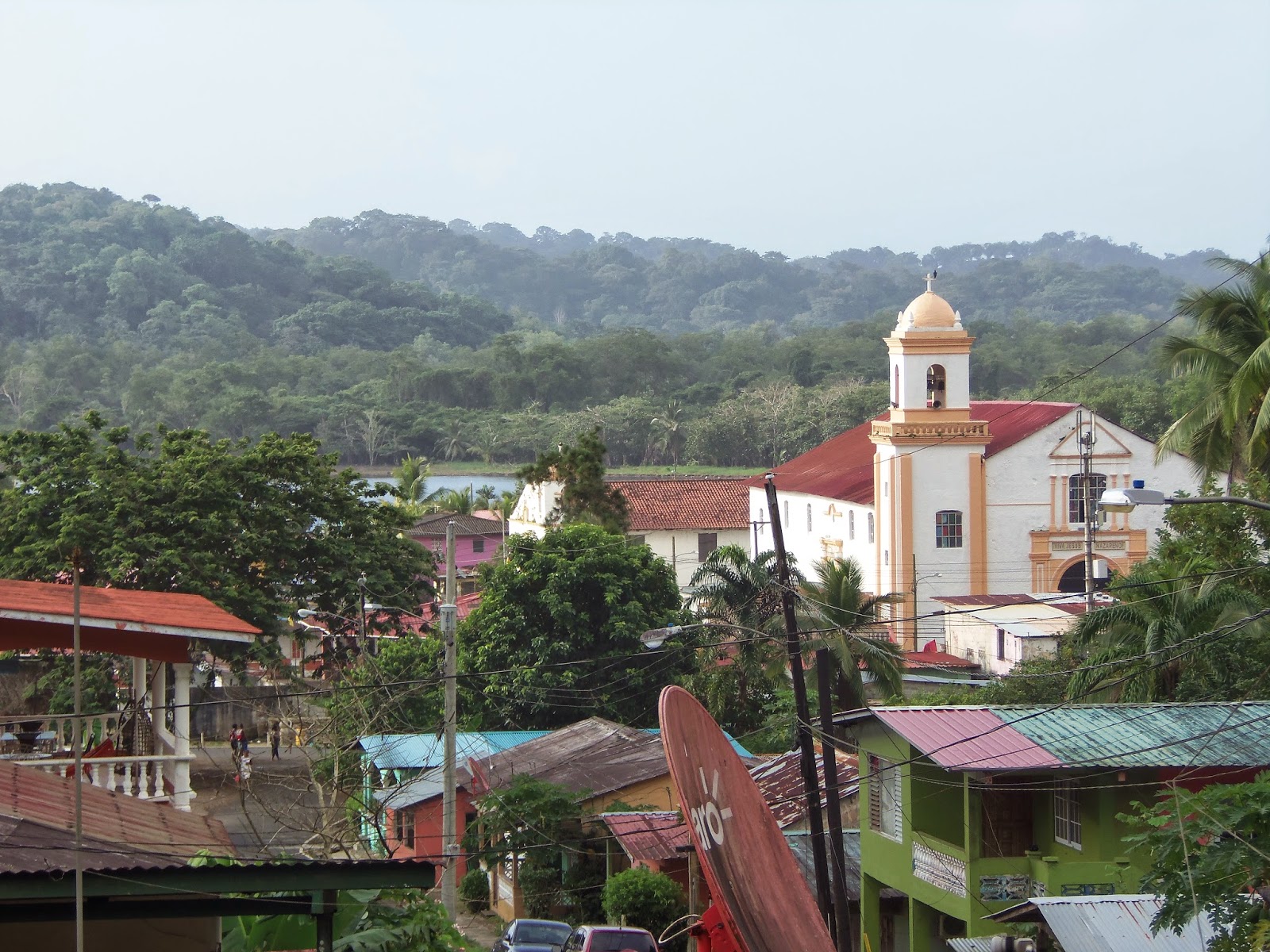
Portobelo Looks Attractive from Afar
Captain Jack’s had no private rooms.  Dorm beds cost $13 not including breakfast, although there was coffee in the morning.  The terrifying reviews on the internet are mostly the product of a deranged individual who has it out for Jack.  Jack and the staff were friendly and helpful.  That said, there were definitely issues with the place.  When I arrived late in the afternoon, I was given clean sheets, but the other beds were still covered with dirty sheets and abandoned clothing.  There was only one toilet.  The smaller rooms had their own showers, but they were over the basins, so the areas tended to be wet.  The upstairs restaurant was pleasant enough, but the prices were about 50% higher than elsewhere in Panama.  At least the food was good and they had Thai curries, which weren’t common in Panama.  Beers were $2.  I shared a dorm with three people who would be my shipmates, anyway.  The space was cramped, but there was a louvered window and two fans, so the temperature was bearable.  The neighbors were celebrating Colombian Independence Day with a very loud party, so the noise was deafening until midnight or so.

It hadn’t occurred to me until I was already on the bus to Portobelo that I needed $500 in cash to pay for my trip.  Portobelo didn’t seem like the sort of place that would have an ATM, so I wasn’t sure what I would do.  I asked the clerk at one of the grocery stores in town if there was an ATM and she said that there had been one at the bakery, but that it seldom worked.  I walked over there, but couldn’t find an ATM at the bakery.  I thought maybe it had been removed.  Later, I asked again at Captain Jack’s.  They told me that the ATM was across the street from the bakery, but they also said that it was usually out of money.  I hurried straight there, which was fortunate because it was locked after 5:00 and I got there about 4:50.  Miraculously, it worked and I got my cash.  I took that as a good omen for the trip.

Our captain and crew showed up to meet us about 7:00 pm.  The Italian captain was named Andrea and his Italian mate was named Enrico.  Andrea's girlfriend, ChiChi, was visiting from Italy.  An English girl named Rose rounded out the crew.  She had joined the boat in the Canary Islands and never left.  They all seemed nice enough.  Enrico showed me where we would be going on a chart application on his phone.  Andrea took our passports and money so that he could go to the port captain in the morning, while Enrico and Rose saw to the provisioning.  The entire group chatted and got to know each other for a couple of hours while we waited for Hannah and Matt, a brother and sister from New Zealand, who had accidentally taken the wrong bus and ended up back in Panama City.  I went to bed when our little party broke up and read for a bit until some of my other roommates came in and wanted to go to sleep.

July 21, 2014

There was no reason to get up early, so I lazed around until nearly 8:00, when I decided to get up before there was a run on the shower.  I went upstairs for a cup of coffee and then spent the morning using the internet and talking to Linda, a cruiser who had a boat in the anchorage and was also using the internet.  When the power went out about 1:00, I left my pack in the common room and went down to the grocery store to buy lunch and drinks for the trip and pick up a bit more cash, since I was starting to worry that Columbia might not let me in if I showed up with less than $20.  Once again, I lucked out with the ATM.  As I came out, a local asked me if it was working and seemed surprised when I told him that it was.  While buying beer at the local grocery stores turned out to be expensive, I got boxed wine for $3.55 and a fifth of Ron Abuelo (rum) for under $10.  Enrico said that with two boxes of wine and a fifth of rum he could make 5 liters of sangria.  That sounded like a good solution, since cold beer could only be purchased at $2.50 a pop.

Dock in Portobelo
We were not due to leave until 4:00 in the afternoon.  I spent the remainder of the afternoon at a picnic table behind the hostel, writing and reading my book while my phone charged.  The guest kitchen facilities at Captain Jack’s were extremely rudimentary (BBQ and laundry sink), but there was an electrical outlet rigged under the picnic table and the internet did reach out there.  About 3:15, I shouldered my pack, picked up my provisions and the day pack with the clothing I would need for the trip, and walked down the hill to the dock by the fort where we were due to meet Micamale at 4:00.  Everyone else appeared at 4:00 on the dot, but it was a bit after 4:00 when Rico showed up.  He had been in town looking for ice.  Before he could start transferring us to the boat, he had to take the dinghy over to the shore near where he had found ice and then take the ice out to the boat.  Finally, about 4:30, he came back with the dinghy and somehow managed to load five people and all their belongings into the dinghy and take them out to the boat, which was on the far side of the harbor, without getting swamped.  I went in the first group.  Rico then when back for the remaining two people.

Interior of Micamale and My Bunk on Right
Our professional crew consisted of the captain, Andrea, and his girlfriend, ChiChi, Rico and Rose.  Passengers were Ophelia and Antony from France, Bec and Kieran from Australia, Matt and Hannah, siblings from New Zealand, and me.  There was a crew cabin forward, two double cabins forward of the main salon and two double cabins aft.  All of the cabins had ensuite heads.  Being the odd person out, I slept in the dinette. This was actually fine with me because it was the coolest spot and, being amidships, also had the best motion underway.  Being an early riser (I would never have said that before this trip.), I was up before people began moving about the galley and those who stayed up late hung out above decks where it was cooler.  The only issue with my spot would have been if we were heeled over on a starboard tack, which we never did.


Micamale
When we finally raised anchor, we only went as far as a house on the shore opposite Portobelo where we stopped to fill out water tanks.  We stayed there while the crew made a delicious dinner of curried lentils, rice and salad.  Unfortunately, there were a lot of no-see-ums that bit me mercilessly and seemed completely immune to bug repellent.  I marveled at how an insect so small could raise a welt so many times larger than itself and cause me to itch for a week afterwards.  Not wanting to arrive at the reefs around the San Blas Islands before it was light, we waited there, being devoured by miniscule torturers, until 9:00 pm before we finally left the harbor.

There was very little wind, so we motored all night.  It was quite warm and humid and lightning flashed continually over the mainland.  The sea was a bit lumpy and, after we turned to the southeast, the swells were hitting us broadside.  Micamale had a 110 hp turbocharged Yanmar engine that allowed us to motor at impressive speed.  Even so, the rest of the passengers, with the exception of Kieran, were all miserable.  They spent the first night puking or huddling in the cockpit.  It looked like a battlefield out there.  I slept fine, once I put my earplugs in, and was surprised to find the cockpit littered with bodies when I got up at 4:30 am to enjoy the early morning hours.  I stayed up, chatting with Rico who was on watch, until well after dawn and then went back to my bunk and slept until 8:00 when the galley came alive.

July 22, 2014

We arrived at Porvenir and dropped anchor just after 8:00.  Porvenir is the capital of Kuna Yala, the semi-autonomous Panamanian province occupied by the Kuna Indians.  The Kuna do not appreciate their islands being referred to as the San Blas Islands.  They prefer “Kuna Yala,” which means, “the land of the Kuna.”  The tribe was decimated by the arrival of the Spanish and only moved from the mainland to the archipelago after their arrival.  Today, their economy is based on coconuts.  Every coconut tree in the region belongs to someone and helping yourself to a coconut is a severe transgression.  The Kuna are friendly and appreciative of the income that tourists bring as long as visitors are respectful of their home and their ways.  It was inappropriate to swim naked or visit their villages dressed only in swimwear. 
Porvenir
The city, which was only a cluster of shacks, covered three nearby islands.  Andrea went ashore on one island to visit immigration and check us out of the country.  Once he came back, we all went to the main island to see the village.  There wasn’t much there and we were all hard pressed to amuse ourselves for an hour.  There were no streets or cars on the islands.  Houses had sand floors, palm thatch roofs, and walls made of cane.  Some were constructed on platforms over the water, including a simple, but pleasant looking hostel that was completely unoccupied.  The dwellings on the windward end of the island had been leveled by a storm sometime previously.  It was obvious that almost any sea level rise would spell the end of habitation on the islands.  Some had already been abandoned. 

As is traditional in Kuna villages, there was a large structure where the Kuna gathered in the evenings to listen to the wisdoms of the chiefs.  A two room concrete block schoolhouse served the children of the surrounding area.  The only other sturdy structure spanned the passageway from the dinghy landing to the town, with a grocery store on one wide and a bar on the other.  Benches lined the passageway and people gathered there to take advantage of the shade.  It was very hot and there was very little shade on the island.  The inhabitants mostly stayed indoors.  Many women sold molas (colorful squares of cut and appliqued fabric, sometimes made into bags or pot holders) and beaded jewelry, but they were not at all pushy.  It only took us about five minutes to see the whole village.  It took us longer to find the cooler full of cold drinks in the grocery store. 

Attracted by a small orange kitten lying on a stump outside his door, I met the local herbalist.  He was reading a medical dictionary (in Spanish) given to him by an American doctor.  He was friendly and, being the only one in the group who spoke Spanish, I chatted with him a bit.  He wanted to know where we were from and was interested to hear that we were such an international group.  As soon as Andrea had a chance to drink a cold beer, we headed back to the boat.  We chilled for a bit and went for a swim.  The crew made tasty pasta for lunch.  Then we hauled anchor and motor sailed a couple of hours further to Cay Holandes where we spent the second night.
Kieran at Cay Holandes

Cay Holandes was the picture of a tropical island, covered with coconut palms and ringed by white sand beaches, it was surrounded by reefs and blue water.  We swam again and then went ashore to build a fire from dried palm leaves and coconut husks.  Andrea and Rico had befriended Julio, the headman of the island, on a previous trip by rigging a solar powered electrical system for him.  Julio and his wife and dog came out to meet us when we arrived.  We invited them to dinner, but only the dog accepted our invitation.  We roasted potatoes and peppers in the coal, grilled chicken, pork ribs and Italian sausages, and ate with our fingers.  Rico had made two 5 liter bottles of sangria and we drank most of one of them.  It was too warm to sit near the fire, but it was fun to sit around on downed palm trunks.  We all felt like we were in an episode of Survivor. Sated, we went back to the boat and were surprised to realize that it was only about 8:30.  I managed to stay awake until 10:00 or so, but was the first one to head for my bunk.

July 23, 2014
Boat at Anchor in Cay Holandes

Our second day at Cay Holandese was devoted to snorkeling and lazing about on the beach.  Rico gave us a ride over to the reef where we snorkeled along towards the gap between two islands where waves were breaking.  The snorkeling was okay, but not stellar.  There were lots of small, colorful fish, but nothing large.  The water was too rough to be really clear, so we couldn’t see very far.  Some people saw small rays or turtles, but I did not.  We eventually swam to the shore and then headed back to the boat.  Lunch was the leftover meat from the night before made into tacos.  They were tasty, but definitely the most Italian tacos I had ever eaten.

Later in the afternoon, we put on some clothes and took the dinghy across to the island to visit the village.  Unfortunately, they were entertaining a boatload of Germans when we got there.  Rico was immediately drafted to make adjustments to the solar system he had installed the time before, but the rest of us just stood around until it was time to go back.  The village consisted of eight or ten flimsy huts of cane and palm fronds, some of which were covered with blue plastic tarps.  Only the chief had a solar panel.  He wanted a television, which was why he put in the solar panel, but didn’t have one yet.  They begged us to charge a cell phone for them, but their plugs were inconsistent with our outlets.  We went back to the boat, drank the remaining sangria and played cards until Andrea produced a lovely pasta for dinner.  We ate late, so I managed to last until 10:00 or so before I headed for my bunk.  For once, I was not the first person to pass out.

July 24, 2014

I got up just before six and immediately went for a swim to rinse off all the sweat from the night before.  It felt marvelous.  By the time I had washed my hair and dried off, Rico and Rose were up and raising the anchor.  There was 14 knots of breeze, so we sailed most of the way to Coco Bandero, where we dropped anchor around nine in the morning.  Micamale had clearly begun life as a charter boat.  Her rig was definitely designed to be simple to sail and unlikely to become overpowered.  The mast was shorter than normal, which resulted in a proportionately smaller main sail.  She had no traveler.  What little adjustment could be made to the position of the boom was accomplished through the use of preventers permanently rigged on each side of the boat.  The main could easily be dropped into a cradle with the assistance of lazy jacks.  The headsail was no bigger than 100% and there was not sufficient track to fly a larger one.  The head foil had two tracks, so a second headsail could be raised for downwind sailing.  Micamale was not rigged for a spinnaker.
Coco Bandero

Once we anchored, Andrea and Rose served us a large breakfast of eggs, toast, fruit, cereal and cookies.  After breakfast, we all jumped in the water and snorkeled over to the nearest island to look at the numerous large, orange sea stars on the sea floor.  The water was very shallow.  There were a lot of sea stars, but only a few small fish.  I swam carefully over the reefs until I could surf onto the sand and climb out onto the island.  We walked completely around the island.  On one end, the water was undercutting the island and there was a jumble of fallen coconut palms along the shore.  I swam back to the boat and spent the rest of the afternoon on board because we had run out of fresh water to rinse off after swimming.  We had carefully conserved our first tank of water but, unfortunately, Andrea’s girlfriend left the tap on when the tank ran dry, so the second tank just ran down the drain when we switched over.  We had to switch to 5 gallon bottles, so we were required to ration water after that.  Our lunch dishes were washed in salt water.

Matt & Kieran on a Tiny Island
Hannah Rescuing Appio's Boat


After a late lunch, we all went our separate ways.  Kieran and Matt swam to a tiny island a quarter mile or so away.  Hannah and Bec swam to the island with the bar and souvenir stand.  Ophelia and Antony swam to a different island and Rico and Rose took the dinghy ashore.  Andrea bought lobsters from Appio, his local contact and stayed aboard to make pasta sauce from the lobster heads.  Appio was quite a character.  He came aboard and spent a good part of the afternoon lounging in the rear of the boat.  At one point, his boat came untied and started to drift away.  He seemed quite unconcerned and Hannah jumped in the water and rescued it for him.  I stayed on the boat to photograph Kieran and Matt’s epic swim to the island that reminded them of something out of a Far Side cartoon.  The boat was swinging about on its anchor and it was difficult to focus the camera at the extreme range of my zoom.


Bec and Hannah Swimming
Lobsters for $4 Each
                                                                                                                                          It was dark by the time we all regrouped at the boat and wonderful smells were issuing from the galley.  For appetizers, we gnawed on the lobster shells and legs.  Then came the pasta with a salty sauce made from lobster heads, garlic, olive oil, chili pepper and rum.  We finished with delightful lobster tails with butter, garlic and herbs.  I had a couple of glasses of red wine while everyone else drank white.  After that big meal on top of a day of swimming, we were all ready to make it an early night.

July 25, 2014

We were due to leave at 6:00 am, so I got up to take a swim a few minutes before that, knowing that there would not be another opportunity to bathe for a few days.  We were already out of fresh water, so I had to make due with a salt water bath, but at least it got the stink off.  We didn’t actually leave until nearly 7:00 and most people were up by then, having risen uncharacteristically early.    We backtracked for an hour or so until we reached the channel through the reef and then headed out into the open sea.  It became rough almost immediately.  Micamale had a very flat bottom and only weighed 22,000 pounds.  She wasn’t a tippy boat, but she frequently launched off the top of a wave and slapped back into the water, sounding very much like the big, plastic shell that she was.

There wasn’t much to do on board.  The auto pilot was driving and the crew kept a lookout.  The cockpit was spacious, but lacked proper cushions, so I found it difficult to sit there for long periods.  Having decided against coffee on an empty stomach under those conditions, I was sleepy and spent most of the day lying in my bunk, dozing and dreaming.  I got up for lunch and again for a beer about 5:00, but that put me out and I slept through dinner.  All the pasta, rice, beans and bread were getting to me, anyway.  I was happy to swear off eating for a bit.

July 26, 2014

I woke to the sound of Rico tacking the boat and got up to see what was going on.  The waves were huge and what little wind there was came straight on the nose.  Rico tacked a few times and then gave up and doused the sails.  I stayed up for a couple of hours and then went back to sleep.  No one really wanted breakfast.  Once again, I spent most of the day in my bunk, popping out once in a while to get some air.  I got up around lunchtime because I was thirsty.  Andrea really wanted to feed me something, but I declined lunch.  He insisted that I try some of the rice from the night before.  I ate a bit, but was unable to finish the large portion he had served me.

Cartagena
About 2:00, I popped by head out and could see Cartagena in the distance.  The first sight of the city was the skyline of tall buildings built on a peninsula that forms one side of the bay.  There is an island in the middle of the mouth of the bay with entrances on either side referred to as Boca Grande (big mouth) and Boca Chica (little mouth) respectively.  The Spanish built a wall across the larger opening to better protect the harbor.  At one point, the French rammed a hole in the wall.  We entered through that gap which today is well marked with red and green channel buoys.  Once we rounded the peninsula, we could see the bay spread before us with the marina and old town ahead, modern city to the left and container and cruise ship ports to the left.  Many boats were anchored in the bay, but we headed for the marina.
Cartagena Anchorage

The marina in Cartagena is very European in that there are no finger piers.  Most boats put an anchor (or two) forward and then back into the pier.  We milled about for some time, trying to contact the marina to determine where we should go.  Eventually, they squeezed us between two boats where we didn’t really fit.  This involved three men jumping into the water to move lines.  We banged into the boat beside us and there was lots of yelling, but we eventually managed to secure the boat to the dock and stretch a very narrow and flimsy looking plank across to the dock.

Andrea offered us the opportunity to stay aboard overnight and eat dinner for an additional $50.  It seemed like a lot, but I elected to do so because I would have had to return the following day to retrieve my passport and I figured hotel, dinner, breakfast and two taxi rides would come to nearly that, anyway.  As soon as possible, I scampered ashore and took a shower in the newly renovated bathrooms.  The shower felt heavenly.  Everyone else had left by the time I got back from my shower.  Andrea, ChiChi, Rico, Rose and I went up the street to use the free internet at the grocery store and to buy food for dinner.  I stopped at an ATM in the grocery store and got some Colombian cash.  There are about 1800 Colombian pesos to the dollar, which makes for some large numbers.  The ATMs dispense 50,000 peso bills.

Cartagena is All About Contrasts
We were all in the mood for steak and salad.  Andrea cooked delectable rare fillets that melted in our mouths and we had a big green salad and fresh bread to go with them.  Colombia definitely got the award for best lettuce on my trip.  The grocery store was very modern and upscale.  Cartagena, at least, was very first world with prices to match.  Rico and Rose excused themselves to go enjoy some private time and Andrea, ChiChi and I sat in the cockpit, drinking wine, enjoying the balmy evening and talking about the state of the world in a combination of Spanish, English, and Italian.  It was a thoroughly satisfactory evening, a good way to end our adventure, and well worth my $50.