Wednesday, February 15, 2017

ISLAND LIFE – ISLA EL CORDONCILLO, EL SALVADOR

January 29, 2017

When I came up to the main house for coffee in the morning, I met a sleepy Jan who informed me
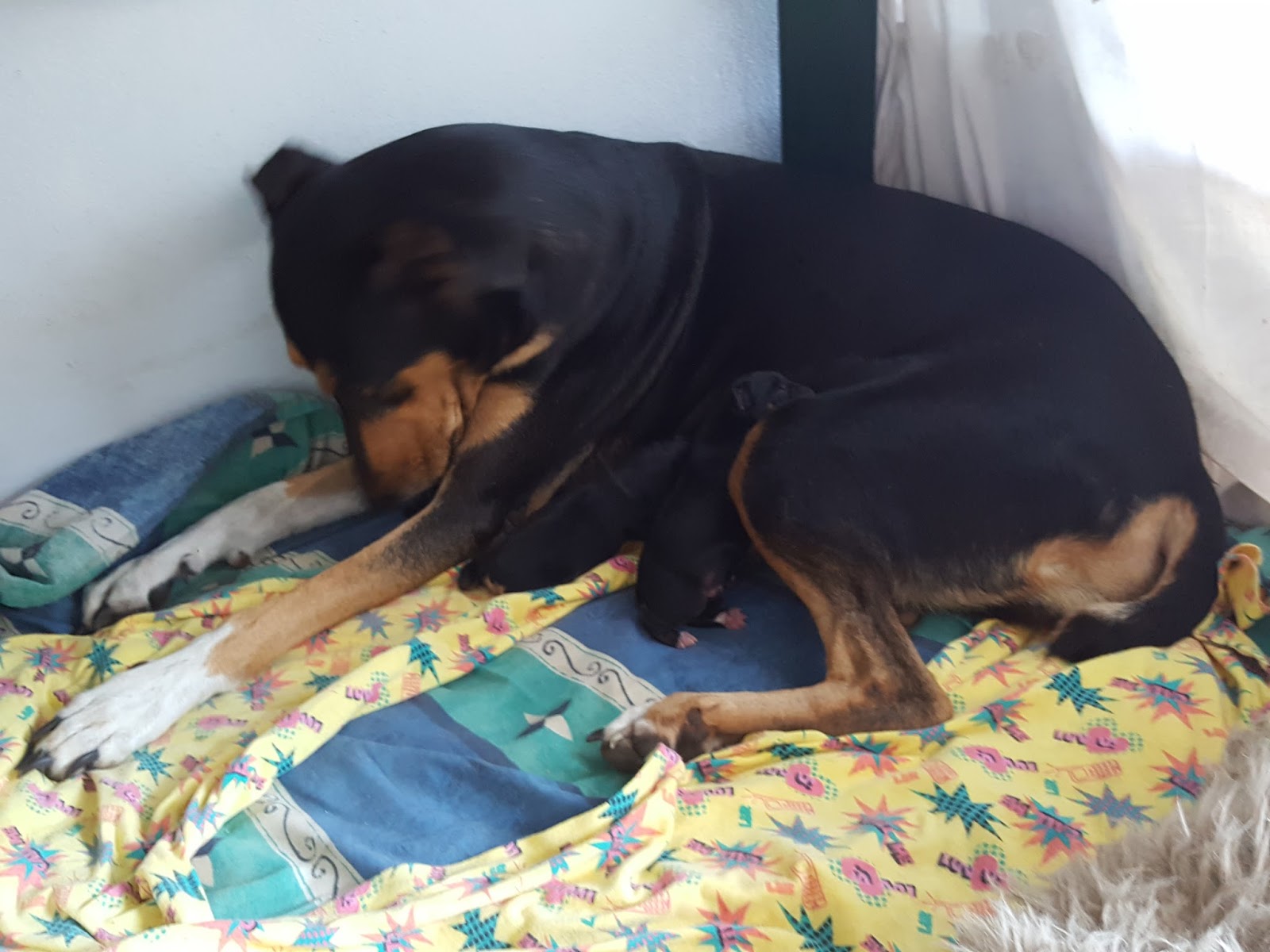
Mama Shadow With Her Babies
that one male and two female puppies had been born in the early morning hours.  All three of them were black and marked like their mother, making it impossible to tell who the father had been.  Like her earlier litters, two were born with no tails.  They were tiny, whimpering black lumps with miniature, embryonic looking limbs.  Shadow seemed very happy to be finished with her pregnancy.  Every time she went outside, Ember, the young female Labrador, tried to get at the puppies.  She was very curious.  Jan had to keep her outside so that she didn’t bother Shadow and the puppies.
The new toilet valve that we had installed had ceased to work and my project for the morning was to repair it.  I thought it might be clogged with algae, but cleaning it did no good.  Eventually, I determined that the water pressure was not strong enough to reopen the valve once the float closed it.  I took it apart and removed the “o” ring from the plunger and that allowed it to move freely enough to operate with the pressure at hand.  I also bent the arm on the float so that the tank didn’t fill as full.  Water was a scarce commodity on the island.

Then it was time to wash some laundry.  I didn’t want to use any more of Jan’s water than necessary, so I only washed a week’s worth of underwear and a nightgown.  I had plenty of clean clothes.  The rest of the morning was spent reading “Treasure Island” in the hammock.

Lin and Lou's Gorgeous Pool
At 1:00, Eduardo came to put the motor on the dinghy so that we could take it across to the hotel where Jan parked her truck.  Then we drove to Lin and Lou’s, five miles up the estuary.  Lin and Lou hosted a potluck barbecue at their lovely home every Sunday.  I had met them on my last trip to El Salvador and wanted to see them again and meet some of the other cruisers.  Jan was tired and didn’t stay long.  Bill and Jean offered me a ride home, so I stayed and enjoyed the beautiful pool and the company.

The Lovely Dinghy Ride Home
Perhaps the best part of the day was the dinghy ride back down the estuary as evening fell.  From there, the volcano was clearly visible.  We passed mangroves and islands until we finally arrived at Bill and Jean’s.  We were met on the dock by some local children who wanted to give us hugs.  Jean sometimes gave them treats, so they always met her at the dock.  This time, they also wanted to retrieve their father’s cell phone which had been charging at Bill and Jean’s.  Bill and Jean invited me in for a drink and I accepted so as to give Jan more time to nap if she was sleeping.

It was dark by the time I got home and it was a good thing Jan was awake because she had locked the gate and the dogs made a big ruckus until I managed to get it open.  I ran in to charge my phone and Kindle before the generator shut off.  Jan didn’t make it long.  She went to bed before 9:00.  I retired to the casita to write so that I wouldn’t disturb her.  She had only napped for an hour before the crew of Longta arrived to see the puppies.

January 30, 2017

The water tank in the casita ran dry on Monday morning.  This was a bit of a mystery, as I had used very little water.  I hauled a bucket of water from the barrels for plant watering to fill the toilet tank and flushed sparingly.  I knew Jan was planning to haul water that week, so resolved to make do until that time.

The kids came for their English lessons that afternoon.  The little ones were introduced to colors while I worked on the numbers one to twenty with the two older boys.  They got them down before the end of the hour and picked up twenty-one to thirty-nine almost instantly.  We had a very good time and they applied themselves.  The youngest child in the group was the daughter of Jan’s caretaker.  He was determined that she get a good education and not end up like himself, doing grunt work at the age of thirty.  She was a smart child and did learn, but didn’t have the attention span, at four, to concentrate for the full hour.  It was interesting to observe the difference in maturity between four and six.

The second group began to arrive almost as soon as the younger ones left.  As much as we would have appreciated a break between the two classes, it was heartening to see that the kids were so eager to come to class.  The older kids were introduced to the vocabulary for describing people.  Most of the class was spent introducing them to a wide array of new words.  In the last few minutes, they were each given a card with a picture of someone on it and asked to describe that person.  Unfortunately, they were a little overwhelmed and mostly acted silly.  Even so, they did try to use some of the new vocabulary.  I had faith that they would do much better at the beginning of the hour on Thursday.
Stoves Staged in the Yard

By the end of the hour, we could see pangas full of stoves heading for Bill and Jean’s dock.  I had offered to help unload, so I headed over there as soon as the class was over.  Half the stoves had already been moved to Bill and Jean’s yard by the time I got there.  Jamie, from Allare, and four of the islanders were moving the heavy, concrete stoves in pairs of two.  I jumped in and helped to move the remainder.  Soon there were 55 stoves littering Bill and Jean’s front yard.  It was very exciting.  I couldn’t wait to see them distributed the following morning.

January 31, 2017

Genesis Carrying a Comal
Joint Canadian and Salvadoran Rotary groups financed the sale of $75, high efficiency wood stoves to the islanders for five dollars.  Not all of the islanders could come up with five dollars, but Bill and Jean offered to lend five dollars to anyone who needed one.  Jan gave five dollars to two young women that she felt were hard working, but living under difficult circumstances, so that they didn’t need to borrow.

When I arrived at the meeting on Tuesday morning, a Salvadoran businessman was addressing the group of islanders on the danger of wood smoke.  Young children breathing wood smoke damaged their lungs, resulting in asthma and susceptibility to respiratory infections.  Jan had complained that certain children were always sick, but her theory was that they were the children who went from hammock to arms without being allowed to crawl around in the dirt.  Both factors made sense to me.  The gentleman behind the stoves also lectured them on air pollution and global warming contributing to sea level rise, an issue that was quite relevant to an island that had already been submerged by an extreme high tide in 2015.
The Islanders Being Informed About the Stoves
After the lecture, two of the island women fired up a stove and cooked some pupusas.  The stove smoked like a regular one until it got hot, but within a few minutes it was nearly smokeless.  Each stove had a “comal,” a steel plate that rested atop the concrete portion of the stove and formed the cooking surface.  I later received a report that a family of five had been fed dinner using only three pieces of wood.

Island Ladies Cooking Pupusas
The Rotarians from both Canada and El Salvador attended the distribution and gave out stuffed toys to the small children.  There was a huge group of people standing around in Bill and Jean’s front yard, chatting and trying to find shelter from the sun.

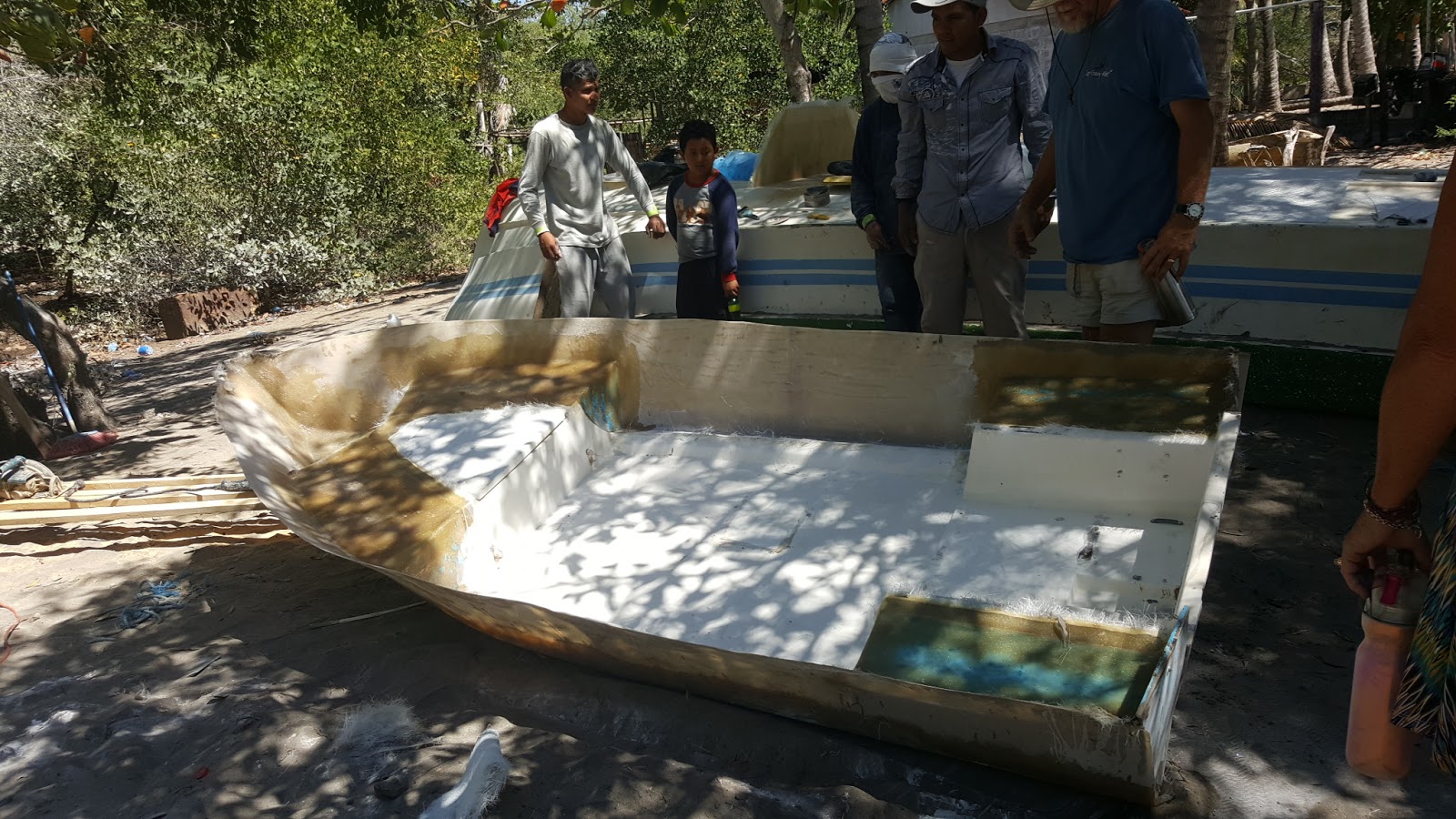
Jeff and Judy and a young couple from Washington were walking down to where Jeff and Judy’s new dinghy was being constructed and I decided to tag along so as to see more of the island.  I had met Deni, the man building dinghies, on our previous trip to El Salvador when he had provided us with potable water on a number of occasions.  He was an enterprising sort and had started building fiberglass dinghies after everyone had been impressed with my friend Venus’ hard dinghy.

Deni had started with the body of a dead RIB (rigid inflatable boat) and was building up the sides with fiberglass and adding flotation that also would provide seating.  The sides were coming along, but the bow was still rather unformed.  It was fascinating to see the construction process.

Jeff and Judy's Dinghy in Process
By the time we got back, the rest of the young couple’s family was visiting with Jan on the front porch.  We all had a cold drink and chatted for some time.  After everyone left, I decided I had better break the news to Jan about the water tank in the casita being empty.  At that point, she asked me to leave and suggested that I rent a room from Lin and Lou.  She didn’t have their number, so I headed over to Bill and Jean’s dock where a group of people were having cocktails.

It turned out that Lin and Lou were about to return to the United States and I didn’t really want to be five miles up the estuary without a dinghy, anyway, as lovely as their home was.  I was in El Salvador to help the community, not lounge at a resort.  One of the skippers offered up the possibility of my helping to sail his boat to Panama and we agreed to pursue that further on Thursday, as he had to spend the following day in San Salvador looking for glue to repair his dinghy. 

Bill and Jean offered to let me stay with them for a few days until I could solidify a plan.  I was able to go back and tell Jan that I would be leaving in the morning.  She was in a much better mood when I got back and we actually passed a pleasant evening.  She offered me a drink.  I had already had a shot of tequila at Bill and Jean’s, so I mixed myself an orange juice and soda just to be companionable.  It was apparent to me that Jan’s water situation really couldn’t support the two of us.  I was still puzzled as to what had happened to the 300 gallons of water that should have been in the tank.  While I later heard an unconfirmed rumor that there had been another guest before me, it occurred to me that the shower had leaked quite copiously between the time we fixed the toilet and the time I went to bed that night, discovered water everywhere, and turned off the main.  I had fixed the shower before turning the water back on, but the leak was no doubt at least in part responsible for draining the tank.

February 1, 2017

Interior of the Casita
I got up at dawn and swept out both sides of the casita and the porch before I went up to the house for coffee.  Jan apologized for asking me to leave, but said she just had too much on her plate.  I had come to help her with projects, but she already had two guys working on the cistern all day and, with a shortage of water, really couldn’t handle any more demands on her resources.  She left for San Salvador and we parted on good terms.  I finished cleaning out the casita and started moving my things to Bill and Jean’s.  They leant me a wheelbarrow so that I didn’t need to drag the big duffel bag through the deep sand on parts of the path.  As Isla El Cordoncillo (the Ribbon) is long and narrow and there are no vehicles on the island, the main road was just a sandy path along the beach.  The rear of the island was swathed in mangroves, so there was no thoroughfare on that side.  With the exception of a few families who owned their land and the ones who were acting as caretakers for absentee owners, most of the islanders were squatting in a ramshackle village just past Bill and Jean’s.  There were a school (built on squatted land), Evangelical church, Catholic church, and a couple of small tiendas selling groceries, beer, and snack items.  The beach in front of the village was deep with plastic garbage, which unfortunately discouraged cruisers from landing there to patronize the tiendas.

Isabel and Jean Making Cushions
Bill and Jean’s was a hive of activity in the morning.  Isabel and Jean were busy replacing the foam in the cushions from the catamaran Rapscullion.  They were not replacing the covers, but some of them required substantial rework and I helped where an extra pair of hands was useful.  Jean was teaching Isabel, who was an excellent seamstress and could design and sew anything in the way of clothes, to make boat cushions.  The cushions from Rapscullion were complicated with ridges that fit into depressions in the fiberglass to keep them in place.  The original covers had a burlap like fabric on the bottom that had raveled in some places to the point where it could no longer serve as a pattern.  Jean was patiently explaining pattern making to Isabel, who never used patterns.  There was a fine line between helping and taking away work for which Isabel would earn money, so I mostly just watched until six hands were needed.  Still, it was fun to get to know Isabel better.  She was an intelligent woman who spoke decent English.

We took a break for lunch and I made quesadillas out of cranberry covered goat cheese, candied jalapenos, and diced pork ribs.  They were very fancy and tasty, too.  After lunch, work resumed on the cushions.  Bill and I spent a large portion of the afternoon playing the guitar and I finally found the motivation to change the strings on my guitar which had been there for almost three years.

The social event for the evening was cocktails at Colette and Ralph’s.  Their place was a three-story A-frame over on the other side of the village.  Bill mixed up some kumquat margaritas and we hopped in the panga and zipped over there, landing on the beach.  We arrived at the same time that Deni delivered Richard and Elizabeth (whom I had met in Chiapas) and Judy who had somehow gotten separated from Jeff who had gone to San Salvador with Jan, but went his own way once there.  Another few couples joined us there and we had a nice group outside on the terrace.  I chatted quite a bit with Judy and Elizabeth and Judy floated the idea of my crewing for them on the passage to Panama, as they had crew coming to join them there.  Jeff wasn’t there to discuss it, but it was a very tempting idea because I knew them and their boat, Just Passing Wind, was large and beautiful.

We all stayed until the tide threatened to go out and strand the boats on the beach and then the party broke up.  Bill took the group home that had arrived in Deni’s taxi and Jean and I walked down the beach.  As we were passing the village, one of the women cornered Jean because one of the older men had a bad case of flu and was vomiting.  Jean, who was a nurse, agreed to come back and give him a shot.  She administered Benadryl in this sort of situation that really only made them sleep, but at least allowed them to rest and recuperate.

Bill made some very tasty pork ribs with potatoes and onions, which were ready in about 20 minutes in the pressure cooker.  It was nearly nine by the time we ate, but the food was worth the wait.  We relaxed in hammock chairs for a bit after dinner and then turned in.

February 2, 2017

After having had perfectly good internet through my phone over my entire trip, the morning that I needed to do my banking and try to firm up my plans, I had no connection.  My mission for the day was to talk to Jamie from Allare about crewing for him but, though he arrived early, he was on another mission.  He had gone to San Salvador the day before to see about purchasing glue to repair his PVC dinghy.  He found some, only to be told that it cost $500 for a pint.  By the time he arrived at Bill and Jean’s, he was ready to consider having Deni build him a fiberglass one.  He left with a promise to return later in the afternoon and I let the matter slide at that point.

Isabel returned and she and Jean resumed work on the cushions.  There wasn’t much for me to do and I was having a hard time keeping my eyes open, despite a cup of leaded coffee.  I finally lay down for an hour, although I never did go to sleep.  Eventually, I gave up, rose, and drank one of the diet cokes leftover from the Rotarians.  That revived me enough to sit in the hammock chair and write.

We had sundowners on the dock and, by that point, Jamie had decided to stay long enough to have Deni build him a fiberglass dinghy.  Clearly, our timelines were not going to align.  Since arrangements to visit my cousin in Mexico City, La Cruz, and Comet in the Sea of Cortez were coming together nicely, I decided to confirm those plans as soon as I got a connection.

We had gringo tacos for dinner.  Gringo tacos are corn tortillas lightly fried (but not crisp) and stuffed with lettuce, tomato, hamburger, onions, and whatever else was in your fridge, tossed with a mixture of mayonnaise, ketchup, cumin, and paprika.  They were very tasty.

February 3, 2017

My phone still wasn’t picking up internet when I got up on Friday morning.  Jean and I were heading to Zacatecoluca to go to the bank and pick up a few things, so I decided to see if my signal improved when we got there.  We took the panga across to the hotel, dropped off our laundry, and then took a bus to Zacate.  It cost $1.  The bus took the scenic route, but we were assured of having a seat all the way.  We stopped in Santiago Nonualco where the vendors were selling small pupusas made with rice flour for 10 to the dollar.  We got a couple and snacked on them as we rode to Zacate.
The Interior of a Salvadoran Bus


We got off at the strip mall near the entrance to town and went to the Dispensa de Don Juan (a supermarket) where there were several ATMs.  We looked around the store, but didn’t buy anything because we didn’t want to carry things around town.  We stopped at a fast food restaurant called Biggest for brunch.  I still wasn’t getting internet, but my text messages went through and I got a few Facebook messages.  We ordered a variety of Salvadoran items to eat.  I had a slice of fried cheese, what they called an empanada which looked like a corn fritter filled with sweet cheese and a piece of bacon.  Jean had a fried sweet corn tamale.

After our meal, we walked up the hill to the square where there was a pretty white church and another supermarket called Super Selecto.  We bought rum, juice, cabbage, onions, and cat food.  I picked up batteries for my LED lamp and radio.  Then we walked back down the hill to the bus station and waited for a bus back to La Puntilla.  I didn’t take many pictures because I was leery of taking my phone out in the city, but I did snap a few from the bus before it filled with passengers.

It was a long, hot ride back to Bahia del Sol.  We were very happy to get into the panga and feel the wind on our faces.  We returned to the house by 2:30.  I had to borrow Jean’s wireless stick when we got back so that I could finally make my travel arrangements and do my banking.  I had planned to take the bus back to Tapachula and then fly to Mexico City.  However, I found a flight for only $383 instead of $650 that would save me two nights in hotels and an entire day of travel time.  It would still be more expensive, but the convenience seemed worth it.  My cousin agreed to pick me up at the airport.  I also accepted Ulla’s offer to rent me the palapa at Agave Azul in La Cruz for three weeks beginning February 10th  and booked a cheap flight from Mexico City to Puerto Vallarta.   Arrangements for hooking up with Comet in March would have to wait until later when Don had some idea of where he might be.

Ralph Grilling Sausages
Dinner at Ralph and Colette's
Making all the arrangements took a couple of hours and I barely had time for a drink before we were ready to walk over to Colette and Ralph’s for dinner.  Ralph had barbecued some pork ribs and then cooked some nice sausages.  We brought wine and some bean dip and fresh chips that Bill made.  Ralph and Collette were perfect hosts and we all stuffed ourselves.  Their deck was a perfect venue for dining al fresco because, being on the second floor, we were not plagued by the jejenes (no seeums) that had been biting me for two weeks.  They were not as awful as the ones in Mexico because they didn’t leave the same huge welts, but the bites did itch fiercely at times.  Bug spray discouraged mosquitoes, but did little to stop the jejenes.  It was especially frustrating to be so annoyed by something you couldn’t even see.

It was after 9:00 when we got back.  Bill wanted to stay up for a couple of hours to run the generator, but I didn’t make it past 10:00.

February 4, 2017

I awoke at 3:20 and stayed awake, reading for a couple of hours.  Finally, I was able to go back to sleep for another couple of hours.  I got up, drank coffee, did the dishes, and ate a banana.  I managed to study Italian for a few minutes before Jean invited me to go with her to La Colorada, a village on the island of Tasajera where there is a woman artesan’s coop.  Jean helped them to market their products in San Salvador and through the National Geographic’s online store.  She also brought some to Lin and Lou’s every Sunday where she often sold things to cruisers.  She needed to refresh her supply.

Clearing a Plastic Bag from the Outboard
We stopped at the marina and picked up Elizabeth from Georgia B.  We had trouble backing out of the marina and didn’t get very far before the motor conked out.  A large, black plastic trash bag was fouled in the propeller.  Elizabeth and Jean were attempting to clear it, but couldn’t easily reach that far.  A panguero from La Puntilla stopped to help us.  He managed to remove the bag and then threw it back into the estuary.  Elizabeth, who is Chilean, rounded on him in Spanish and plucked the bag back out of the water before it could inconvenience anyone else.

Restaurant Built on a Sand Bar
The Way to Tasajera
We headed towards the mouth of the estuary and then turned to the left to follow the shore of Isla Tasajera.  Isla Tasajera is much bigger than Isla Cordoncillo.  It has electricity and some functional wells.  It sits higher above sea level, also.  Twelve hundred people live on the island.  Some of the residents operated restaurants built on a sand bar in the middle of the estuary.  They were built on stilts and sometimes appeared to be in the middle of the water.   We followed the shore of Tasajera and passed the town of Tasajera then we turned to the right and followed a channel through the mangroves to a public dock at the village of La Colorada.  La Colorada was a fishing village and many pangas and cayucos were tied to the long pier that extended up a muddy slough.

Public Dock at La Colorada
We walked along the dock and then down the main road through the town.  The residents of Tasajera owned their property and kept it neatly fenced.  There was an actual sandy road through town and we saw homes of various construction, concrete wells, and even some brick outhouses.

The women’s coop was a spacious cement block building.  They made tote bags and purses out of hand woven fabric and beaded jewelry.  They had four or five industrial sewing machines in the interior of the building and displayed their wares on the covered porch, although few people even came to buy anything except Jean.  Most of their orders were effected via the internet, which was often difficult because their coverage was no better than mine and they often had to depend on people who went back and forth to the city.
Sewing Room at the Women's Co-op

Bags for Sale at the Co-op
We spent an hour or so looking at their operation and admiring their wares.  I bought a couple of pairs of beaded earrings for my cousin and her daughter in Mexico.  Elizabeth bought a bracelet and a couple of pairs of earrings.  Jean stocked up for the Superbowl party at Lin and Lou’s the next day.  Then we hopped back in the panga and zipped back to the marina where Jean and I collected our laundry and then stopped for an icy cold beer on Georgia B before heading back to the island.
We had leftover gringo taco salad for lunch and then spent a relaxing afternoon working on our separate projects..

Saturday night, most of the gringos on the island and in the boats went to Bill and Jean’s caretaker Jairo’s house for dinner.  On Saturday nights, his wife made pupusas.  This week, she was eager to show off her new stove.  Her specialty was queso quemado (burnt cheese.)  They were fabulous.  They had even gone out to buy beer so that they could sell it to us.  Her kitchen was basically in an outdoor shed.  They set up a large table outside and we all crowded around it in resin chairs.  My dinner cost $1 and we all had a great time.  We stayed until well after dark and I was ready for bed by the time we got back.
Pupusas Being Cooked on One of the New Stoves

Pupusa Night on El Cordoncillo


February 5, 2017

My Quarters at Bill and Jean's
Our mission for the day was to go to Lin and Lou’s to watch the Superbowl.  Bill got up very early to start roasting the pork to make pulled pork sandwiches.  Maura, the president of the island’s non-profit organization sold bread in the mornings.  Bill and Jean had ordered a whole lot of buns from her for the sandwiches.  I got to say goodbye to her when she came to deliver them.  I spent the morning packing and getting ready to leave.  Isabel came to work on Henry’s cushions some more before we left.

About noon, we loaded all the food into Bill and Jean’s panga and headed up the estuary to Lin and Lou’s.  Once we got there, I used the internet while Bill took Lou’s truck back to the hotel to pick up the majority of the cruisers.  By the time he returned, I was ready to be social.  It was Superbowl Sunday, so nearly every foreigner in Bahia del Sol was there.  We drank cocktails and lounged in the swimming pool until it was time to devour the pulled pork sandwiches.  Then we returned to the pool until it was time for the kickoff.

Huge Hibiscus Flower
The first half of the game was rather dull.  Atlanta got a couple of touchdowns and the Patriots barely managed a field goal.  It looked like a lost cause.  We stayed to watch Lady Gaga’s halftime show and then Bill took the cruisers back to the hotel and we headed down the estuary in the dark, stopping at the Paradise Marina to borrow a spotlight from Sine Timore.  When we turned on the radio back at Bill and Jean’s, we were shocked to discover the game was tied.  Apparently, it was the first time that the Superbowl had ever gone into overtime.  That was exciting for a few minutes.  Bill needed to run the generator for a couple of hours, so we sat up and talked and then it was time to go to sleep.  It had been a long day.


Wednesday, February 8, 2017

SOUTH TO EL SALVADOR 2017

January 21, 2017

The Ticabus agent had told me to come to the office at 6:15 am to get my seat assignment.  We got up at 5:00 and called a taxi at 6:00.  Scott needed to go to the airport, as he had a flight at 9:00.  Since we were only about four blocks from the bus station, they dropped me off on the way.  The taxi didn’t want to leave me on the street outside the closed Ticabus office because the hours indicated that it didn’t open until 7:00.  The agent had clearly told me to come at 6:15 and I figured that the worst that could happen would be that I would have to drag my luggage across the street and look for someone in the main station.  I waved them off and the driver reluctantly pulled away.   A minute later, the agent arrived.  She assigned my seats and I then followed her across to the main station where she accepted my checked luggage.
Ticabus

The bus left at 7:00.  There were only about ten passengers.  I was the only gringo.  We drove out of Tapachula towards Volcan Tacuba.  The scenery quickly became wilder and more mountainous.  Within a half an hour, we arrived at the Guatemalan border at El Carmen.  This was the part of my journey that I had been dreading.  The Mexican immigration window was professional and quick.  They stamped my passport and I followed the signs across the border to the Guatemalan side.  Then I had to run the gauntlet of money changers and aggressive, official looking, crooks that wanted to take my money.  

Guatemalan Customs
When I had crossed the border there in 2014, I was taken in by a fellow with an official looking ID badge who claimed I needed him to handle my entry into the country and took nearly all my money to “pay for my visa.”  This time I was prepared.  I had changed some pesos into quetzales in advance and brushed off the boys looking for tips.  More difficult were the ID badge waving crooks.  One of them grabbed my passport as I approached immigration and gave me a story about how I needed to pay 200 quetzales because I didn’t have my Mexican tourist card.  Knowing that Mexican immigration has just taken that card, as they always do upon exit, I wrested my passport from his grip and told him I would pay the immigration agent.  At that point, he admitted defeat and looked for another victim.  The immigration agent stamped my passport perfunctorily and charged me nothing.

The bus was waiting for us outside immigration.  I was the third one to reboard.  The driver didn’t believe that I had managed to get through immigration so efficiently and demanded to see my passport stamp before letting me back on the bus.  He and the conductor were somewhat incredulous that I had pulled it off when several Central Americans were having trouble.  We waited while the remaining passengers trickled in and then proceeded to customs.  The exterior of the bus was searched and one passenger had to disembark while they searched her baggage, but no one came aboard and my baggage was unmolested.

Guatemalan Countryside
We continued through the mountains, eventually intersecting a highway through the plains where we passed tree plantations and cane fields.  At 10:00, we stopped at a Burger King for a food and bathroom break.  I ordered a breakfast muffin sandwich which turned out to be easily twice the size of a similar menu item at home.  Back on the bus, we continued another three hours through the highlands until we arrived at the Ticabus station/fortress.  The air conditioning became progressively colder as we proceeded.  I put on my sweater and zipped the legs onto my shorts, but couldn’t get warm.

Tiny Hotel Room in Guatemala City
Ticabus had changed locations since my last visit there in 2014.  The new station was more modern and more fortresslike.  The bus entered the parking lot through a giant gate.  The terminal building formed the heart of the compound with hotel rooms both above the terminal and in another building across a smaller parking area with another towering gate.  I paid my $25 to the clerk at the snack bar and was ushered to a tiny room in the far building.  I should have bought something to eat because the snack bar apparently closed after the 2:00 bus left.


I was chilled and tired, so crawled under the comforter and tried, unsuccessfully, to nap.  The traffic noise was constant and I was freezing.  Finally, I got up and put on socks and a fleece.  It was 63 degrees.  After three weeks in Chiapas where it never dipped below 78, even at night, I was a wimp.  It took me five hours to get warm.  I poked my head out about 5:00 to see if I could get something to eat, but all was dark in the terminal.  I went back to my room and ate the ancient Lara bar in my backpack.  Fortunately, I had brought a bottle of water from the Hotel Mo Sak with me.

Ticabus is an odd organization.  They effectively run buses from Tapachula, Mexico to Panama City, Panama.  Many of their stations include hotels where travelers can lay over or arrive the night before early departures.  Their website appears modern, but you can’t buy tickets online, although they have been promising that feature for at least 2.5 years.  I tried to make a hotel reservation online and received a regurgitation of my information that might have been a confirmation, but didn’t identify itself as such.  I verified that reservation with the Ticabus office in Tapachula, but the snack bar clerk had no reservation system and merely wrote my name and payment in a manual ledger.  Still, since my bus ticket from Tapachula to San Salvador cost me only about $35, it was hard to complain.  Flying would have cost me $650.

I locked myself back in my cell and entertained myself with the excellent wifi (there was wifi on the bus, too) before retiring early.  My bus would depart at 6:00 am the next day.

January 22, 2017
The Ticabus Terminal in Guatemala City

I need not have worried that no one would remember to let me out of my cage in the morning because they came around at 5:00 am to knock on my door and tell me to report to the station at 5:30 to check in.  I had hoped for some breakfast, but there was nothing at the snack bar except junk food, so I had a tiny, but tasty, latte and a package of cookies for breakfast.  For the past year, I had been looking for a slightly larger replacement for the bag I had purchased in Yelapa in 2014 that had become disreputable looking over the years.  Apparently, those bags originate in Guatemala.  I purchased a beautiful new one in a larger size for 50 quetzales or about $6.25.  That was a couple of bucks less than I had paid for the smaller one in Mexico.

Misty Morning in Guatemala
It was 61 degrees outside and everyone was bundled up in boots, hats, and scarves like it was snowing outside.  The bus left right at 6:00.  It was too dark to see much of Guatemala City as we drove through.  By the time it got light, we were up in the mountains again.  It was misty and I couldn’t see far.  The roads were bad and we progressed very slowly.  I kept hoping that we would stop somewhere for breakfast, but we never did.  The highlands we traveled through seemed much more prosperous than the jungle near Chiapas.  We drove past modern businesses and nice new homes intermixed with the sort of shacks that had predominated near the border.


Guatemalan Homes
By mid-morning, we reached the border of El Salvador.  It was nothing compared with the border of Mexico.  The conductor took our passports to Guatamalan immigration and got us stamped out of the country.  A Salvadoran health agent came aboard and told us to wash our hands to avoid illness.  They the customs official appeared with a list of our names and checked each of our passports or ID cards against the list.  Customs didn’t even bother with us.  We never left the bus.  Soon we were rolling down out of the mountains to San Salvador.
The Salvadoran Border


              Our first stop was in a nice area on the northern fringe of San Salvador where I had actually been to buy boat batteries in 2014.  Then we spent half an hour crawling across the city through traffic and arrived at the Ticabus station at 12:00.  This station was less of a fortress than the one in Guatemala City, although an armed guard did open tall gates to let the bus pass.  We disembarked and collected our baggage.  As soon as I stepped out onto the street, a taxi driver approached me and I asked him to take me to the Terminal del Sur.  I think he thought I was crazy to want to get on a Salvadoran chicken bus, but he took me there and located the proper bus for me and loaded my duffel bag aboard.  This particular bus had no luggage space behind the rear seats, so he put my bag on the floor near the rear door and I took a seat beside it.  He advised me not to take my phone or camera out of my backpack and not to flash more than a $5 bill on the bus.  The cab ride to the bus station cost me $8.

I sat on the bus at the station for a little over an hour before the bus filled up enough to warrant leaving.  I was on the Costa del Sol bus.  The bus was just over half full when we left the station.  I was charged double because of my luggage, but the fare was still only $3.  We had not gone far before the bus was full  It seemed that every woman who boarded the bus had a dish pan full of some type of food that got shoved under the rear seats or piled in the rear aisle until that area was full and the pans stretched up the aisle towards the front.  No one could pass the obstructions, but people kept cramming into the bus until there were young men hanging out the door. Despite having paid for two seats, I tried to move over to give a spot to a pregnant woman who sat her little girl there instead.  There was a party atmosphere as we rolled out of the hills and down towards the coast.  We call such buses “chicken buses,” but this was the first one I had seen in a long time with an actual chicken on it.  The owner had it wrapped in a plastic bag.  She held the bag handles and the chicken’s feet in her hand and the bird’s head poked out through a hole in the bottom of the bag.  It glared at me malevolently.

Waiting for My Ride
The occupancy of the bus peaked after we took on passengers coming from Zacatecoluca and gradually thinned as we headed towards Bahia del Sol.  I was one of the last passengers to disembark.  I got off at Hotel Bahia del Sol and dragged my belongings down the long driveway to the reception area.  My friend, Jan, texted me just as I picked up my phone to call her.  I continued down to the marina while Jan got in her little boat to come and get me.  We were back on the island in time for cocktail hour.


January 23, 2017

Jan installed me in her little guest house, which consisted of two bedrooms with a bathroom between.  It was quite comfortable, but had been unoccupied for some time and the plumbing revealed problems when the water was turned back on.  No water was getting to the toilet tank and, when I poured a bucket of water in it to flush, it leaked out onto the floor.  After cleaning all the algae out of the shower head, I got a shower, but the shower faucet leaked so badly that I had to turn the water back off afterwards.
Jan's Casita

We started the day with a trip to the hardware store to buy six bags of cement to be used to improve Jan’s cistern.  Jan parked her truck at the hotel.  When we got there, her truck battery was dead.  A couple of the marina employees brought out a charger and charged it enough to get it started, but we didn’t dare turn it off again, so we left it running while Jan bought the cement.

Returning to the Island
Our main priority for that day, however, was the beginning day of the season’s English classes.  We had two groups.  The beginners came from 1:30 to 2:30.  There were seven children between the ages of four and nine, four girls and three boys.  They were adorable.  We started them with the numbers one through five.  They could all count, but they had trouble recognizing the numerals and putting them in order.  We were teaching them numbers as much as English.  The nine-year old had come before and was ahead of the others.  He wanted to skip ahead while the others were still struggling.  After half an hour, we took them out back where we had numbers tacked to stakes and played games involving their running to a specified number.  The girls were shy at first, but soon they were all running around and having fun.


The more advanced group came from 3:00 to 4:00.  They ranged in age from eleven to fourteen.  There were two boys and six girls.  We started with a review of opposite adjectives.  We then asked them to write five sentences describing a person or thing.  It took them half the class, but all of them were able to do it.  I was impressed.  We were pleased with how the classes had gone and glad to relax when the children finally left.

There was no city water and no electric utility on the island.  Wells had once provided fresh water, but salt water had intruded, so water needed to be collected from rain or purchased from the filtration plant.  Electricity came from solar panels and was stored in batteries that were topped up by running a gas generator for a couple of hours at night.  Jan also had inflatable solar lights we used as flashlights and at night when the generator was off.  Jan was in the process of building a large cistern to store more rain water for use during the dry season.

My casita had a sink, toilet and shower gravity fed from a tank on the roof, but I had had to turn off the water because the shower faucet leaked so badly.

January 24, 2017

Tuesday was our shopping day.  Jan had broken her glasses so we had planned to go into San Salvador to get her some new ones.  The death of the truck battery meant that we had to go to PriceSmart to get a new one and there were other errands to do in the city.

Inside PriceSmart
We left at 8:30 and took the dinghy across to the mainland.  Once again, we had to get the guys from the marina to charge the battery before we could start the truck.  Then we drove straight to PriceSmart to get a new battery.  PriceSmart was basically the same as Costco.  Even the brands were the same.  We bought some cat food, rum, and cases of beer and club soda.  I commented that we looked like a couple of drunken cat ladies.  Once the battery was installed (no discount for core charges in El Salvador) we headed to the shopping center to get Jan’s glasses.


San Salvador Newspaper Headline
The shopping center was a modern mall, much like any mall in the United States.  Jan picked out some frames and had her eyes examined.  Her glasses with high index plastic progressive lenses cost $270.  I had paid $1,000 for the same thing in the United States.  I sat and read the newspaper while Jan was having her eyes examined.  The local paper was speculating that either Russia, China, or Germany would assume world leadership now that Trump had vowed to take an isolationist position.

Once Jan was finished at the optician’s, we went downstairs to buy a watch battery for one of the cruisers and then decided to get lunch before going grocery shopping.  I had been in El Salvador for two days and not yet eaten a pupusa (corn meal patties filled with various ingredients), so we went to a pupusa stand in the food court.  We each got the lunch special of two pupusas and a drink for $1.99.  This was actually expensive for pupusas, but they were larger than normal and very tasty.  I had one chicharron (fried pork belly) and cheese and one bean and cheese.  They both came with cups of tomato sauce and pickled cabbage.  It was a very tasty and filling lunch.

After lunch, we went to Super Selecto (a modern grocery store) to pick up some groceries.  Then we headed across town to the hardware store.  The traffic was heavy and it took us some time to get there.  Jan knew half the staff at Vidri, the big hardware store.  We needed to buy new innards for my toilet and a washer for my shower faucet.  Jan chatted with a couple of the clerks and then we went looking for one of them who was on his lunch break because she had prepared a glossary of hardware terms in Spanish and English for him.  We eventually found him sitting at a table across the street.  He spoke some English and was very grateful to Jan for her effort.  She couldn’t resist helping anyone who wanted to learn English.

Groceries Waiting on the Launch Ramp
We drove back down the hill and out to the beach.  Despite it being the late afternoon, we made good time, arriving at the hotel by 4:00.  Chequi met us at the launch ramp and brought the dinghy over so that we could load our groceries into the boat.  Then he took the boat back to the dock so that we didn’t need to get our feet wet or worry about falling on the slimy ramp.  That was a real concern, because I had lost traction at one point while loading the groceries.

Back at the island, I made straight for the Casita to rebuild the toilet before it got dark.  We verified that water was coming through the intake hose and cleaned it thoroughly.  After replacing all the guts of the toilet tank, we turned on the water and still nothing was flowing.  This was mysterious.  I decided to take apart the new valve and water came rushing out as soon as I loosened the screws.  Algae grew in the PVC pipes because they let light through and it had clogged the valve.  The old one probably would have worked fine if we had thought to clean the algae out of it, but we had needed to replace the leaky seal between the tank and base, anyway.  Finally, the mystery of the toilet was resolved and I was able to flush, although I still had to keep the water turned off because the shower leaked.  Jan decreed that it was time for a rum, so the shower would have to wait for the next day.

January 25, 2017

My friend, Jan, had three large dogs – two Doberman mixes and a big black lab named Ember.  I was awakened about 6:15 when Ember came bursting through my screen door and bounded onto my bed to say good morning.  She was soon followed by the younger of the two Dobermans, Wolf, who also wanted his morning pats.  His mother, Shadow, was pregnant and was spending a lot of time digging nests in the sand.  Jan had no idea how she had gotten pregnant, so didn’t know exactly when to expect the puppies.  It seemed like she was getting close, though.
Ember

Wolf

Shadow

I got up and set to work on fixing the leaky shower.  I had to chip away some cement that was preventing me from unscrewing the valve.  I cleared the cement away from the valve, but needed a better wrench to get it out, so I got dressed and went up to the house to get coffee and breakfast.  After a little break and chat with Jan, I took a crescent wrench back to the casita and pulled the valve out of the wall.  Sure enough, the washer was bad as I had expected.  I changed it and put everything back together.  The shower no longer leaked, but it was still filthy from all the algae that had come out of the pipes, footprints from all our repairs, and the cement crumbs.  I drew a bucket of water from the rain barrel and washed down the shower.  By the time I was done, it was time for us to leave.

La Brasas
We took the dinghy across to the mainland and then drove out to the restaurant Las Brasas.  Jan gives English lessons to the owner’s two children, but we went an hour early so that we could have lunch there first.  The restaurant was a pleasant, shady location.  Jan ordered chicken soup and I ordered a 6- ounce beef tenderloin.  The food was very good.  The tortillas were thick and tasty, almost like pupusas without the filling.  My steak lunch was $6.95.  Beer was $1.00.


After lunch, Jan gave the kids their lesson.  They were reviewing commands and verbs.  We played Simon Says for half of the lesson and they enjoyed that.  Then we played Chinese Checkers with them.  They cheated at both Simon Says and Chinese Checkers, but they were well behaved kids and we had fun with them.

It was nearly 5:00 by the time we got back home.  I finally got my shower and then I had a little time to study Italian before it got dark.

January 26, 2017

I had a little time before the 1:30 class to wander two doors down and visit my friends Bill and Jean.  Isabel, one of the islanders I had met the last time I was in El Salvador, was there sewing some window covers for one of the cruising boats and I got to say hello to her.  The two trawlers I had met in Chiapas were due to arrive that afternoon but, even though the port captain had driven out from La Herradura, they didn’t make it to the rendezvous point by high tide.  We didn’t have long to visit, but agreed to meet later for a drink and a swim at the home of some friends who lived on the mainland side.

Improvements to the Cistern
One of the smaller kids in our beginner class came early with his father who was helping Jan to build a larger cistern to store rainwater.  She had had 2000 gallons in it when to iguanas fell in and died, making it necessary to dump all the water. Now, she was rounding the corners to prevent the water from pushing the walls apart and adding a cover.  The father was doing the work so that he could afford school supplies for his children.  The children at the public school were required to wear shoes and to have clear plastic backpacks so that they couldn’t conceal weapons.  Jan had had to purchase these items for two of his children so that they could start school.  She figured it was better to hire the father and let him pay for such things.


I reviewed the numbers one through five with the boy.  He did well with two and three, but had trouble recognizing the others, although he could count just fine if I showed him a picture of four or five items.  Gradually, the other students trickled in.  Despite Jan’s lecture that missing more than three classes would result in expulsion, three students were missing.  The island school was closed for painting and Jan suspected that the parents might have assumed Jan’s school would be closed, too.  The school on the island was seldom open five days a week.

We reviewed the numbers one through five with all the kids and then the older kids split off to work on six through twenty while I continued to practice with the little ones.  A few of them did pretty well, but others had more trouble.  The youngest one had done well at first, but lost interest and became very shy.  We worked with flash cards and then I had them run to numbered stakes on the grass.  Then I had them tell me where to run.  They got a kick out of that for a few minutes.  Finally, time was up and Jan quizzed each of them and rewarded correct answers with a candy.

The Main Road on El Cordoncillo
The island had a terrible litter problem, as does most of El Salvador, because there was no trash collection.  People regularly threw wrappers out the windows of the buses and there were middens of debris next to the bus stops. Jan attempted to teach the children in her classes to put their wrappers in the trash can.  The little ones were pretty good about it because they ate their candy right away.  The older ones took it with them and I later found some of the wrappers on the pathway.  I brought the evidence back to Jan so that she could bring them to task.


We had a short break before the older kids arrived.  We reviewed adjectives and nouns with them and then dealt each of them five picture cards.  They were asked to write a sentence describing each of the cards and we tried to guess which ones they were describing.  They knew the colors very well, but didn’t do as well with the other adjectives when pressed.

I had told Bill and Jean we would be done at 4:00, but the kids lingered until 4:20 and it was 4:30 before I could get back up to Bill and Jean’s.  They made me a margarita and we hopped in their dinghy and zipped across the estuary to the dock at Terry and Andrew’s.  Terry and Andrew were building/renovating a house on the mainland side.  They had a beautiful pool and yard and were close to finishing a lovely house.  We lounged in the pool with our drinks and talked until the sun started to dip low.  I got back to Jan’s before dark, but I missed dinner.  Jan ate her big meal at noon and just had a snack for dinner.  Since she was thin and I needed to lose a few pounds, I was adopting her eating habits.  A missed meal didn’t kill me.

January 27, 2017

I woke at 6:00, but read until 7:00.  We had a leisurely morning until 10:00, when Jan was supposed to have a meeting with the local bank.  They were going to send a banker to talk to the people on the island about how they could obtain business loans.  Loans had been unavailable to them because they didn’t have proper addresses or verifiable income because the economy on the island is mostly all cash.  Jan was the treasurer of the island’s non-profit organization.  One of the missions for the meeting was to change the signatures on the organization’s bank account.  We arrived at the designated spot a few minutes after 10:00 to find only one of the other officers in attendance.  Jan called the president who came down to join us.  Apparently, the banker had cancelled the meeting.  We chatted for a few minutes and then agreed to reconvene when the banker was available.

I studied Italian for a couple of hours and Jan made some Italian wedding soup for lunch.  At 1:00, Jan's worker arrived to resume work on the cistern.  The previous day, he had cut and bent pieces of rebar to bridge the corners.  He finished drilling the holes in which to insert the rebar and then he and Eduardo (the caretaker) made concrete forms out of metal mesh and slabs of plywood.

Jan’s two high school students arrived for their English class at 2:00.  Christina’s father, Jose Luis,
The Pinuela Hedge
came with them.  He chatted with Jan's employees and distracted them from working on the cistern the entire time we were talking to the girls.  His daughter, Iris, was an only child and he was clearly very proud of her.  Both of the girls spoke pretty good English, although they were somewhat shy about it.  They had both just started their first year of high school at fifteen.  High school begins at grade 10 in El Salvador.  They both hoped to go to university.  Christina wanted to be an architect and Iris wanted to be a chemist.  She struck me as being a serious, studious sort of girl.  She was perhaps the only child on the island with her own computer.  It was a bit tough to keep the conversation going, especially with all the commotion at the cistern, but we chatted with them for two hours.  Jan had to keep getting up and checking the back of the property for intruders because, the previous day, iguana hunters had used the cover of the English classes to throw tree trunks across the spiny pinuela hedge and come onto the property to hunt the iguanas.  Jan had had to have Eduardo toss all the downed wood from the neighbor’s property onto her side so the iguana hunters couldn’t pull the same trick again.  The neighbor had many large trees along the property line and was too elderly to maintain them himself.

After the girls and the workers left, I cracked a beer and sat down to write.

January 28, 2017

I had stayed up late reading the night before, so I slept in until 7:30.  I got up and took a shower and washed my hair.  It was a little warmer at 7:30 than at 6:00, so the cold shower was bearable.  For once, we had nothing planned for the day.  I made a cup of coffee and lounged around until it was time to start cooking lunch.  My big plan for the day was to make drunken chicken.  Drunken chicken is made with chorizo, diced tomatoes and vegetables, tequila and orange juice.  Everything was slightly different than at home, but it still turned out tasty.  We sat down to a nice meal about 1:00 and even had a glass of wine.

After lunch. I sprawled in the hammock and read.  Jan worked on the lesson plan for Monday’s classes.  She was going to teach the younger kids colors and the older kids adjectives to describe people.  About 4:30, one of the island women came by selling fried tortillas with pickled cabbage, hard-boiled egg, cheese, and salsa.  These were the local version of empanadas, a dish that varies from turnovers to tamale pie, depending on the country.  I got dinner for both of us for $1.40.  The food was very tasty and satisfying.  I had done without dinner the previous two nights and it was nice to eat something substantial for a change.  After eating, I returned to my hammock.  It was a perfect day in paradise.
Island Takeout