Thursday, February 15, 2018

LA PAZ TO LA CRUZ AND AN ADVENTURE AT ISLA ISABELA

February 1, 2018

Great Blue Heron at Marina Palmira
It had started raining about midnight the night before and was still raining when I woke up to listen to the net on Thursday.  It was a good day to be lazy.  I stayed in bed and texted a friend in the U.S. until about 10:00, when I finally ventured out to take a shower.  The marina was very quiet, as even more boats had departed that morning.  A great blue heron was prowling around the dock and let me approach within ten feet of him before strolling off down a finger of the dock.

Don was up when I came back and I made pancakes, since we had lots of time.  About noon, I headed up to the office complex to do laundry and upload a blog post from the cruisers’ lounge.  Marina Palmira offers a convenience store, dive shop, cruisers’ supply, pool, bar, a couple of restaurants, nice laundromat, and cruisers’ lounge with an impressive library and fast internet.  Two tokens for the laundry cost 58 pesos and were sufficient to wash and dry one large load.  Don took the propane cannister up to the store to be filled and returned the next day.  Propane service is usually on Fridays, but Friday was a holiday, so they were doing it a day early.

Marina Palmira
Don did his laundry later that afternoon while I read a bit and then went back to the cruisers’ lounge to use the internet.  The weather cleared up, but was still cool.  We decided to walk further into town to the Bismarck-Cito, a popular fish restaurant across from the malecon.  I tried to order the lamb ribs, but they were out of season. I had some wonderful shrimp chiles rellenos instead.  It was quite a walk down there and it did us good to get off the boat and stretch our legs.


Cruisers' Lounge at Marina Palmira

February 2, 2018

I got up, showered, and spent the first half of the morning in the cruisers’ lounge, working on my blog.  When Don got up, we went to the new restaurant next to the pool in the marina for breakfast.  It was hard to tell that the place was open, as there was no sign or menu in the window, but they were friendly and glad to see us.  I had decent chilaquiles and Don had an omelet.

The Cathedral in La Paz
                                  Our mission for the day was grocery shopping.  We left about noon to walk the two or three miles to the big Ley’s on Cinco de Mayo.  We walked along the malecon most of the way and then turned inland and walked past the plaza and cathedral before hitting Cinco de Mayo and continuing on to the store.  I play the guitar and had succumbed to my guitar teacher’s entreaties to do something about my fingernails.  The only way I had ever been able to grow my nails was to get acrylic ones.  Having been sailing, I was about two weeks overdue for a fill.  I found a nice salon near the Ley’s, but the first open appointment was not until 5:00.  I took the slot and we continued on to the store.

Avenida 5 Salon
We were out of absolutely everything, so we stocked up.  It required a taxi to get our booty back to the boat.  Of course, this meant that I had to walk all the way back downtown for my nail appointment at 5:00.  It was actually fairly warm and I was dripping with perspiration when I arrived at the lovely Avenida 5 Salon for my appointment.  Getting my nails done there was a very pleasant experience.  In the United States, all the manicurists are Vietnamese and, while they are sweet and do a good job, I can’t understand them.

At Avenida 5, I was able to chat with the manicurist and the other clients.  They convinced me to get sparkly silver nail polish.  The salon was actually nicer than the one I went to in the U.S. and had all the latest products.  I was quite satisfied with the results and even more satisfied with the price of 300 pesos (about $17.)

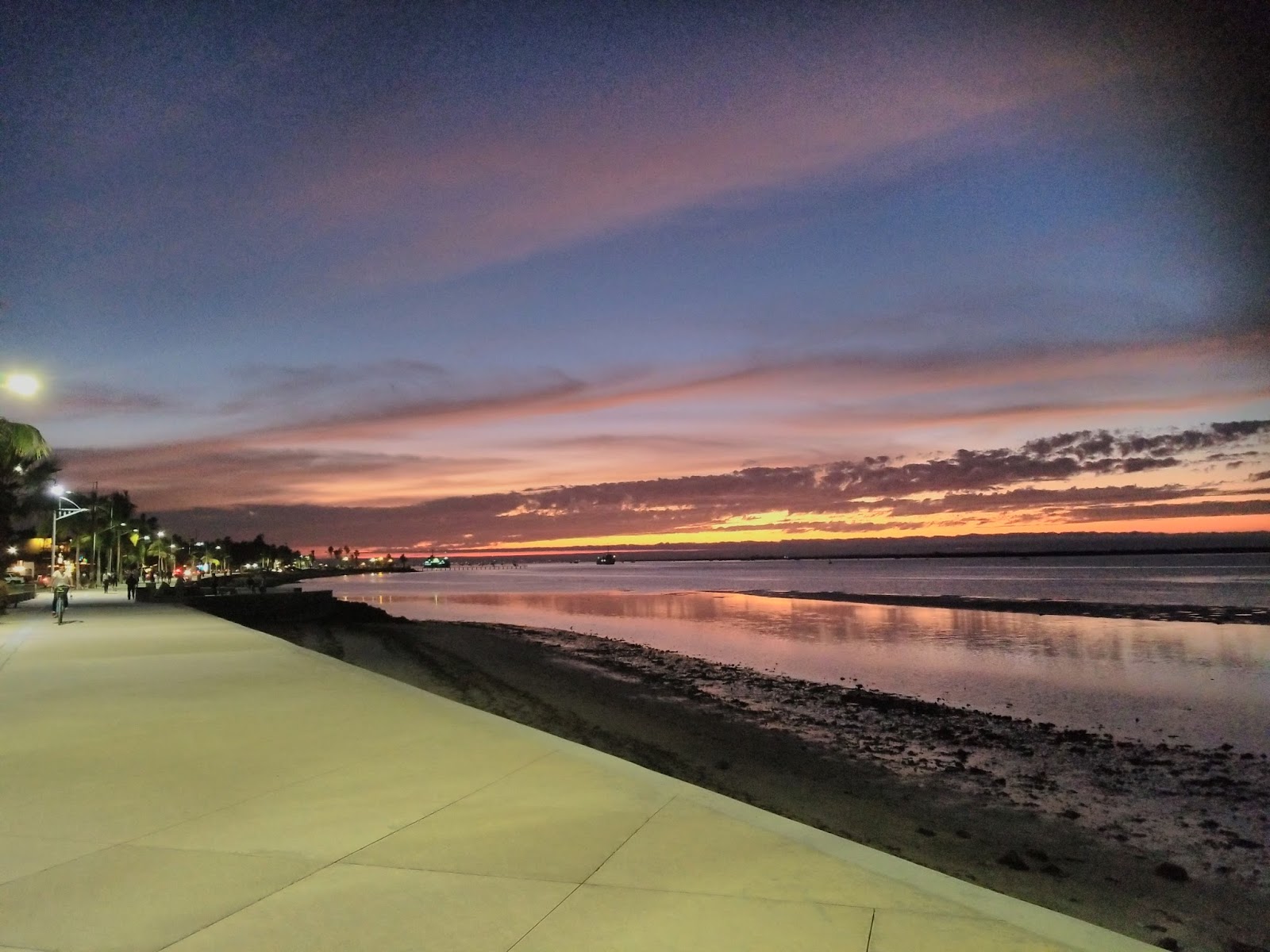
La Paz Malecon at Sunset
Having walked to the salon, I then had to walk back to the marina.  I meandered back through the town and then along the malecon.  It was full dark by the time I got back to the marina.  Neither of us was very hungry, so I made salad with some leftover arrachera that I found in the bottom of the refrigerator.
February 3, 2018

I got up early to shower and drink a cappuccino from the new restaurant while I worked on my blog.  My friend Carlos, who crewed for us on Fool’s Castle in 2013, was coming from Cabo to visit me that day and I wanted to get as much done as I could before he arrived.  After finishing my blog post, I returned to the boat and made breakfast.

Carlos showed up around noon.  He was hungry so, after we visited with Don for a bit, he and I headed off to find some lunch.  Carlos is a picky eater, so I let him choose.  Don stayed behind to repair the bilge pump without us underfoot.  Carlos chose a small birrieria and ordered lamb tacos.  For 150 pesos we got three sodas and more than the two of us could eat.  The meat was crispy and greasy and I hadn’t had lamb like that since I was in Turkey in 2000.  We sat and talked for a couple of hours, catching up on all that had gone on in our lives over the past couple of years.

Carlos had an inflatable stand-up paddleboard with a hole in it back in Cabo and wanted to look for something with which to patch it.  We started at Harker Boards on the malecon where they sell and rent paddleboards.  They referred us to Pingo Marine, on the main drag a few streets past the light after Marina La Paz.  He was locking up as we arrived, but told us that it was actually the owner’s brother who repairs paddleboards.  When Carlos told him the board was back in Cabo, he was kind enough to tell us where to buy the cement.  We headed inland to a small marine store a couple of doors down from a resins and plastics shop.  There, we purchased a tiny can of cement for $40.  This was apparently the same outrageously expensive cement used to repair Hypalon dinghies.

That mission accomplished, we returned to the boat where Don was finishing up his bilge pump repair.  The pump was fine, but a stray piece of metal had been fouling the float.  Don sewed a small bag out of plastic window screen to put around the float and prevent that from happening again.  The original metal screen had corroded away.  We sat and visited for another hour or so and then Carlos had to leave to drive back to Cabo before it got too late.  We said goodbye and vowed not to go so long before seeing each other again.

February 4, 2018

Fuel Dock at Marina Palmira
Once again, I got up early to work on my blog and drink cappuccino.  I stayed longer than I had
intended and, eventually, I received a text from Don asking me to check on the availability of the fuel dock.  There was no one there, but the office said they would send someone.  I went back to the boat and we headed over to fill the tanks before heading off across the Sea of Cortez the following day.

Restitching the Propane Cover
                                                                              Back at the slip, I made breakfast and spent the afternoon re-stitching the cover for the propane tank.  Sunbrella fabric lasts a very long time, but the stitching rots in the sun.  I was replacing the original cotton thread with a more durable Goretex thread.  It was Superbowl Sunday and we had reservations at the sports bar for 3:45.  We went up there and ordered margaritas and chips with guacamole.  The guacamole was bland, so we requested some hot sauce and jazzed it up.

The bar was busy, but not jammed.  The Eagles were playing the Patriots and it seemed like everyone was rooting for the Eagles.  I am not a football fan, so I worked on stitching the propane cover until it got too dark to see.  It was a close game with a number of spectacular plays.  During the second half, we ordered spinach salads for dinner.

The Eagles won after a tense fourth quarter and we returned to the boat to spend a quiet evening before retiring early.  We wanted to get up early to listen to the weather report before making the crossing.

February 5, 2018

Marina Palmira in the Rear View
I got up early to string the antenna in hopes of catching Geary’s weather report at 7:45.  I got the bright idea of raising the antenna on the spinnaker halyard.  It didn’t help us to hear the weather, but it pulled loose when I tried to bring it back down, leaving the spinnaker halyard two thirds of the way up to the spreaders.

Having got myself into this pickle, I figured it was my responsibility to correct the problem.  I climbed up onto the boom and flailed away at the halyard with the boat hook at full extension.  I could reach the shackle, but the hook was too large to pass through the eye and the halyard was over the shroud, creating too much drag to allow me to slide it down the mast easily.  Don came to the rescue and taped a gaff hook to the end of the boat pole, allowing me to snag the shackle and pull the halyard back down.  We remembered that we could get Geary’s report off the internet, so we listened to that and, assured that the weather would cooperate, pulled out of the marina and headed towards open water.

Proper Way Through La Paz Channel
The First Two Gates of the La Paz Channel
La Paz Channel Past Costa Baja
The beginning of the La Paz channel is very confusing and some navigation software will direct you across a shoal.  I spent the outward trip trying to take photographs to show the order in which the buoys should be taken.  Once clear of the channel, we followed the coast past Pichilingue, Caleta Lobos, and Balandra and then entered the Ceralvo Channel.  There was no wind and I made us an egg breakfast underway.  The water was glassy and the sky overcast.  It was difficult to tell where one ended and the other began.
Sky and Sea All Run Together When It's Calm

We got to the end of the Ceralvo Channel about sunset and headed for open water.  I made hot wings for dinner and then took the 7 to 11 watch.  There was no moon and it was very dark and lonely out there.  Don took over at 11:00 and I went below to sleep.
The Ceralvo Channel Late Afternoon


Febraury 6, 2018

I came back on deck at 3:00 AM.  I made some instant vanilla cappuccino and tried to listen to music, but discovered my playlist had not downloaded in La Paz.  I listened to a few podcasts to entertain myself. The moon had risen during Don’s watch and visibility had improved, but we saw no boats all night.

When morning came, it was discouraging to discover that we could still see land.  There was no wind, so we were motoring.  We were running the engine at the usual RPMs, but seemed to be going slowly.  We were barely making five knots.
Dawn on the Sea of Cortez

I was enjoying the sunrise and it wasn’t cold, so I let Don sleep until 8:15 when I started to fade.  He took over and I went below to sleep.  I got back up about 11:00, dressed, and ate a bowl of cereal.  Then I wrote until noon when I took the helm back from Don.  He had decided that something was wrong with the tachometer and that we were going slowly because we weren’t running the engine hard enough.  He had increased the RPMs from 2000 to 2500 and we were then motoring at about six knots.  There was still no wind.

A Relaxing Afternoon Watch
The afternoon watch was very relaxing.  There was no wind and we saw no other boats.  It was warm and pleasant out and I was able to put on shorts.  By that time, I was very tired of the same jeans and three long sleeved shirts that I had been wearing since Guaymas.  We were finally out of sight of land.  We reached the half way point that afternoon.  When Don took over at 4:00, I hung out and then made pork chops and potatoes for dinner.  I took a short nap before coming back on watch at 8:00.  Don had turned the stereo on and I enjoyed the music all throughout my shift.  There was still no wind and we were still alone out there.


February 7, 2018

Sunrise Over the Sea of Cortez
Don took the midnight to 4:00 AM watch and I made another instant cappuccino and came back up at 4:00.  Don had killed the stereo, so I listened to my iPod and watched a few fishing boats pass us in the distance.  I enjoyed another colorful sunrise.  We still didn’t have enough wind to sail.  Don took back over at 8:00 and I went below to sleep until just before noon.

I had another bowl of cereal and took the helm at noon.  Just after 1:00, Isla Isabela peeked over the horizon.  It grew steadily larger as we approached.  Twenty knots of wind had been predicted for Wednesday afternoon, but we didn’t have enough to sail until we were approaching the island and would have needed to douse the sails, anyway.  It never got much about 10 knots.

Approaching Isla Isabela

We motored around to the south side of the island and anchored in the rocky cove that contained a small fish camp.  It seemed more protected than the open roadstead in the lee of the Monjas, two jagged pinnacles of rock just offshore, where the other anchorage was located.  Our cruising guide mentioned that the anchorage was rocky and suggested putting a line with a float on our anchor in case we needed to dislodge it later.  We did this and anchored close to the rock wall of the cove.  By 4:00, we were riding comfortably.  It was too late to risk getting wet in the dinghy, so we opened a bottle of Baja zinfandel and had cheese and crackers in the cockpit.  It seemed very civilized.  As the sun dipped below the horizon, I served chicken thighs with black beans and salad.  It was good to have the crossing behind us.
A Little Bit of Civilization
February 8, 2018


Fish Camp and Anchorage at Isla Isabela
Isla Isabela is a rookery for blue-footed boobies and frigate birds.  The squawking began as soon as it got light.  Frigate birds have curiously angular wings and look like pteradactyls when they fly.  Hundreds of them wheeling overhead gave the place a prehistoric feeling.  Isabela is a volcanic island and seemed a world away from the desert islands of the Sea of Cortez.  It was rocky and thickly forested with stunted avocado trees.  A caldera graced the center of the old volcano.

Las Monjas
After a quick breakfast of fried eggs and tortillas, we put the dinghy in the water and motored out of the cove and around to the other anchorage where we met Witte Raaf, a Dutch boat whose owners we had met in Conception Bay two years before.  We chatted with them briefly and then set off through the surf to land the dinghy on the beach.  The beach was steep, which made it easy to motor almost up to shore before goosing it, tilting up the motor, and riding the swell onto the beach.

The beach itself was made of wave tossed bits of coral interspersed with rounded volcanic pebbles.  They were a bit large to be comfortable once inside your shoes, but we didn’t have far to haul the dinghy before we could take off our sandals and put on proper hiking shoes.
Beach of Coral Fragments
The boobies were nesting just above the high-water mark on the beach.  We had to pick our way between the nests to get to the beginning of the trail to the caldera.  A booby nest is just a depression in the sand.  The only delimiter is a ring of guano.  Most of the nests had eggs.  We only saw a couple of fluffy white chicks.  The boobies glared at us with their intense, curiously forward-facing eyes.  Both sexes look alike.  You can only tell them apart by their voices.  The males whistle at you, but the females squawk.  There was a camp of researchers at the end of the beach and we chatted with them for awhile.  They assured us that the colony was quite healthy.

Boobies Were Nesting Everywhere
They Even Nested in the Path
Baby Booby


Healthy Boobies Have Very Blue Feet

Boobies Look Right at You
Male Frigate Birds Puff  Out Their Throats
The frigate birds nested in the avocado trees that covered the island.  Frigate birds do not build elaborate nests.  In fact, they weren’t big enough to hold the adult birds.  We saw a few nests of chicks and observed several males with their red throats puffed out like goiters.  The noise was constant.  As we walked through the jungle, it sounded like the soundtrack for a creepy movie.  I half expected to see King Kong. Isla Isabela is known as the Galapagos of Mexico because of its abundant and fearless wildlife.  Iguanas are almost as numerous as the birds.
Nest with Frigate Chick
Iguanas Were Also Abundant


Path Through the Jungle


We hiked up the hill and down to the shore of the caldera which was filled with greenish looking fresh water.  We skirted along the bank, past the trail that went to the north side of the island, and then climbed up to the rim of the caldera on the other side.  From there, we could see the fish camp near where we had anchored.  We didn’t walk down, figuring it would be easier to go there by dinghy.

Launching the dinghy through the surf can be difficult.  We didn’t do badly, but got our shorts pretty wet as we stood up to our thighs, waiting for a lull in the waves.  We motored back around to our cove, but never did get to
shore by the fish camp.  We stopped at the boat
The Caldera on Isla Isabela
for a beer and then didn’t feel like getting wet again.  We relaxed and tried to calculate our best option for getting to La Cruz without running out of fuel.  I made tostadas for dinner and we went to bed early, hoping to leave at first light for Punta Mita where we hoped to arrive before dark.


February 9, 2018

Morning at Isla Isabela
I got up at 6:00, but it was still completely dark.  I didn’t bother waking Don until it started to get light.  We drank coffee and got ready to pull up the anchor as soon as we could see.  Our anchor chain was wrapped around a huge rock and did not pull free as we took it in.  Just as we reached the point where the boat was directly above the sticking point and the chain was tight, a rogue swell came through.  The bow went down and the stern went up until it felt like we were going to pitch pole.  Then the swell passed under the boat and tried to lift the bow.  Don’s extremely beefy anchor roller bent like rubber, twisted to the side, shearing off the bolts, and pulled right out of the bow.

The Roller Ripped Out of the Bow

Once we calmed down, we decided to try pulling up the anchor from the line attached to the float.  We retrieved the float and put the line on the winch.  I ground the 2500 pound test line in until it snapped, but didn’t budge the anchor.  We put a weight on the float and dropped it back down to mark the location of the anchor.  Don dove in and tried to see which way to unwrap the chain, but the water was too deep to see anything.  We had stowed the dinghy on deck, so we had to launch it again.  Don attached a line to the chain and tried for an hour and a half to unwrap it from the rock, without success.

About that time, two pangas full of fishermen arrived to help.  The first panga took our line and tried to pull the chain free with his 50 hp outboard, but still couldn’t move it.  Fortunately, the second panga had a compressor and an air hose and one of the guys dove on our anchor and managed to unwrap our chain.  We recovered the anchor, chain, and mangled anchor roller.  We gave them 1000 pesos for their trouble and thanked them profusely.  I can’t count the number of times my friends and I have been rescued by fishermen in pangas.  Please, cruisers out there, be kind to pangueros.  They are skilled seamen and we want them to continue being there for us. 

It was 11:00 by the time we finally got our dinghy stowed again and headed out to sea.  Our plan to arrive in Punta Mita before dark went out the window.  We contemplated stopping at Matanchen Bay, but were afraid we didn’t have enough fuel.  We decided to make straight for Punta Mita, figuring we had been there enough times to navigate the anchorage in the dark.
Comet's Main Sail

We hoped to sail and save fuel, but there was not enough wind.  We put the main up anyway, hoping to get at least a bit of assistance.  We ate the last of our cereal for breakfast around noon and continued, alternating watches, throughout the afternoon and evening.  I didn’t feel like cooking underway, so we had instant noodles for dinner, knowing real food awaited us in La Cruz.

It was dark and moonless as we approached Punta Mita.  Distances were deceiving and we looked and looked for the lights on Punta Mita and the Marietas.  Eventually, the two lights on the Marietas hove into view, but the light on Punta Mita appeared to be out.  We stayed well offshore as we rounded the point and then motored into the anchorage, dropping the hook in 30 feet of water as soon as we started to encounter boats.  It was too dark to go motoring through the crowded anchorage.  We came to rest just before midnight.

February 10, 2018

The Anchorage at Punta Mita
We awoke to a nice, calm morning in Punta Mita.  We didn’t have far to go, so were in no hurry.  We drank coffee and I made pancakes.  Around noon, we motored out of the anchorage and headed for La Cruz, arriving at the marina by mid-afternoon.  The office was closed for the day, but Porfirio from Security welcomed us and gave Don a key.  We put the boat away and I finished packing.  Then we headed up to the restrooms for much anticipated showers.

I was sad to leave Comet and sorry to be at least temporarily done with cruising, but I was excited to move into the house where I had rented a room.  By 5:00, we loaded all my bags into a dock cart and I hailed a taxi to take me the mile or so across town to the house where I was renting a room from my friend, Cherie.  The house was on a funky dirt road in a quiet part of town.  The house was attractive, if somewhat sparsely furnished, and perfectly adequate.  There were hot water, good internet, and hammocks.  I was happy.


Sunday, February 4, 2018

PUERTO LOS GATOS TO LA PAZ – THE (SECOND) BIG BLOW

January 25, 2018

Puerto Los Gatos in the Morning
We were still alone in the anchorage when I awoke just after dawn.  I got up, made coffee, and sat in the early morning sun, enjoying the lack of cold wind. When I got dressed, I put on shorts for the first time in a week.  Don got up and went for a swim and then we ate bacon and eggs.  Mexican bacon is so paper thin that it is more like the idea of bacon than actual food.  It still smells great, cooking, though.

Shortly after breakfast, we hauled up the anchor and motored out towards the San Jose Channel.  There was almost no wind and we didn’t even bother putting up the main.  We kept an eye out for blue whales, which are

rumored to play nearby, but saw nothing.  The seas were flat.  It occurred to me how remarkably free of trash the Sea of Cortez was.  We almost never saw anything, natural or unnatural, floating in the water except the occasional patch of orange algae.  This was in stark contrast to Central America where the fisherman regularly tossed their oil bottles overboard to litter the water and beaches.

Nopolo
All day we motored south.  We passed the tiny fishing village of Nopolo on the mainland, where a cluster of small houses cling to a narrow beach, accessible even from other parts of the village by boat alone.  Mangle Solo and Punta Salinas on Isla San Jose beckoned, but we continued on towards San Evaristo.  The last hour of our trip, we spent fiddling with the jib furler, trying to get the jib to take an extra couple of turns.  I pulled the jib out and Don rolled it up.  We must have done it six times.  Anyone watching us must have wondered what the heck we were doing. 


We pulled into the usually busy anchorage of San Evaristo at 5:00, to find a single other cruising boat tucked up into the northern lobe of the bay.  We anchored in Don’s usual spot in front of the desalinization plant.  It was pleasant out, but we lacked the motivation to go ashore for dinner,  We had a cocktail to celebrate our arrival and then I made chicken in green mole over rice for dinner and we spent the evening reading and listening to music.
San Evaristo in the Morning

January 26, 2018

I was awakened long before dawn by the Port Captain in La Paz on the radio saying, “Buenos dias, gente del mar.  Que buen dia!”  This translates to, “Good morning, people of the sea.  What a great day!”  I wasn’t sure how he could tell because it was pitch black outside, but I appreciated his sentiments and the fact that he came in loud and clear and spoke intelligible Spanish, something not common on marine radio in Mexico.

San Evaristo from Above
I didn’t get up at that point, but did get up at 7:30.  It was completely still and the water was glassy.  I made coffee and sat in the sun in the cockpit, watching the wildlife.  Tuna were hunting in the bay and schools of smaller fish were leaping out of the water, trying to avoid them.  The pelicans were having a field day and were splashing noisily all around me.  Eventually the sun got hot and I dove into the water for a swim, managing two laps around the boat in the chilly water.  With no wind, it was pleasant to sit in the sun, drying off, and I finished my coffee sitting on the cabin top, wrapped in a towel.

The Beach on the Other Side of the Hill
I made French toast once Don got up and thought we might get an early start, but we lacked enthusiasm.  It was very pleasant.  We decided to stay another night.  We took the dinghy to shore, walked over the hill to gaze at the beach on the other side, and ate an early dinner at Lupe Sierra’s and Maggie Mae, the little restaurant that caters to cruisers.  First, we tried to sit out back where it was sheltered from the wind, but it quickly grew too hot.  We moved to the front where it was windy, but almost pleasant.  We ate shrimp quesadillas and drank a couple of beers.  There was nothing pressing and we took our time.


Arch on the Other Side of the Hill
San Evaristo has very poor cell coverage, but there is a sweet spot in front of the mini-super on the north end of town.  People gather on the porch of the store or stand out front to use their phones.  We stopped to update our weather information and collect messages.  Then we had to face the windy dinghy ride back to Comet.  It wasn’t as bad as I had feared.  There was wind, but our proximity to the north end of the bay limited the size of the waves and we made it back with nothing worse than chilled lower extremities from wading into the chilly water while launching the dinghy.  Don had this down to a science.  I had only to hop on the bow to raise the motor clear of the bottom and we were on our way.

We passed a quiet evening aboard, mostly reading.  The wind grew stronger and stronger and the boat grew noisy.  Soon we had gusts to 27 knots.  The anchor snubber would ride up the side of the anchor roller and then snap back down to the middle with a loud bang.  We kept getting up to secure halyards, the boarding ladder, and bits of the kayak.  A single hander in a Cal 20 was anchored near us and his halyard was banging.  I grumpily imagined him being too drunk to bother to fix it.

January 27-29, 2018

The Menu at Lupe Sierra and Maggie Mae's
Being stuck at anchor while waiting for a weather window is an exercise in avoiding boredom.  We awoke early, hoping the wind would have died down enough to leave and then, after ascertaining that it was still much to rough out there to leave, were faced with even more time to fill.  We read books and did little chores about the boat.  I cooked breakfasts and made guacamole.  Saturday night, we went ashore for dinner.  Our supplies were running low and we were attempting to stretch our provisions.  After dinner, we walked back to the store on the other end of town.  We had bought beer and cookies from the Sierras, but still needed eggs and tortillas.  We got eggs, but there were no tortillas to be had.  After checking our messages, we headed back to the boat and spent another quiet evening.

Gulls on the Beach at San Evaristo
We didn’t leave the boat at all on Sunday.  It was quite windy all day.  Don repaired a few things around the boat.  I practiced the guitar and read.  We were both more than ready to be underway, but the weather forecast was for two more days of wind.  Our hopes of being in La Cruz in time for Superbowl dwindled.  My computer was the one item that I could not charge with 12-volt power.  I had work to do, but didn’t dare use up my battery before we got to La Paz.
Sunrise in San Evaristo

Monday was windy again. We were sick of the constant howling.  I started another book, but couldn’t bear another day of reading.  I restitched the hatch cover instead.  That took most of the afternoon and evening.  Once again, we never left the boat.  I scratched together a pasta dish from a jar of tomato sauce and whatever was left in the refrigerator.  We used our last lime and bit of the rum.  We decided to leave the following morning, wind or not.


January 30, 2018

Single Sideband Receiver
I got up early to string the SSB receiver antenna so as to catch Gary’s weather report at 7:45. It was somewhat less windy when I got up.  Gary predicted wind in the mid-teens all day. That sounded good to us.  We rigged the boat and left before breakfast.  The swells weren’t too bad at first, but the wind soon picked up to 20 knots or so.  Soon, we shut off the motor and continued under sail alone.  We were doing better than 6 knots most of the time.


We passed Isla San Francisco and I made oatmeal.  The large passenger ship that we kept seeing was anchored at Isla San Francisco.  We continued on towards Isla Partida.  The swells grew larger and larger.  The boat was rolling quite a bit, but we stayed dry and the wind went east after we passed Isla San Francisco.  We made good time.  The day grew cloudier and cloudier.  It wasn’t really cold, but neither was it warm.  Even Don put on long sleeves.


Don Crossing to Isla Partida
The last 12 miles went very fast.  We passed Los Islotes, when people swim with sea lions in warmer weather, and skated down the coast of Isla Partida and then across to Espiritu Santo.  The anchorages looked like fjiords, although we couldn’t imagine there having ever been glaciers there.  The mountains were striated and the rocks colorful.  Finally, we slipped between Isla Gallo and Espiritu Santo and into Ensenada Gallo.  Isla Gallo was so covered with Guano that it looked like it was dusted with snow.

Ensenada Gallo is large and mostly surrounded by red cliffs dotted with caves.  We anchored in 20 feet of water near the northern wall.  The anchorage would have been just as good in a
Cliffs at Ensenada Gallo
southern wind if we had moved to the other side.  It was very quiet in there.  For the first time in almost a week, we couldn’t hear the wind.

Sunset from Ensenada Gallo

I cooked the last of our meat, some delicious arrachera, for dinner with fried plantains and the last of our salad fixings.  After dinner, we sat in the cockpit, drinking tequila and pineapple juice, since that was all we had, and listening to music.  The moon was almost full and we could see the cliffs clearly. It was still and pleasant.  It seemed a shame to go below to catch up on my writing.

January 31, 2018

Tattered Mexican Courtesy Flag
It was dead calm when we awoke in Ensenada Gallo. If it had been sunny, it would have been a perfect morning for swimming or paddle boarding.  Unfortunately, it was overcast and a bit chilly.  We listened to Gary’s weather report and then I made a quick breakfast, which we downed before leaving.  By 8:30, we were hauling up the anchor and motoring out of the anchorage.  Our poor Mexican flag was looking worse for wear after all the wind it had suffered over the previous ten days.

Anchorage at Ensenada Gallo
We motored around behind Islas Gallo and Gallina and then continued down the coast of Espiritu Santo towards La Paz, pondering what geological events had created the fjord-like bays.  It was strange to look into the distance and see large man-made structures after so much time in remote places.  By mid-afternoon there was still no wind and we continued motoring past familiar anchorages near La Paz where we stopped a couple of years before when arriving in La Paz from the opposite direction.

Looking Towards Islas Gallina and Gallo
The channel into La Paz is tricky and threads between shoals.  The corner where Marina Costa Baja is located is especially hard to navigate, as there are many buoys and it is hard to tell in which order they should be taken.  Navionics was trying to steer us directly into the shoal and even the first red buoy was in very shallow water.  The best course is to stay to the left past Berkovich's boatyatrd, as if you were going to enter Costa Baja, and then make a last minute turn to starboard.
The Entrance to the La Paz Channel

Berkovich's Boatyard
We arrived at Marina Palmira about 3:00.  We found the marina clean and well-maintained, but rather deserted as many boats had taken advantage of the calm weather to depart.  We took a shower and then relaxed at the sports bar with margaritas.  Don wanted to stay in La Paz long enough to see the Superbowl, so we made reservations to watch it there in the sports bar.  We thought about eating dinner there, but the place was deserted.  We decided to walk up the road to El Molinito where things were somewhat livelier.  Don had the combination brochetta and I had some tasty fish tacos.  

Walking back along the malecon after dark was especially pleasant, as we could see the lights of La Paz in the distance.  The La Paz malecon stretches for two and a half miles from Marina La Paz to Marina Palmira.  It is dotted with interesting sculptures and benches for contemplating the harbor.  At night, it is reasonably well lit and busy with walkers and joggers.  The marina was peaceful and we passed a quiet evening aboard.

Saturday, February 3, 2018

PUERTO ESCONDIDO TO PUERTO LOS GATOS – THE (FIRST) BIG BLOW


January 20, 2018

Puerto Escondido in the Morning
We awoke to a beautiful, warm morning and sat in the cockpit for a couple of hours, drinking coffee and enjoying the sun, before I made eggs and tortillas for breakfast.  Winds were light and the seas flat, so we decided it was the perfect time to inaugurate the stand-up paddleboard.  Don attached the fin and leash and then I took it for a little spin around the neighboring boats.  Flat as it was, I managed to complete my tour without falling in.  Don, who was a complete novice at SUPs, was not so fortunate, but he persevered and started to get the hang of it.

Don on the SUP

The radio net had advertised a farmers’ market in the parking lot so, after Don got warm and dry again, we loaded my laundry in the dinghy and headed for shore.  Don made me drive, since I have an aversion to outboard motors, but it went fine until we got to the dock and had a bit of trouble finding a place to tie up.  The marina workers had part of the dock deconstructed and other cruisers had tied their dinghies with short tethers.  Eventually, the workers took pity on us and offered us a clear spot further down the dock.

The new docks at Puerto Escondido are interesting in that they have no pilings.  Instead, they are tethered to massive blocks of concrete with giant bungee cords that allow them to move up and down.  We later talked to some people who had been there in 58 knot winds.  They said that cleats were pulling out of the docks and it was a mess.  They held fine in the high winds we would see the next day.

The farmers’ market turned out to be one guy with an SUV full of goat cheese and kale.  We bought some goat cheese.  I needed to do some laundry, so repaired to the laundry room to wait for a washer while Don sat out at one of the tables in front of the marina to use the WiFi.  I quickly nabbed a washer and started the laundry.  My computer needed charging and there was fortunately a free electrical outlet.  I managed to upload photos from my phone but, unfortunately, there was no WiFi signal in the laundry room, so I was unable to work on posting my blog.  Instead, I spent the time chatting with other cruisers, catching up on gossip about Marina Chiapas, and learning about South Africa where I would be heading in the late spring.

Laundry finally completed, I rendezvoused with Don.  The wind was starting to pick up a little bit.  I went to the new marina market and did my best to provision.  They had a reasonable selection of produce, but nothing in the was of fresh meat except bacon and some lunchmeat.  I did my best to fill our larder from the limited selection, resorting to canned goods clearly purchased from Costco.  Knowing we might be trapped in the boat for the next few days while the wind blew, I cleaned out their supply of Diet Coke and Don bought a bottle of rum. 

By this time, the sun had dipped below the mountains and the wind was rising.  It was chilly.  Still, we decided to conserve our limited supply of fresh food and have burgers ashore before heading back to the boat.  The cheeseburgers at Pepegina’s were excellent, but we didn’t linger any longer than necessary.  We had a long, cold dinghy ride ahead of us.  While it was windy, the seas weren’t too terrible and we managed to get back to the boat without getting my laundry wet.  It wasn’t blowing more than 15 knots at the time, but the wind was expected to come up in the night. Don fastened everything securely in anticipation.

We sat in the cockpit, sipping drinks and admiring the stars, until it got too cold for my tastes and I ducked below.  I tried to read, but ended up taking a pre-bed nap on the settee before finally retiring about midnight.

January 21, 2018

The norther hit at 2:00 AM, just as predicted.  I woke up, checked the wind speed, decided it wasn’t serious, and went back to sleep.  At 6:00, something was thumping, so I went on deck to try to quiet it.  I couldn’t find the problem and decided it was something to do with the mooring lines, so returned to my warm bed.

Windy Afternoon in Puerto Escondido
I was awakened by the radio net at 8:00 but, having nothing pressing to do, stayed in my bunk, reading, until Don got up at 9:00.  We passed the entire morning sipping coffee and eventually eating some oatmeal (I had forgotten to buy eggs.)  It was windy, but not too cold behind the dodger.  

Gradually, the windspeeds increased until gusts reached 30 knots.  The predictions were not for more than the low 20s, so we hoped this wind event would blow itself out as the afternoon progressed and we saw wind speeds climb to 38 knots.  The harbor was full of white caps and boats curvetted about their moorings, but the seas stayed fairly small due to the depth and lack of fetch in the caldera.

The wind increased as the day progressed, finally topping out at 38 knots.  We stayed in the boat all afternoon, reading.  When dinnertime rolled around, I made pasta from all the things left in our fridge, including bacon, goat cheese, and vegetables.  The wind was still howling when we went to bed, but we slept comfortably enough.

January 22, 2018

Sunrise in Puerto Escondido
We both woke up at 3:30 AM when the wind increased, but there was no serious problem and we went back to sleep.  I turned on the radio to listen to the net at 8:00, but there seemed no reason to get up since we were unlikely to go anywhere. We didn’t get up until after 9:00.  We were out of eggs and almost out of oatmeal, so I made grilled cheese and bacon sandwiches for breakfast.

The wind wasn’t too strong in the morning, so we decided to take the dinghy to shore for showers, water, and internet.  It was probably half a mile from our mooring to the dinghy dock.  We got there without getting wet, even though I was wearing long pants and shoes.  We filled the water bottle and then took showers.  The WiFi wasn’t working outside, so we spent the afternoon in the marina office, using the internet.  I uploaded photos for a blog post, which took hours.


By the time we finished with the internet and bought a few groceries it was nearly 4:30. The wind had grown much stronger and the basin was filled with whitecaps.  We still had to cross the entire mooring field to get back to Comet.  We knew it would be a wet ride, so I exchanged my jeans for a pair of shorts and put on my waterproof jacket.

It was a wild ride.  While no waves broke over the bow of the dinghy, splashes were constant.  We were drenched and water was sloshing around in the bottom of the dinghy.  My backpack was waterproof, so my belongings stayed dry.  Don’s pack got soaked.  His iPad, despite being in a water-resistant case, got wet.  It stopped working.  Don put it in a bag of rice and hoped for the best, but it was beyond salvaging.

The wind continued to howl.  We dried out and warmed up.  I heated up cans of chili for dinner, which we ate with crackers and goat cheese.  We spent the evening listening to podcasts.  At least one more day of wind was anticipated before we could move on.

January 23, 2018

Our Mooring in Puerto Escondido
Tuesday morning was windy and we made no attempt to leave the boat all day, having learned our lesson on the previous day’s dinghy ride.  I got up early and tried to get Gary’s weather report on the SSB receiver, but couldn’t make out his words through the static.  I stayed up, listened to the net, drank coffee and lounged until Don got up.  Then I made pancakes.

There was nothing much to do, so I occupied myself by dusting and scrubbing the galley floor.  We did a lot of reading and, after a dinner of tostadas, spent the evening listening to podcasts.  We were more than ready to get moving again and decided that the following day’s wind forecast didn’t preclude our departure.  We were, after all, a sailboat and sailboats need wind.

January 24, 2018

Electrical Improvements for New Marina in Puerto Escondido
A large passenger ship hailing another vessel on channel 16 woke me at 6:50.  I got up and started the water for coffee.  Don got up in time to listen to Gary’s weather report at 7:45, which was audible after he strung an antenna half the length of the boat.  The wind was predicted to be 16 to 19 knots, but lighter as we went south.  We decided to go for it.  About 8:30, we dropped the mooring ball and motored over to the fuel dock to take on water.  We offloaded our garbage and visited the store for last minute supplies.  Carmen, the proprietress, had just added a freezer, so we were able to buy enough meat to see us as far as La Paz.  By 9:45, we pulled away from the dock and headed out of Puerto Escondido.

Fast Sailing on a Windy Day
The seas were small in the morning, but the wind was constant and they did build as the day went on.  We saw winds as high as 20 knots, but nothing serious.  We made good time.  We contemplated stopping at Agua Verde, but decided to pass it by, since it was only 1:00 when we passed it.  This was somewhat disappointing, since Agua Verde is my favorite anchorage, but we wanted to get to La Paz before the high winds started again on Saturday.


Misty Mountains Near Punta San Telmo
We had a nice sail and reached speeds of up to 8 knots, even with a reefed main.  We contemplated stopping at Punta San Telmo, but ultimately decided to continue another couple of miles to Puerto Los Gatos.  We arrived at 5:00, just in time for happy hour.  While it had been warm enough to sail in shorts earlier in the day, I had all my layers on again by the time we dropped anchor.  I declined a beer and had a shot of tequila instead.  Thus fortified, I washed the breakfast dishes and then made steak, salad, and mashed yams for dinner. We were alone in the anchorage, so felt free to enjoy our music.

Pulling into Puerto Los Gatos

Thursday, February 1, 2018

GUAYMAS TO PUERTO ESCONDIDO – WINTER IN THE SEA


January 14 and 15, 2018

We didn’t have a lot to do to get ready to go, so we took our time on Sunday morning.  Don changed the oil and, since he had to remove the companionway to access the engine, I was trapped outside.  I puttered around the deck, lashing down the fuel cans and kayak and rinsing the last of the yard dust from the bimini side curtains.

After noon, we went out to buy water and last-minute grocery items.  We were unable to obtain any additional five gallon bottles from the water stores and didn’t want to buy one that we couldn’t return, so Don made a few trips to fill the water tank while I took off the sail covers and made ready to leave.  We ate an early dinner at the Dougout, a baseball themed seafood restaurant, where Don got fish tacos and I had shrimp ceviche and an oyster taco that was delicious.  We swathed Don’s SUV in its cover and left it in the parking lot of the Fonatur marina in Guaymas for the summer.

At 6:15, we cast off the docklines and, as our dock neighbors commented, “sailed into the sunset.”  Guaymas is deep into a bay and it was full dark before we reached open water.  We threaded our way between the red and green buoys and dodged the fishing boats working the banks just out side the bay.  It was a clear night and the lights of Guaymas twinkled prettily behind us as we sailed out into the moonless night.

Don took the 8:00 to midnight watch and I tried to sleep.  We soon had 15 knots of wind and the waves were big enough to make it hard to stay in my bunk on the uphill side.  I dozed a bit, but mostly just lay there and tried not to bang any body parts against hard surfaces.  When I came up at midnight, we were thirty miles offshore and it was dark enough that we could see myriad stars.  I was wearing just about every bit of clothing I had brought and just managed to stay warm.  For a couple of hours, the wind was gusting to 20 knots and then it calmed back down to 12 to 15.  It was gorgeous and we didn’t see another boat all night.

Caleta San Juanico
I was definitely ready to crawl back into my sleeping bag by 4:00.  I moved out to the low side off the settee and slept well until 8:00 AM when I got up, made a cup of cocoa, and resumed my station so Don could sleep.  We were then back in sight of land, although still 15 miles or so from our destination.  It was clear, but still cold.  The waves had calmed down, making the ride more comfortable.  As we approached the coast, we saw a few boats leaving Caleta San Juanico, where we were headed, and one boat arriving from the south that followed us into the anchorage.  We dropped the hook in 12 feet of water to the left of the big rock that divides the anchorage and had everything tidied by noon.
Comet at Anchor in San Juanico
It was too early for a celebratory beer, so Don made coffee and then I made French toast.  The wind dropped and the sun was warm.  Don spent the afternoon reading while I slept until 5:00 when I started to get chilly.  I got up in time for a beer and chips with salsa.  Thus fortified, I made salad, broccoli and arrachera for dinner.  We were going to barbecue the meat, but discovered the propane hose for the barbecue was cracked and leaking.  I cut the meat into strips and sautéed it instead.  The meat was exceptionally tender and we devoured all of it before settling down for a pleasant evening of listening to music and, in my case, writing.

January 16, 2018

It was cold when I woke up.  I pulled the blanket over my head and went back to sleep.  Sleeping with the hatch open seemed like a good idea when I was gazing at the brilliant stars the night before, but kept me in my bunk until nearly 9:00.  Don finally got up and started the water for coffee and I guiltily arose and tried to redeem myself by making breakfast.  The sun was warm in the cockpit and there was little breeze.  I put on shorts and dared to dream of a shower and possibly even a brief swim.

Refurbished Comet Shell
After breakfast, we put the dinghy in the water and took a spin around the anchorage so Don could see how his new outboard worked on the dinghy.  We went ashore at the cruisers’ shrine and took the shell emblazoned with Comet’s logo back with us to be refurbished.  From there, we ventured out around the sawtooth rocks bordering one side of the anchorage and then headed across towards the far shore.  Unfortunately, a cold north wind blew up about this time and the waves built quickly until our ride was bumpy and wet.  We abandoned the idea of visiting the opposite shore and made a beeline for the boat.

We had originally planned to go ashore for a walk, but neither of us really wanted to get any wetter.  We spent the afternoon lounging around the boat.  Don puttered around the deck and I practiced the guitar and tried to get warm again, finally resorting to making a cup of hot coffee and putting on warm clothes just before the wind dropped in the late afternoon.

Sunset at San Juanico
Dinner was boiled potatoes and pork chops with salad.  We spent the evening listening to podcasts and music. The water sparkled with phosphorescence like stars on the water.  We could see fish, large and small, leaving glowing trails through the water.  It was cold, but beautiful.  Once again, I couldn’t bear to shut out the starry night by shutting the hatch.  I just added a heavier blanket.
Don on the Beach at San Juanico

January 17, 2018

We got up in time to listen to Gary’s weather report on the morning net.  Don had purchased a single sideband receiver so that we could listen in.  He predicted winds from the northwest in the mid-teens and that sounded good to us.  Since our bananas were overripe, I made banana pancakes for breakfast and then we took the dinghy to shore to return our refurbished Comet ornament to the cruisers’ shrine. We landed on the beach nearest the boat and then walked along the shore to the little tree where cruisers leave their marks.
Cruisers' Shrine in San Juanico

We pulled up the anchor at 11:30 and headed out of the anchorage.  We raised the mainsail and motor-sailed in order to charge the batteries.  The wind was blowing, but the sea was unusually flat.  It got windier and windier.  When the wind reached 25 knots, we reefed the main and shut down the engine.  We were doing over eight knots with a reefed main and no jib.  We charged across the strait between the mainland and Isla Coronados.  The wind eventually dropped to about 15 knots and, after I put on long pants and a couple of extra layers, we had a comfortable sail to Puerto Balandra.

Tigger Anchored at Puerto Ballandra
Balandra is a small bay, well protected from a north wind.  There were three boats there already.  The bay is deep and then rises steeply to the beach.  We finally dropped the anchor in 28 feet of water at 4:15. The wind howled through the rigging, but we rode comfortably.  We had a beer and I made guacamole and chips.  Dinner was tostadas because the chicken I had planned to cook for dinner had failed to thaw.  We had data service for the first time in days, so Don downloaded some podcasts and we listened to them after dinner.

January 18, 2019

It was warm and calm in Balandra in the morning.  We drank coffee in the cockpit and then Don made oatmeal for breakfast.  After breakfast, we threw the kayak in the water and I kayaked to shore and then over a small bar and up into a small estuary that reached into Isla Carmen.  It was quite green along the waterway and I saw great blue herons and egrets, as well as gulls who squawked in irritation as I approached the beach.  I kayaked up the estuary until it ended in a mud flat and then turned around and drifted back down to the bay.
Mouth of the Estuary at Balandra

Don was in the water when I returned and I decided that a rinse was worth the possibility of freezing and took a quick swim, myself.  Don then took the kayak out for a bit while I practiced the guitar for an hour.  We spent a lazy afternoon reading and dozing. 

Dinner was chicken adobo over rice, which was filling and satisfying and we lounged and listened to podcasts for a couple of hours before Don did the dishes and then, getting a second wind, we stayed up talking until nearly midnight.

January 19, 2018

Glassy Crossing to Puerto Escondido
It was even warmer our second morning in Balandra. I got up and made coffee about 8:00 and basked in the sun for half an hour before Don got up.  We had eggs and beans for breakfast and then secured the kayak and got ready to head out.  We left about 11:00 and headed across the strait to Puerto Escondido.  It was very warm and there was little wind.  The sea looked glassy.  We didn’t even bother putting up the sail.  It was warm enough that I made it the whole way in a tank top.

Looking Out Through the "Windows" at Puerto Escondido
Puerto Escondido is located in a volcanic caldera at sea level.  No matter how well I know that one can't sail uphill, I always feel like we are higher than the level outside.  We motored to the south end where the entrance is located.  There were many boats anchored or attached to mooring balls in the “waiting room”, a cove just outside the caldera.  Only one boat was moored inside the ellipse, a small basin just outside the entrance.  When we were in Puerto Escondido two years before, there was a rumor that the ellipse was going to become a marina, but nothing there had changed.


The former Fonatur facility, however, had seen a lot of changes.  New docks had been installed with some slips and a long dock for side tying. There were mooring balls in the basin enclosed by the dock, but it was unclear whether they were intended to be used for Med mooring or fore and aft mooring in the center.  None were occupied.  We continued past the marina and picked up a ball in the mooring field in the caldera.  It was emptier than it had been later in the season, but probably 60% of the moorings were occupied with boats either stored there or occupied.

We drank a beer to celebrate our arrival and I was happy to finally be warm enough to drink a beer in shorts and a tank top.  Then we took the long dinghy ride to the marina office to pay for our mooring and take much needed showers.  The showers had been renovated since our last visit and were very modern and attractive, but completely devoid of hooks or benches on which to put one’s clothes.  Each shower stall had its own sink and everything had to be piled there.
Pepegina's Restaurant at Puerto Escondido

After our showers, we repaired to the new bar/restaurant on the second level where we had margaritas, salad and pizza for dinner.  The food was good and reasonable, but the margaritas were a bit pricey, although not short on tequila.  We sat there, using the Wifi (also upgraded), until it started to cool off and we made a beeline back to the shelter of Comet where we settled down to listen to music and write.


Monday, January 22, 2018

RETURN TO THE CRUISING LIFE – GUAYMAS 2018

January 7 – 10, 2018

My New Kitchen
Having finished my TESOL (Teaching English to Speakers of Other Languages) certificate program and kitchen remodel just before Christmas, I was finally free to go sailing, once again.  My friends, JR and Sandra, moved into my house to take care of things there while I was away.  It had been a stressful semester filled with student teaching and building a new kitchen and I was ready for a break.

JR and I drove down to Los Angeles in my truck on Sunday.  She left me at my friend Tom’s house in Van Nuys and took the truck back to her place to help complete their move.  I had a nice lunch with Tom before My friend, Don, arrived in the late afternoon.  I would be sailing from Guaymas to La Cruz aboard Don’s boat, Comet, the adventures of which had been chronicled in this blog in previous years.  The three of us visited for a couple of hours and then Don drove us to Marina del Rey where we met the rest of our gang for a farewell happy hour.  We finished the day by spending the night with our friend, Andrea, in Topanga.  It started raining while we were in Topanga.  The storm barely troubled us, but it would later dump over 5 inches of rain on Montecito, resulting in devastating mudslides that destroyed a hundred homes and killed at least 17 people.

Andrea made us a hearty breakfast on Monday and we finally left Topanga by the early afternoon to drive as far as Indio, where we spent the night with our friend, Trish.  The traffic was heavy and we drove through some heavy rain, but it was only sprinkling by the time we got to Indio.  We took Trish out for Mongolian Barbeque and spent a pleasant evening catching up with her.

Despite our intention to hit the road early, it was 11:30 before we left Indio on Tuesday.  We shared a leisurely breakfast with Trish and then set off for Tucson, where we stopped to visit Don’s sister-in-law, Annie.  The rain followed us to Tucson and, though it was only a light rain, it remained chilly.  Having seen a weather forecast of temperatures in the 80s in Guaymas, I had not packed many warm clothes and was getting tired of the same wardrobe.  Annie made us an elaborate dinner and we visited with her for a few hours before making an early night of it.

Having retired early the night before, we actually got up early enough on Wednesday to have bacon and eggs with Annie and still hit the road by 9:30.  The rain had stopped, but there was still a chill in the air and I was still wearing my jeans and long-sleeved shirt.  Annie packed us ham and corn bread to go and we set off for the Mexican border.
Mexican Customs

We crossed at the commercial border crossing in Nogales.  American customs hardly gave us a look, but we had to stop at Mexican customs where the agent asked us a few questions and looked casually through the tangle of personal belongings in the back of Don’s SUV before sending us on our way.  After driving several miles through a no-man’s land where the highway was lined with tall fences, we arrived at the immigration office.

We filled out our visa forms and showed our passports and then were directed to go to the Banjercito office to pay our fees.  A tourist visa cost 533 pesos and they granted us 180 days.  We returned to the immigration office with our receipts, were given our tourist cards, and got back on the road.  The drive from the border to Guaymas passes through oak dotted grassland before becoming drier and more desert-like as we approached the coast.  Finally, we could see the rocky hills above San Carlos and pulled into the Guaymas Marina about 4:00 in the afternoon, just as it started to get cold again.

Comet in the Yard
Comet was in disarray after having all of her gear stowed below decks, so we spent the early evening putting things away and unloading all of gear from the car into the boat.  The boat was propped up on jack stands in the yard, so all our gear had to be hauled up onto the deck by attaching it to a halyard.  We got the majority of it stowed away a then enjoyed a dinner of Annie’s leftovers before having a couple of cocktails and hitting the sack.


January 11, 2018

While the rain didn’t follow us to Guaymas, the overcast had and it was cool overnight.  I had a fleece sleeping bag, but I was still cold at times and awoke early on Thursday.  It was nippy when I got up at 7:15 to use the restroom, but started to warm up as soon as the sun hit us about 9:00.  We made coffee and breakfast, took showers, and cleaned the interior of the boat.  Before noon, I was ready to switch from jeans to shorts.

Broken Dock at the Fonatur Marina in Guaymas
Our first order of business was to head over to the Fonatur marina to make a slip reservation so that we would have somewhere to go once we launched the boat.  Many slips had been damaged by a hurricane and we weren’t sure there would be one available.  Fortunately, we were able to get a slip.  That accomplished, we repaired to the Walmart to stock up on groceries to last us as far as La Paz.  By 3:00, we were back at the marina and made a date to launch the boat on Friday morning.  That arranged, we wandered over to the restaurant Koyotl, owned by the proprietor of the marina, and had a delicious late lunch while chatting with some other cruisers at the next table.


Don paid the marina bill on our way back to the boat and we bought Marina Guaymas long-sleeved T-shirts for just 50 pesos (<$3.)  I was glad to have another long-sleeved shirt, as the sun was starting to go down and it was getting chilly again. 

Municipal Dock Outside Guaymas
Don had heard that there was a free municipal dock in the next cove over where many cruisers went after putting their boats in the water.  He wanted to check it out, so we spent an hour exploring and finally found the spot.  The docks were very nice and mostly empty.  The parking lot was fenced and the gate guarded.  It looked like a great place to stay if you didn’t need water or electricity.  We got back to Comet just as the sun began to set.  We made a mental list of the few things we needed to do before the boat could be launched, made drinks, and settled down to relax and, in my case, write my blog.


January 12, 2018

Friday was a busy day.  Comet was scheduled to be launched at 10:00 AM, but we were directed to be ready by 8:00 in case the boat scheduled to be hauled out at that time did not appear.  We got up early and set about attaching fenders and dock lines and removing covers.  We didn’t see anyone from the yard at 8:00 and I had just decided I had time to hike over to the restroom when I met the travel lift inching its way toward us.  I reversed my course and ran back to the boat to warn Don.
Launching Comet
It is always alarming to watch a boat hang from slings while it proceeds to the ways.  I followed Comet and took pictures as they drove slowly through the yard and out onto the ways.  Once suspended over the water, the boat was slowly lowered until she was once again floating in her element.  We wasted no time in clearing the ways and made our way the few miles from Marina Guaymas to the Fonatur Marina.

The marina had been damaged by a hurricane and all the slips on one side had been destroyed.  Water and electricity had not been restored to all the slips on the other side.  We found working electricity, but had to share one water connection between three boats with a series of splitters and valves.

Our Water Connection
Comet was filthy from having spent the summer in a dirt yard and I spent the better part of the day hosing dust from the deck and anything else that had been exposed.  The deck was running with mud as I started hosing the topsides. We worked until 3:00 and then stopped for a beer.  After lounging for a spell, we decided it was too early to quit, so we hopped in the car and went in search of a new starting battery.  A neighbor from the yard had recommended MALPA Autovalu as a good place to get batteries and we drove around for a while trying to find it.  We had finally given up and decided to just go to the Autozone, when I realized we were on the street we had been seeking.  We turned around and eventually found MALPA, where Don purchased a starting battery to replace the one that was failing.

That mission accomplished, we stopped by Autozone for a gallon of oil and then ate dinner at a seafood restaurant in town.  My coconut shrimp were delicious, but Don’s fish was lukewarm.  We returned to the boat after dark, just as a loud band began playing on the malecon.  With horns, drums, and accordion echoing all over the waterfront, I managed to mostly stay awake until 11:30, when I finished writing and decided to call it a night.

January 13, 2018

We planned to leave on Saturday evening, so we got off to a good start in the morning.  Don reinstalled the jib while I made pancakes from scratch after the momentary panic when we realized we had no pancake mix.  After breakfast, I rinsed the boat again, washed the solar panels, and filled all the water containers.  We hit a snag when Don went to install the new battery, which required tearing apart half the galley storage to reach it, and realized that the battery he had purchased the day before had only automobile type terminals.  He searched through his collection of parts, but eventually came to the conclusion that his adaptors were in storage in Marina del Rey.

Fuel Dock at Guaymas Fonatur
It was 2:00 when we finally went out to the battery store to return the core and look for adaptors and the store where we bought the battery was closed for the day.  We went to Autozone and fortunately found adaptors.  We bought five gallons of purified water, dropped by the grocery store for a few last-minute items, and then returned to the boat.


It took longer than anticipated to reinstall the battery and reassemble the galley.  We abandoned the idea of leaving that night, but still managed to get to the fuel dock to buy diesel and gas for the dinghy before they closed at 6:00.  After returning to the slip, I made salad and hot wings (Why does nobody sell pre-marinated hot wings in the USA?) for dinner and we relaxed, knowing that we had few remaining chores to fill the next 24 hours.