Santa Margherita and Portofino - Day
47 – Tuesday
I had another of Gian Luigi’s wonderful omelets for
breakfast and spent as much time as I could connected to the Wi-Fi, which was
in good form for a change. Getting my
bags to the station was a challenge because the road through town is closed to
traffic during business hours. Gian
Luigi was going to give me a ride to the bottom of the hill, at least, but he
ended up sending a taxi for me because taxis are allowed to drive through town. Sounds to me like the taxi lobby had
something to do with the traffic regulations.
It was painless for me, however.
I wanted to avoid changing trains with my luggage and the
ticket agent told me that the 10:55 train would get me to Santa Margherita
without having to change. This was a foreshadowing
of things to come as far as ticket agents went.
We did go to Santa Margherita, but the train did not stop there. I had to get off at the next station and take
a regional train back, dragging my bag down the stairs and back up to the
opposite platform as I had been so eager to avoid doing. I didn’t have to wait long, however, and at
least the 10:55 train had a first class carriage. There wasn’t much to see along the way, since
the tracks once again ran through tunnels, almost as if it were a subway.
 |
| Santa Margherita |
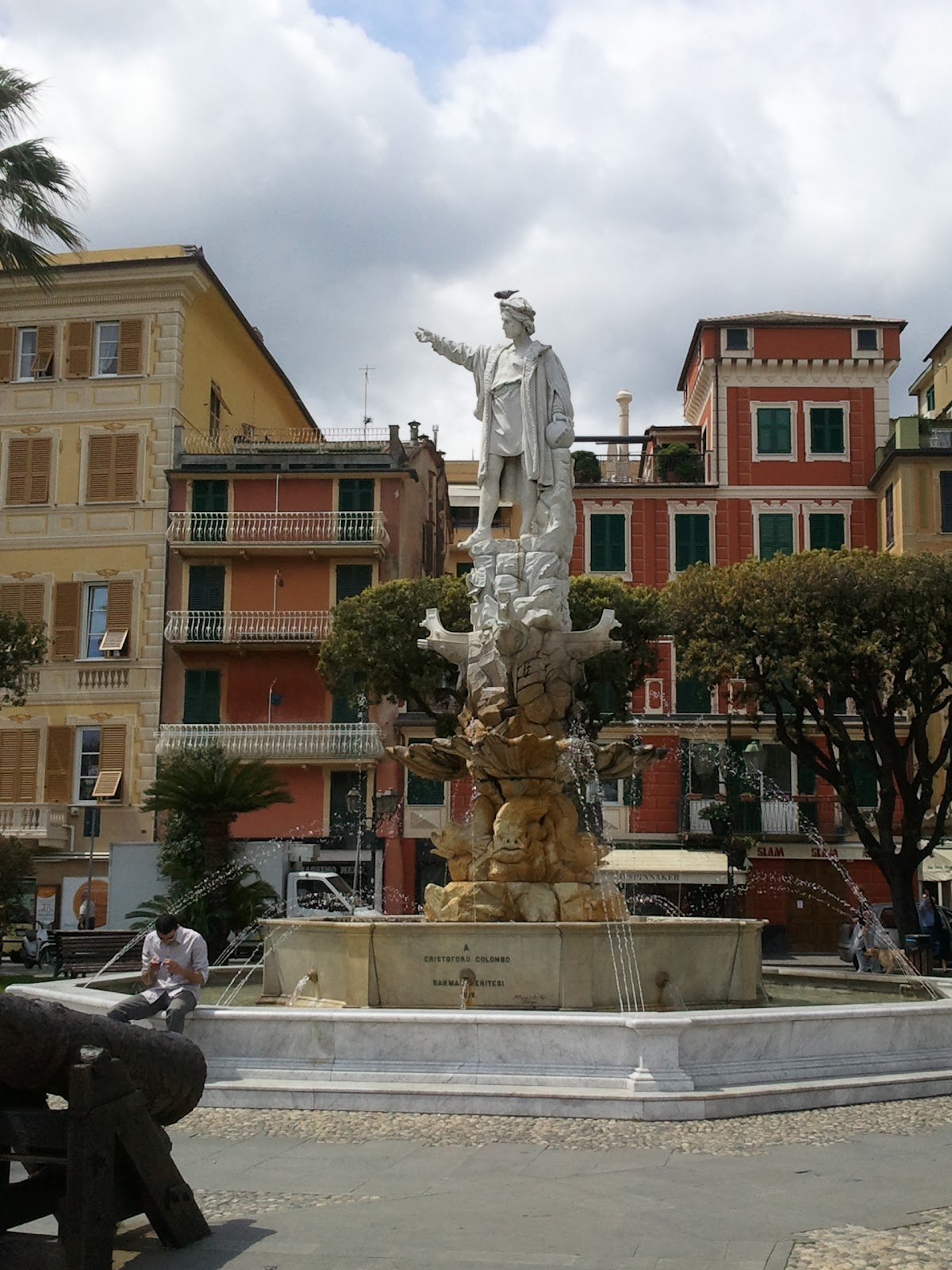
Santa Margherita is bigger and grander (and more expensive)
than the Cinque Terre, but the terrain is equally spectacular. I paused at the train station to make
reservations for the rest of my trip. I
had the original civil servant with a bad attitude for a ticket agent. He acted irritated with me for existing and
even more irritated that I had a first class rail pass, since that created
extra work for him to reserve seats for me.
It never occurred to him to be helpful.
He acted like I was lucky to get whatever he gave me, no matter how
inconvenient it was. Despite my trip to
Venice being the longest one of my entire journey, he insisted that the earliest train was at 1:39, even though I know that there were several before
that. I suspect it was the easiest one
for him to book. When I had the audacity
to ask for a second reservation from Venice to Bolzano, he insisted that I had
to go the Milan to change trains (doubling the distance), when I should have been
able to change in Verona. He gave me no
information whatsoever about the regional trains I would need to take to
complete my journey. I left with tickets
to someplace other than Bolzano, but I figured I would have to change to a
regional train to get there and didn’t stop to get out my map until I got to my
hotel. (More on this subject later.)
 |
| Cristoforo Colombo |
 |
| Hotel Jolanda |
It was an easy walk downhill to the hotel and the hotel
proved to be very nice. If I had been
interested, they had an arrangement for their guests to use the private beach
of one of the waterfront hotels. Best of
all, there was good Wi-Fi, although I had to get two passwords in order to be
able to send photos from my phone to my computer. My purpose in coming to Santa Margherita had
been to see Portofino, so I settled my things in my room, changed my shoes and
headed out. Santa Margherita proved more
intriguing than I expected, so I vowed to get back early enough to explore a
bit before dark. The bus to Portofino
left from the harbor and I had a few minutes to enjoy the view before the bus
arrived. Santa Margherita is a cruise
ship destination and there were a cruise ship and a couple of megayachts
anchored in the bay. There were also a
lot of sailboats in the marina.
Portofino is probably beyond the budgets of most cruisers so, like me,
they probably come to Santa Margherita instead.


The bus ride to Portofino was incredibly scenic. The water varied from cobalt blue to emerald
green and the flora is lush. The
Mediterranean always looks like Lake Tahoe to me. We passed beaches of pebbles and sand, many
of them with fancy resorts spreading fresh sand for the coming season. Last winter was tough on the Riviera’s
beaches, stripping away the sand and depositing flood debris in its place. All over the area, resort operators are
working frantically to clean up and prepare the beaches for the summer crowds. The coast between Santa Margherita is also
dotted with immense villas, most of which have been there for some time. I’d hate to think what they cost. Twenty years ago, one of my former employers
was considering buying a modest one for $5 million. Condos in bargain Santa Margherita cost as
much or more than they do in San Francisco.


Portofino couldn’t be more beautiful if it had been designed
by Disney. It fills a picturesque little
ravine forested with oaks and pines. The
harbor really is fine. It’s a natural deep
water harbor with cobalt blue water. The
entire surrounding area is a nature preserve.
There are nicely maintained paved trails through the hills above the
road and a boardwalk cantilevered out over the water on the outside of the
guard rail along the road. There isn’t
much to the town. There are a few
expensive stores, but not nearly as many as I expected. Most of the town seems to be given over to
ridiculously expensive harbor side cafés and bars.
 |
| Yacht Club Gangway |
 |
| Portofiino Yacht Club |
I made an attempt to visit the yacht club, thinking I might
find a reasonable beer there, but it was closed on a Tuesday afternoon and the
gangway was drawn up. The club itself is
tiny, but there is a pleasant covered patio overlooking the harbor located at
the top of the sea wall. There weren’t a
lot of boats in the harbor, but the ones that were there were impressive. Several huge sailboats were moored at the
mouth of the harbor and there were a few mammoth power boats. It is either too early in the season or just
too expensive to attract a lot of business.
I walked around, took pictures and admired the scenery. Then I set out to walk back to Santa
Margherita because the scenery is the biggest attraction as far as I am
concerned.
 |
| This Water is Too Blue |
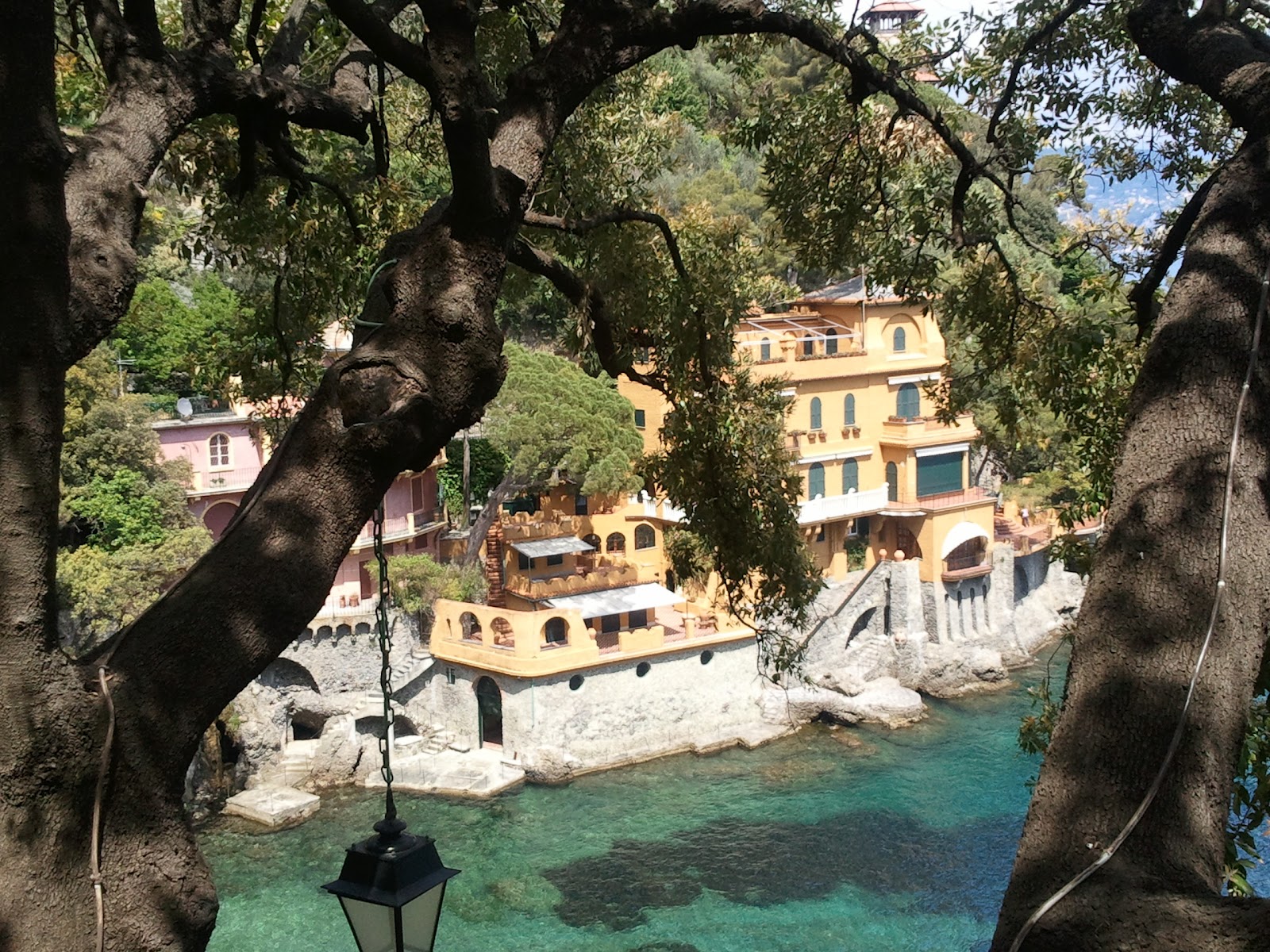
I took the attractive brick pathway around the point from
Portofino to Paraggi Beach. The path
leads through the trees, high above the road, and offers a beautiful view of
the water and the fantastic homes. The water
in California is just never that blue. I
spent the whole hike pondering this phenomenon, as I once spent a week in
Turkey. Paraggi Beach is a posh beach
club in a narrow cove with a sandy beach, docks for swimming and decks with
lounge chairs and umbrellas for sunning.
It was even more deserted than Portofino. The jet set seems to be staying away in
droves, although the hotel in Santa Margherita was booked solid and turning
away several people per hour who were looking for a room.
After my beer, I ambled the rest of the way along the shore
to Santa Margherita, past the new hotels being constructed north of town. All of the construction that has been
prohibited in the Cinque Terre since the 80s seems to be happening in Santa
Margherita. Santa Margherita has a nice
downtown area with lots of shops and restaurants. Most of the shops were clothing shops and I
was amused to see that the nautical theme was big here, as well. One clothing vendor is sponsoring a coming
regatta. I finally found a gift store to
buy something for my friend, Pat. I was
tempted to buy a Portofino shirt for Scott, but figured he’d rather have an
Americas Cup one from Venice.
I went back to my room to work on sending my photos to my
computer for a bit before dinner. I
decided to look at a map and figure out just what, exactly, had happened with
my train reservation. It turned out
that, not only did I not have a ticket to anywhere near Bolzano (which is near
Austria), I had a ticket to Switzerland (which shouldn’t even have been
possible with an Italy only rail pass.)
I wonder what would have happened if I had tried to use it. This was clearly not going to work, so I
decided I’d better head back to the station and straighten things out before
dinner.

Fortunately, there was a different clerk on duty by this
time. She was somewhat less resentful of
my expecting her to perform her job.
Explaining what had happened taxed my Italian, but I managed. She tried to help, but the tickets were
non-refundable and the computer wouldn’t let her change or refund them, even
though it had been her colleague’s fault.
I had paid 30 Euros for tickets I couldn’t use, but at least the trains
I did need were regional ones that didn’t require paid reservations and I came
away with the correct information.
Later, I would realize that the ticket the first guy had sold me from
Switzerland back to Milano wasn’t even for the right day. What a mess.
I had dinner in a little trattoria in the center of
town. I elected to try something novel
and ordered the trofie with pesto and a glass of sangria. I had never had sangria with apples and
strawberries before, but it tasted fine and had clearly been fortified with
brandy, as true sangria should be and usually isn’t in the United States. Trofie are little slug like fresh pasta. The pesto was tasty and the bread was moist
and heavy and by far the best I’ve had in Italy, so far.
Santa Margherita to Venice – Day 48 – Wednesday
There are not many things I miss about the United States,
but most of them have to do with bathrooms.
I miss towels dried in the drier that don’t scrape my skin off after a
shower. I miss showers big enough to
pick up a dropped bar of soap without having to open the door. I would say that I miss having enough space
to put my toiletries, but I don’t have that at home, either. Most of the bathrooms here are bigger than
the one I have at home. Why do the
showers have to be so small? It’s
impossible to shave my legs in one of them.
The one room I had with a bathtub didn’t have a shower or a plug (or any
water pressure.) What was I supposed to
do with that? Twenty years ago, I would
have put it all down to the fact that Europeans didn’t bathe as often as we do,
but that no longer seems to be the case.
I haven’t had to suffer through a subway car full of smelly armpits once
since I’ve been here.

I certainly haven’t suffered for lack of food I like and
there is enough variety in Italian food and enough other ethnic food available
that food hasn’t been as issue. The only
things I miss are Mexican food and soda that doesn’t cost as arm and a
leg. Even water with a meal costs as
much as soda does in the U.S. This is
probably a good thing, however. I drink
too much soda, anyway. The only soda I’ve
had here was when I’ve had a refrigerator and could buy it in the
supermarket. I do, however miss good
beer. Dark beer doesn’t exist in Italy,
with the exception of Guinness which, while I am partial to it, is not exactly
what I want to go with my pizza. I’m
sorry I missed my iris blooming, but I have seen a lot of them here and so many
other flowers. The only real difference
between the flowers here and the ones in my garden is that the poppies are red
instead of orange.

My train didn’t leave until 13:39 and checkout time was
11:00. I checked out and then sat in the
lobby using the internet for an hour and a half before dragging my bag up the
hill to the station. I waited for an
hour at the station. The wind was
howling through the station so loudly that I thought there must surely be a
train coming. Every passenger seemed
determined to pass through the waiting room and blast me with cold air. Finally a group of noisy young men arrived
and lit up cigarettes, driving me out onto the windy platform. First class carriages are usually at the head
of the train, which minimizes the distance baggage has to be carried when the
trains head into major stations, but sometimes results in a very long walk when
they pass through stations along the way.
This was one of those times and there was a large group of senior
citizens with heavy luggage ahead of me.
I was afraid the train would leave without me before I could get aboard.
When I got to my assigned seat, there was a family with two
young children in my compartment and the father was sitting in my seat. They were about as annoying companions as
they could be, despite being affable and helping me to stow my heavy bag. The children were noisy and ran in and out of
the compartment the entire way to Milan.
The little boy had smelly diapers.
They were constantly getting up and rummaging in their suitcases for
some needed item. This is the sort of
thing I tried to avoid by buying a first class ticket. Fortunately, I changed trains in Milan and
only had to tolerate them for two hours.

There are two types of first class carriages in Italy and
each has its pluses and minuses. One
type has six passenger compartments with a corridor on one side. These are generally more spacious and nice in
that it is easy to get up and down without disturbing anyone, but they have no
place to put heavy bags other than over your head. The other type is seated four across with an
aisle in the middle. Sets of seats face
each other with tables in the middle. There
are electrical outlets, which makes them nice for computer users, but they are
packed in like airline seats and there is no way to get out of a window seat
without a major upheaval, as the table must first be folded back and the person
in the aisle seat has to get up. These
have some baggage storage at ground level on the ends of the cars, but the
overheads are not large enough to accommodate them. If you are seated in the middle, you just have
to trust that no one will steal your bag.
I admit that mine is now so battered that no one would want to steal it
and so unwieldy that a thief could never get away once he took it.
The train to Milan was ten minutes late. I had to wait for all the seniors to get
their heavy bags off the train, which gave me about two minutes to run through
crowds of people, across the monumental Milano Centrale Station to my train for
Venice. I barely made it. The carriage was of the second type and the
train was packed. There was no way that
I could maneuver my bag past the vestibule. I just had to leave it there and hope. Someone was sitting in my seat, of course, so
I had to make do with a window seat. I
couldn’t even get up to check on the bag from time to time.
The train from Milan heads east across the fertile plain at
the foot of the Alps. Fields of corn
stretch off on both sides and there are lots of trees. No cypresses or oaks here. This is a land of poplars, cottonwoods and
nut trees. The air smells faintly of
manure. We passed through Brescia,
skirted Lake Garda and stopped in Verona.
People have told me that Verona was their favorite city in Italy, but I
couldn’t see anything from the train, so I will have to wait to explore
it. Maybe I can stop on my way to or
from Bolzano. I will have to pass
through twice more before I am done. The
northern part of Italy is more modern than the south. Construction materials and architecture are
different (no tract houses here), but one could almost think you were in a
springtime Sacramento Valley if you didn’t look too hard. It is very flat until the land starts to rise
towards the Alps.
The woman sitting in my seat left after Verona and the crowd
had thinned enough that I could move my bag to the luggage rack in the center
of the car. I was relieved to see that
it hadn’t left without me. The next stop
was Padua. It was six o’ clock and I was
getting hungry. The French family across
from me tortured me my eating brie on a baguette. The Alps in the distance got taller and
snowier. I may be glad of my warm clothes
again in a few days.
 |
| First Impression of Venice |
 |
| Venice Causeway |
The train tracks to Venice run across a causeway that looks
rather like the approach to the San Mateo Bridge. Once I descended to the piazza in front of
the railway station, however, I was sure that I wasn’t in Hayward. The station fronts on the Grand Canal. There are no cars or buses in Venice. There aren’t even any motorscooters. Everything moves by boat. The equivalent of a bus in Venice is a
vaporetto, which is a bus sized motor boat that stops at barges moored to the
walls of the canal. It took me a few
minutes to work out which of the several barges moored in front of the station
was going in my direction, but I eventually acquired a ticket and got on the
correct boat.
 |
| Is That Seaweed on the Steps? |
My stop was Ca’ d’ Oro or Golden House in the Venetian
dialect. Only the Doge’s palace could be
called a palazzo. All the other palaces
in Venice (and there are many) are called “ca’”, which is short for “casa”,
meaning house. Ca’ d’ Oro is a fancy
white place with a lacy stone façade.
Once, it was decorated with gold, but those days are long gone. No one is allowed to alter the outside of
buildings in Venice, so they are elegantly crumbling from lack of
maintenance. I trundled my bag up a
narrow alley between two buildings to what passes for a main street in that
part of town (the are no through streets in Venice except canals) and the first
thing I saw was … a MacDonald’s.
WRONG! You can’t paint your
house, but you can open a MacDonald’s? Admittedly,
there is only one in Venice and I didn’t see a Starbucks anywhere in Italy.

Navigating in Venice is a challenge. There is no real organization. Streets go over bridges, under buildings and
dead end at walls or canals. There are
no direct routes. If someone tells you to
go, “straight ahead,” that means walk in the same general direction. You can never go more than two blocks without
having to turn a corner. Somehow, I
managed to walk straight to my B&B without any false steps. There was only one flight of stairs. All was well.
The B&B San Paolo is a basic place, but the young man running it was
pleasant and the price was right at 52 Euros a night. It was 7:30 before I arrived and I hadn’t
eaten all day, so I put my things in order and went out to find some
dinner. I ate a tasty pizza at a
restaurant around the corner. It was
chilly and I chose the restaurant more by the fact that they had inside seating
than for any other reason, but the food was fine.


 San Marco was my biggest disappointment in Italy. It never occurred to me that all the pictures
I had seen were paintings and the lofty arches and tiled floors depicted in
those paintings never existed. The
square is large and surrounded by arcades, but they are quite pedestrian, dirty
and covered with scaffolding in several places.
The huge square was crammed with tour groups and the scene made me want
to run. I did suffer through the line to
get inside San Marco, but that was a disappointment, also. The church is interesting in that it is very
old and constructed on the Greek cross floor plan, but it is dark and dingy and
most of the interesting parts were roped off so that they could herd tourists
through faster. I couldn’t wait to get
out of there.


 Murano is Venice on a more human scale. It also relies solely on boats, but there are
no palaces there. The buildings are
lower and people park their boats in front of their homes. The pace was slower and the streets weren’t
completely packed with tourists. Murano
is a city of glass factories and glass shops.
Since I come from a city famous for its art glass, I had to see what was
going on there. Unlike Venice, Murano
had nice wide walkways along its major canals.
The glass museum is in the center of the island(or maybe I should say
archipelago, since it is criscrossed with canals), so I was able to enjoy
strolling along the banks and looking at the glass on my way.


 There was every kind of glass imaginable. At the Doge’s palace, I had seen chandeliers
like lacy crystal confections. No hard
edged, cut crystal here. These are hand
blown and fanciful and sometimes colorful.
Murano produces every imaginable kind of glass, from the traditional to
the crazy. Some of the chandeliers
looked straight out of Dr. Seuss. Every
kind of jewelry and glass animal was represented. There were even some beautiful glass
sailboats. The prices were actually
quite reasonable by Benicia standards, but, alas, glass is too heavy and
fragile to carry. On the way to the
museum, I passed a piazza with a large glass sculpture resting in it. It looked like some sort of giant undersea
creature waving its many blue arms at the sky.


 The racing was done for the day when I arrived and I just
happened to be passing by when a couple of the teams started signing
autographs. Someone thrust a postcard
into my hand and I found myself in line to get the autographs of the Korean
(not one of them was Asian) and French teams.
In Europe, sailors are professional athletes with fans just like any
other sport. Most of the people there
were clearly not sailors, but they were as excited about their teams as if it
had been a soccer match. Luna Rossa was
clearly the favorite.


 We had a half an hour or so until the second start, so we
packed up and wandered out to the quay opposite the race course. It was crowded, but not as bad as I
expected. I was only one row back from
the front and could still see pretty well.
The second race was more exciting.
Oracle was in the lead on the leg up to the finish past the viewing
area. It looked like they were the sure
winners until they had to tack and Luna Rossa Swordfish laid the mark and slid
through behind them. The boats were in
very close quarters and there was a lot of drawn breath and oohing and ahing. Of course the Italians went wild when Luna
Rossa won at the last moment. I was so
busy taking pictures that I actually missed a lot of the action, but I did get
some good shots. It could hardly have
been more scenic, with gondolas in the foreground and Venice behind.