Thursday, June 12, 2014

STUDYING IN GRANADA

June 9, 2014

Common Patio Area
I had registered with a school called Spanish Dale! before I got to Granada.  When I signed up, I asked them to arrange for me to stay with a family.  I had done this a few times before in Mexico and Italy and always found it to be both cheaper and more comfortable than staying in a hotel or apartment.  Depending on the family, it sometimes offered me the chance to practice my language skills.  The house where I stayed in Granada was quite large.  It had two beautifully landscaped patios.  On the street side of the house, there were a garage and a couple of rooms used by the family.  Then came a large patio with a wall on the left side and shady arcades on the other three sides.  A large fountain dominated the patio.  The arcades served as the living room.  They were furnished with several groupings of chairs.  The walls were hung with numerous pictures of buildings in Granada painted by Fatima's father.  There were also many elegant chests and tables of dark tropical hard woods, covered with a collection of knickknacks that made the place feel like a cross between a museum and the home of a grandmother, which, of course, it was.  The owner’s name was Fatima and she spent her days surrounded by her daughters, granddaughter and great grandchildren.

My Room in Granada
On the far side of the patio was a dining room with a kitchen behind that.  To the right, opposite the kitchen and lining the second patio behind that, were at least four bedrooms.  As near as I could tell, three of them were rented to guests.  A couple of them were triples.  When full, there were seven of us staying there.  Unfortunately, this made it feel more like a bed and breakfast than a family home and the table conversation was mostly in English.  Bernarda, whom I took to be Fatima’s daughter, cooked three meals a day for us and the food was excellent, if a little heavy on the rice and beans.  Some other women cleaned, but I think they were hired help, since they only appeared in the morning and early afternoon.  Family members came and went.  It was tough to tell who actually lived there besides Fatima, Bernarda and Bernarda’s husband.  There was decent Wi-Fi in the front patio, but it only reached as far as my room towards the rear of the house when they remembered to turn on the repeater.

Hotel Housing Spanish Dale!
The school was housed in a large hotel near the center of town.  Like most Spanish schools in Central
America outside of Mexico, instruction was one on one.  Students and their teachers met in the rear passageways of the hotel.  It was quiet and shady back there.  There seemed to be two other students besides myself, both of whom were young women from England in their early twenties.  My teacher’s name was Arleen.  She was a woman in her late thirties.  She knew her grammar well and was a good teacher.  The first day, we spent a lot of time conversing so that she could evaluate my Spanish abilities and then we made a mad dash through the present and simple past tenses, making sure I had a handle on the irregular verbs.  As I suspected, I knew these pretty well and could complete exercises accurately, but often made errors when speaking without taking time to think.  It was good to have someone to point out these errors.

My "Classroom"
Nicaraguan Spanish differed slightly from Spanish in other parts of the world.  While the word for “car” in Spain and, at least formally, in Mexico is “coche,” in Nicaragua, “coche” denotes an actual carriage drawn by horses.  Carriages are not in common use in most countries, these days, but in Nicaragua they are.  Nicaraguans refer to “cars” as “carros” or “autos.”  Arleen completely failed to understand the phrase “darse cuenta,” which is quite common in Spanish literature and means to “become aware of.”  I had to give up on that one, relegating it to the category of strange things they say in Spain.  Reading a lot in Spanish has increased my vocabulary, but not always in a useful way.  Since Arleen had not had the opportunity to prepare any homework for me, I got off easy on my first day.  We worked from 8:00 to noon and then I went home for lunch.
The food at the house where I stayed was quite tasty, if not overly plentiful.  For breakfast, I had a banana and a bowl of fruit salad with a (somewhat stale) roll and coffee.  Lunch was a chicken leg in a spinach cream sauce with beans, rice, plantains and salad.  Dinner was a piece of sausage with more beans and rice, a piece of salty Nicaraguan cheese and half a piece of what looked like pita bread.  The guests ate in the formal dining room, at a table set with a tablecloth and place mats.  There was a small water dispenser in the center of the table.  After lunch, I sat in the living area and worked on my blog for a couple of hours.  I went back to the school at 3:00 to go on an outing to Las Isletas.
Las Isletas
Volcan Mombacho from Las Isletas
Kingfisher
Leticia, the two English girls, and I took a cab to the lake shore where we met our boatman.  Granada is situated on the western shore of Lake Nicaragua, which is humongous and reaches nearly to the Caribbean.  The San Juan River, which links the lake to the Caribbean, is navigable and Granada was often sacked by pirates and mercenaries in its history, most recently during the civil war with the rival city of Leon in 1857.  Off the shore of Granada there is an archipelago of some 350 plus small islands known as Las Isletas.  These islands were formed when the Mombacha Volcano erupted, spewing volcanic rocks and ash into the lake.  Some of the larger ones were inhabited and wealthy Nicaraguan families had summer homes on private islands.  The prettiest of these belonged to the family who owned the Flor de Cana rum company.  It is said that they own a quarter of Nicaragua.  One island was populated by howler monkeys, who had learned that people in boats brought them bananas.  They came to the shore of the island to greet us.  One male with a docked tail was so successful at begging bananas that he had quite a paunch on him.   We saw a female named Lucy who was carrying a small baby.  The girls had fun feeding the monkeys while I took the opportunity to photograph them.  There were also purple herons and kingfishers in abundance, feeding on the sardines that leaped out of the water in flight from our passing boat.  Our tour took about an hour and a half and we returned to the school just before 5:00.
Lucy with Baby Hiding in Leaves

Luxury Home in Las Isletas

I took a short walk to Calle Calzada, the tourist street, to check out the action there.  It was pretty deserted, although I could see that it was lined with restaurants, bars, shops, and tour companies.  It was hot and I was thirsty, so I stopped for a quick (and thankfully ice cold) beer on the covered patio of one of the restaurants.  Then I walked back uptown to my house so as not to be late for dinner.  Dinner was served at 6:00 and, although I tried to read after dinner, the beer caught up with me and I just couldn’t stay awake.  I napped until 9:00, when I managed to get up to write for at least a couple of hours before returning to sleep.


June 10, 2014

Street View of My House in Granada
I spent the morning reviewing the finer points of when to use which past tense in Spanish.  I did pretty well with this, with the exception of certain idiomatic phrases that require specific tenses outside of all apparent logic.   Of course, there are many of those in Spanish.  My teacher had warned me that she would be giving me some translation exercises to do.  I had assumed that this would be my homework, but she made me do it on the fly.  I read out loud from a book in English, translating to Spanish as I went.  That actually went very well.  I was surprised.  I had much more practice in translating from Spanish to English.

Fortaleza La Polvora
I went home for lunch after class.  I don’t norm-ally eat grains, pota-toes or le-
Granada Street Scene
gumes.  My lunch consisted of a small piece of pork with rice, beans, potatoes and plantains.  No wonder I was hungry all the time.  All that starch was messing with my hormones.  It was a good thing I wasn’t staying longer, although the quality of the Spanish instruction was making me consider extending my stay.  After lunch, I went for a walk up to the Fortaleza La Polvora (literally dusty fort), a Spanish fort built in the 18th century to protect the city from the ravages of pirates sailing across the lake from the Caribbean.  There was a museum there, but it was closed.  I returned via a different street, passing a couple of interesting churches on my way to the grocery store.  Granada changes rapidly once you leave the tourist streets.  A little girl about 11 years old stopped me to warn me to put my camera away lest a thief on a bicycle grab it.  She then gave me a tale of woe about how her father had died and they had nothing to eat.  I didn’t know if she was telling the truth or not, but she was so sweet that I gave here all the coins in my purse, which elicited a huge smile and profusion of thanks.


I managed to reach the main shopping street (for locals, not tourists) without being robbed and headed off towards the supermarket.  My watch band had been on its last legs for some time, so I stopped at a stall operated by a little old man to see if he could provide me with a new one.  Having tried to buy a band for the watch before, I knew it was an odd size.  The only one he had was an ugly plastic one, but at less than $2, I figured it would keep me from losing my watch until I found a better one and making a sale made him happy.  The supermarket was hidden behind a big gate and I walked right past it the first time.  When the pavement started to give out, I figured I had gone too far and turned around.  I found it on the second pass.  The Pali chain of supermarkets in Nicaragua have all the charm of Costco with a selection little better than 7-11.  I managed to buy some snacks and something cold to drink, but couldn’t find any chocolate other than M&Ms, which I was thankfully able to resist.  I left via the back gate, which led into a quieter street and took that back to my neighborhood.  I spent the rest of the afternoon struggling with idiomatic phrases and the subtle changes in meaning when used with different tenses.  Mostly, I just managed to confuse myself.  I was glad when dinnertime came.  Dinner was a small fried pupusa-like thing and another egg-foo-yung sort of patty covered with spaghetti sauce, served with rice and beans.  Everything tasted good, even if we couldn’t identify what we were eating.

June 11, 2014

A group of high school girls from Wisconsin had arrived during the night and I met them at breakfast.  The two groups of girls were staying three to a room and it made for a very full house, as some of Fatima’s grandchildren were visiting also.  I felt like a grandmother, too, even though they were all nice girls.  I was starting to crave adult conversation, since I had hardly spoken with anyone my own age for more than two weeks.  I dropped my dirty clothes off at the laundry and then spent the morning reviewing the subjunctive tenses and translating an American history textbook into Spanish.  All of that went surprisingly well.  I must have absorbed more grammar than I realized over the years.  It was just the idiomatic phrases that continued to confound me.  Unfortunately, there was a big difference between being able to complete exercises or translate written material and being able to construct original sentences during a conversation.  I may have known the grammar, but wasn’t always able to access it on the fly.
The Front Patio


After class, I came home for lunch. I had a nice conversation, after lunch, with one of the male family members about my age.  He was tough to understand, but I gathered that he was from Jinotega, near where I had been in Matagalpa, and had spent his youth traveling through the mountains, selling goods to the people in remote communities.  He said that he did this alone from the age of 14, but that now it was very dangerous there as there were a lot of bandits.  He complained that young people today had no respect.  I hung around the house for a couple of hours and did my homework.  Then I took a short walk to the Convent of San Francisco, the oldest church in Granada, built in 1529.  On the way, I stopped into a travel agency and reserved a shuttle to take me to San Jorge on Friday, where I could get a ferry to the island of Ometepe.  While the shuttle was much more expensive than taking the bus, I could afford $15 to avoid having to drag my luggage to the bus terminal and then change buses in Rivas and get a cab to the ferry.  It was very warm, so I ducked into the Casa de CafĂ© for a coffee frappe and some air conditioned Wi-Fi.  I remained there, reviewing the use of object pronouns, until it was time to meet my classmates for a carriage tour of Granada.

Our Carriage
Old Hospital
                                                                                                                                      The two English girls, my teacher and I took a carriage tour at 5:00 when it had cooled down a bit.  I got a kick out of the cellular company advertisements painted on the horse drawn carriage.  Our driver was a very good guide.  He drove us all around Granada and told us the history of the important buildings in easily understood Spanish.  In city traffic, a horse and carriage can go as fast as a car.  He used hand signals when turning.  The tour was handy in that we were able to visit a couple of interesting locations where I would not have felt secure going on foot.  Granada gets sketchy quickly once you leave the main tourist arteries.  One of these locations was the old hospital.  It had only been abandoned for about 20 years, but looked haunted and creepy, especially on a cloudy late afternoon.  I also learned that a house around the corner from mine was the oldest house in Granada and had been occupied by William Walker, the American mercenary hired during the civil war between Leon and Granada who declared himself president of Nicaragua after killing the former president.  He was later ousted, but returned in 1857 to burn Granada to the ground.  The whole tour took about 45 minutes.

The woman at the laundry was told me my clothes would be ready at 5:30, but when I arrived at 5:45, she said it would be another 30 minutes.  I went home and ate a dinner of taquitos, rice, and beans and then returned to the laundry at 6:30.  My clothes still weren’t ready and, although they told me it would just be a few minutes I had to wait until after 7:00.  The laundry was in the lobby of a building that must have been some type of recreation center.  There was a dance class going on and I was surprised to see more boys than girls dancing.  I enjoyed listening to the music and watching them a bit.  There seemed to be a martial arts class going on upstairs and the kids were running down the stairs and then jumping back up, two or three steps at a time.  It reminded me of box jumping in CrossFit.  I felt like I should have joined them.  Eventually, my clothes were ready and I beat a quick retreat up the darkened street to my house.

June 12, 2014

I spent Thursday morning reviewing the conditional and subjunctive tenses and reading about the origin of the Spanish language.  A turtle ambled around the garden in the hotel and a hummingbird visited the hibiscus blossoms near where we were sitting.  Nicaraguan hummingbirds are drab brown creatures, nothing like the jewel green ones I am accustomed to seeing in California.  It was hot.  I went home for lunch and had all kinds of ambitions for the afternoon, but ended up taking a nap and staying in to work on my homework.  The coffee I had in the afternoon the day before had kept me up half the night, so I didn't want to perpetuate the problem by having another iced latte.  Granada lacked the numerous tiendas selling sodas, water and beer that I was accustomed to visit, so it was difficult to find a cold drink without going to a restaurant or bar.  It was good to take a break from drinking, but I was starting to crave a cold beer in the evening.  I hoped Ometepe would be more convenient.
Xalteva Park, the Site of the Original  Indigenous Village

Dinner was fried, smoked cheese with salsa over a bed of plantains and, of course, beans and rice.  While I was napping, someone painted the columns around the front patio.  I got the feeling that Fatima's hobby was decorating the house.  She was constantly altering something or changing a flower arrangement.  She must have inherited some of her father's artistic sense.  She had added a water dispenser in my room while I was in class.

I was very tempted to stay and study for another week, but Ometepe and Costa Rica beckoned and I was starved for fish, adult company and a cold beer.  It was time to move on.

Monday, June 9, 2014

PONELOYA TO GRANADA

June 5, 2014

It did not rain on my last night at the Surfing Turtle Lodge, so it was hot and buggy.  I didn’t get to sleep until after midnight and woke at 5:00 am.  I got up at 6:30, so as to be ready to leave as soon as someone was ready to share a cab.  The first group to leave was taking the chicken bus to Leon, but I finally left with a German couple about 9:00.  We crossed the island on a horse cart, plodding through a muddy mangrove swamp to the shore where we met our launch to the mainland.  A couple of minutes and 25 cordobas later, we waded ashore at the launch ramp where our taxi was waiting.  It took us about half an hour to drive to Leon.  The bus terminal was a zoo of vehicles, waiting people, market stalls, vendors, and conductors shouting out their destinations.  I had just enough time to find the proper bus for the Germans, who didn’t speak Spanish, before I made a dash for an express bus to Managua.


The Road to Masaya
The ride to Managua took a little over two hours and cost about $1.75.  We drove through dry countryside with volcanoes in the distance.  Western Nicaragua is dominated by lakes.  Eventually, we reached Lake Managua and followed the shore to the city of Managua.  Managua was a big sprawling place, but not as frightening as Guatemala City or Tegucialpa.  The most frightening thing about it was trying to find one’s way about.  Unfortunately, my express bus didn’t go to the bus terminal.  I had to take a taxi clear across the city to get to the bus terminal, which was actually kind of interesting.  There were a lot of statues of Sandino and some big, wide avenues, one of which was lined with 30 foot tall stylized metal trees covered with hundreds of little yellow lights.  The taxi ride cost about $2.00, which was cheap for a taxi ride, although more than it cost me to come all the way from Leon.  The bus terminal was chaotic, but it didn’t take long to find the bus to Masaya.  There were no luggage racks on the bus, so I shared the seat behind the driver with my bag and two other people.  The ride took about an hour.  We passed the entrance to the Masaya Volcano National Park along the way.


Bus Terminal in Masaya
We actually drove right past my hotel on the way to the bus terminal but, since there are no street signs or addresses in Nicaragua (and therefore no one knows the names of the streets) I had no way of knowing that at the time.  Eventually, we arrived at the small dusty bus terminal on the edge of town.  Fruit vendors were set up in the center of the lot and the buses circled them.  I dragged my bag through the dust to where a taxi waited and asked my taxi driver to take me to Mi Casa Hostel.  Unfortunately, the driver was not familiar with the hostel.  We drove around and around, but even my map was useless because, without named streets or an address, we could not orient ourselves.  Finally, the driver convinced me that the hostel did not exist, so I agreed to go to the Hotel Madera in the same neighborhood.  While the hotel was marginally acceptable, it was quiet and did appear to be the center of tourist activities in Masaya.  I got a room with a bathroom, TV, and fan for $20 a night.  The desk clerk assured me that I could join a group going to the Masaya Volcano if I showed up in lobby the following morning.


The Parroquia in Masya
Mosaic Sculpture at Entrace to Masaya
I dropped off my baggage and went in search of food.  It was my intention to walk down to the lake and get something to eat there.  My map showed a park on one side of the church near my hotel and I thought I could use that to orient myself, but there turned out to be parks on both sides of the church.  I first walked around the block, trying without luck to locate the Mi Casa Hostel.  Then I set off in what I hoped was the right direction.  After walking several blocks, I came to the highway back to Managua and realized that I had gone the wrong way.  There was a chicken restaurant across the highway, so I stopped in there to get something to eat.  I managed to get chicken that wasn’t fried, although it was the smallest chicken quarter I had ever seen.  It was tasty, although not as filling as I might have liked, but they had free wi-fi, so I hung out for a bit to catch up on my communication.  By then, evening was falling and it looked like it might rain.  I decided to leave my walk to the lake for another day and returned the way I had come.  By the time I got back to the neighborhood of my hostel, it was hot.  I had seen a smoothie shop on my walk around the block, so decided to indulge my watermelon ice addiction.  As I sat in the shop, trying to figure out how to drink my smoothie through a tiny straw, I looked across the street and spied the Mi Casa Hostel.  It didn’t look any better than where I had landed, so I decided to stay put.  I went back to my hotel and spent a quiet evening watching American television.  There were thankfully no bugs.


June 6, 2014

There was no purified water available in the hotel.  The owner’s wife suggested I go across the street to buy water and get breakfast.  The breakfast was truly excellent (eggs, sausage, cheese, beans, fried plantanos and sour cream with coffee and a bottle of water for about $4), but I soon discovered that they also owned the restaurant.  Kaching!  I had been suckered.  I showed up at 9:00 for the proffered tour to Masaya volcano, but I was the only one who showed.  This was not surprising, since I think I was also the only guest.  Despite the hundreds of backpackers in Leon and, I assume, in Granada, none of them seemed to have found their way to Masaya.  Rather than forego seeing an active volcano (the whole reason I came to Masaya in the first place), I elected to pay double for a private tour.
Painting of Parrots Nesting in the Crater

View of Lake Masaya from the Museum
The owners’ son drove me to the national park and waited while I visited the surprisingly interesting museum.  There were well curated displays about volcanoes and the local flora and fauna.  I discovered that the names for different types of lava derived from the Hawaiian words for “lava upon which you cannot walk barefoot” and “lava upon which you CAN walk barefoot.”  While I was there at the wrong time of day to see them (they return in the late afternoon), I learned that parrots nest in cavities in the wall of the volcano’s crater.  The museum had a nice overlook from where I could see Lake Masaya and the town.  Lake Masaya was formed when a former volcano collapsed in on itself.  The current Masaya Volcano is slowly filling in the previous crater as it builds a new cone.  The current volcano has two craters, only one of which is presently active. 


Cross on the Summit of Santiago
Steam Rising from Santiago Crater
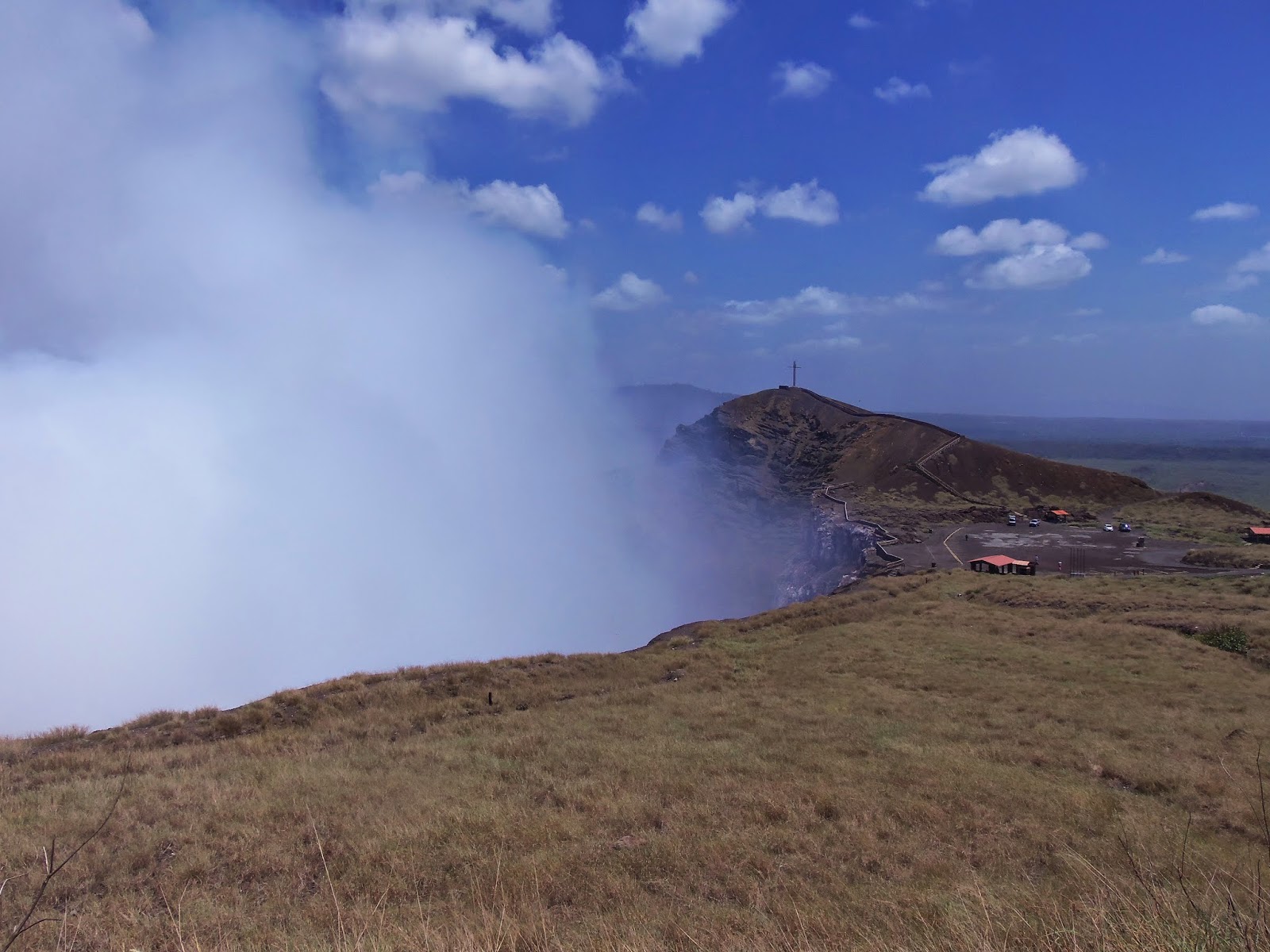
After visiting the museum, we took a very pleasant drive through the jungle to the edge of the Santiago crater.  I may have picked an awful time to go surfing, but I hit the perfect time to visit the forest on the side of Volcan Masaya.  The jacarandas and plumeria were all in bloom.  If it weren’t for the distinctly different culture, one could easily think of Nicaragua as a budget Hawaii.  Spanish clerics planted a cross on the summit of Santiago hoping to exorcise the demons issuing from what they believed to be the mouth of hell.  This cross is today represented by a more modern construction, but the stairway to the summit was closed due to landslides.  Lava bubbles at the bottom of the Santiago crater, although the view is obscured by clouds of sulphrous steam.  The crater walls are fairly shear and the whole effect is pretty spectacular.  My driver waited while I climbed up to the crater of San Fernando which, while higher, was pretty tame in comparison to Santiago.  The view from up there was worthwhile, however.  I could see both the Santiago crater and the ancient crater now occupied by Lake Masaya.  The original volcano must have been massive.  The volcanos of Nicaragua are the result of the collision of the Caribbean and Cocos plates.  The Cocos plate is diving under the Caribbean plate, melting and spewing up magma as it goes.  According to the displays in the museum, the Central American isthmus has undergone tremendous changes over the millennia, being at time a series of islands or even just open ocean between South America and the Yucatan.

 
San Fernando Crater

Walls of the Artisans Market
After I got back from the volcano (and finally having oriented myself), I set off for the Artisan’s Market.  I usually avoid such places, since I am not interested in buying souvenirs and hate being hassled by vendors.  The interesting walls of the market lured me in, however, and I was glad they had because the market was very low key and there was a great band playing in one of the restaurants.  The center of the market featured a performance space for live music and dance.  I was sure it was a happening place during the tourist season.  Unfortunately for me, it was the low season and even the Museum of Folklore was closed.  I did, however, discover a modern supermarket across the street and managed to buy a gallon of water and a small bottle of Flor de Cana, the Nicaraguan rum.
Stage in the Market


Lake Masya
Unfortunate Accumulation of Litter
After I finished shopping, I walked through an attractive residential neighborhood to the edge of town where a shady malecon bordered the lake.  The water is at the bottom of a steep cliff, but the view was lovely as long as you ignored the drifts of litter just below the railing.  I was there on a weekday afternoon when everything was closed, but there were numerous bars and discos lining the malecon and a carnival was setting up in preparation for the coming weekend.  Masaya (90,000 inhabitants) seemed to be a fairly prosperous place, probably due to its proximity to Managua and Granada.  I traversed the malecon and then returned to the center of town through the neighborhood of hammock factories where men were weaving (or should I say tying) hammocks on open porches lining the streets.  Many of the hammocks were quite beautiful and intricate.  If we hadn’t already had more hammocks than we could use, I would have been tempted to buy one.  Not wanting to spend the rest of the afternoon at the hotel, I bought an iced coffee and spent a couple of hours surfing the internet at a cafĂ© adjacent to the parroquia (parish church.)  Something was brewing in Masaya.  All the children seemed to have been released from school early and adolescent boys were setting off firecrackers everywhere.

Masaya Malecon
La Jarochita
I finally returned to the hotel in the late afternoon and wrote for a couple of hours before going out to dinner.  It was very noticeable how little the hours of daylight changed with the seasons so close to the equator.  Despite being only a couple of weeks before the summer solstice, it got dark before 6:30.  While that would have depressed me at home, it was welcome in a place where average daytime temperatures hovered around 90 degrees and seldom dipped below 70 degrees at night.  While I usually tried to be home before dark, Masaya on a Friday night was busy enough that I waited until 7:00 to go out to dinner.  I walked a few blocks back towards the parroquia and at dinner at a Mexican restaurant called La Taqueria Jarochita.  It was an attractive place with colorful tables and chairs set on a vine shaded terrace.  I had excellent enchiladas suizas and a spicy michelada.  Even the chips were excellent.  The food in Nicaragua was generally quite good, but it was still a treat to find good Mexican food.  I took Mexican food for granted in California, but truly came to appreciate its complexity and variety once it became difficult to find.  If you like fish, however, Nicaragua is the place.  The fish was excellent and affordable.


June 7, 2014

Yes, That's a Live Pig!
I had a leisurely morning and then grabbed a latte and a piece of cheesecake on the way to the bus terminal.  I walked to the bus terminal, which was really humming on Saturday morning, complete with squealing piglets.  My plan was to visit the three villages known as the Pueblos Blancos: Catarina, San Juan de Oriente and Diria.  Of course, none of these villages were mentioned in the destinations painted on the buses, but I eventually deduced that I could get at least as far as Catarina on the bus for Diriomo.  Of course, the bus was packed.  The conductor motioned for two large Nicaraguans taking up three seats to make room for me, but the best they could do was to make room for one cheek.  I balanced precariously all the way to Catarina.  The fare was seven cordobas (about 28 cents.)


Laguna de Apoyo from Catarina
Horses for Rent at Catarina Mirador


Catarina Mirador

     While I had enjoyed busy, but relaxed, Masaya, Catarina was refreshing.  Catarina lies on a ridge between Masaya and Granada and is just high enough to be noticeably cooler and greener.  The entire town was made up of nurseries.  I later learned that growing plants on your patio was a current fad in Nicaragua and people were even tearing up pavement to plant trees in their courtyards.  Catarina was capitalizing on this trend.  Every kind of tropical plant seemed to thrive there.  I saw the most humongous hibiscus flowers I had ever seen in my life.  Nurseries and shops selling gaudy ceramic garden ornaments (made in San Juan de Oriente) lined the highway (and every other street.)  The place was gorgeous.  The big attraction in Catarina is the Mirador, an overlook with a spectacular view of Laguna de Apoyo (a crater lake) and the Mombacho Volcano.  The way to the Mirador was uncharacteristically well marked.  There was a pretty hillside park with lots of benches overlooking the view.  Elaborately caparisoned horses were available for rent if you wanted to make the descent to the lake itself, a ride of about an hour.  There were crafts, food and drink for sale surrounding the Mirador, but it was too early for lunch.

Mombacho Volcano from Catarina
San Juan de Oriente
Calves in San Juan de Oriente
On my way back to the highway, I decided to make a detour to the Laguna de Apoyo visitor center, also well marked.  I followed the signs downhill and did eventually find the visitor center, but it was closed.  Across the street from the visitor center, however, was a monument welcoming visitors to San Juan de Oriente.  San Juan was my next stop, anyway, so I continued on down the hill.  I wandered around the back streets of San Juan de Oriente for most of an hour, but never did find the downtown area.  It was very pretty and I was treated to lots of lake views and cute baby animals.  The housing was often primitive and piglets trotted in and out of homes with impunity.  Many of the corrugated metal shacks had million dollar views of the lake.  After I had raised a blister or two, I located the highway again (it turned out the village center was on the other side of the highway along the stretch I had skipped) and continued following it downhill to Diria.  I wasn’t sure where I was going, but there was a nice sidewalk and lots of traffic, so I figured I was going someplace important enough to have a bus back to Masaya.


Parroquia San Pedro in Diria

Street in Diria

Diria was up a steep road between the highway and the edge of the crater.  It, too, had a Mirador, although I never located it.  Diria was not as verdant as Catarina or San Juan de Oriente, but it made up for it with tidy sidewalks and a pretty park.  Diria definitely got the award for the best pavement in Central America.  It had a pretty little parish church which had been destroyed by earthquakes and rebuilt twice in its history.  Unfortunately, everything in the town seemed to be closed.  I was hoping for a restaurant with a restroom, but couldn’t find anything other than a stand selling sodas.  Eventually, I gave up and decided to head back to Masaya.  There was a bus stop on the highway near the entrance to Diria and, fortunately, the large group of teenagers waiting there was headed in a different direction.  A friendly fellow was directing bus passengers and, after he informed the other people waiting that the bus to Managua didn’t stop there, we chatted about my experiences in Nicaragua until my bus arrived.  The return bus was less crowded and I got a decent seat.  The fare from Diria was 9 cordobas (something like 36 cents.)

Ruined Building in Masaya
Everybody in Masaya was out doing Saturday errands and the neighborhood between the bus terminal and downtown was a busy shopping district.  I threaded my way through the throngs of people, motorcycles, horse carts and taxis back to the parroquia and then back up the main drag towards my hotel.  Masaya has casinos, although I never went inside.  It also has its share of buildings ruined by earthquakes and never completely demolished or repaired.  This gave it a rather bombed out look in places, although I don’t believe the area saw any fighting during the war.  The sidewalks were deplorable, full of holes and missing covers, and completely absent in places.  Trying to walk on a sidewalk in Central America was always an adventure, as the height of the pavement above the street varied wildly and it was often necessary to climb up and down steps or jump off precipices, all the while being careful not to step in holes or fall into storm drains.  Since cities seemed to ignore sidewalks altogether, residents attempted to improve the curb appeal of their homes by tiling over the broken sidewalks.  This worked at first, but the lack of a firm underlayment caused the tile to break and come loose over time, making the going even more treacherous. 


Smoothie Shop
By that time it was 3:00 and I was hungry, so I stopped at my favorite smoothie stand and got a large smoothie to go.  I returned to my hotel and napped and contemplated my route through Costa Rica until dinner time.  For dinner, I returned to my Mexican restaurant and ate carnitas tosadas.  Every gringo in Masaya (a bus load of them had appeared from somewhere) was in that restaurant.  While I was there, a religious procession went by.  Throngs of people carrying candles were followed by a float with a statue of some saint and a very small marching band.  I heard drums and a trumpet, but all I actually saw was one tuba.  They made an impressive amount of noise, however.  Fireworks were going off left and right.  Masaya has a reputation for being party central and it certainly seemed like the whole town was out enjoying the evening.  Even I wasn’t in a hurry to return to my room, so I stopped for dessert at an ice cream parlor along the way and watched the children enjoying their ice cream cones while I ate mine.

June 8, 2104

My Home in Granada
I had stayed up late the night before, watching Rambo III, and so managed to sleep until almost 8:00.  I wasn’t hungry, so stayed in my room, packing and studying Spanish grammar, until it was time to check out.  Shortly after I checked out, Leticia, the administrator from the Spanish school where I was headed, arrived in a taxi to take me to Granada.  It was very nice of her to do that, as I could easily have gotten there on my own.  Maybe she felt obligated, since they usually offer airport transfers and I wasn’t arriving by plane.  It was certainly easier to come by taxi than it would have been on the bus and definitely made finding my house simpler.  Granada, however, featured actual street signs and even house numbers.  The pressure of being a big tourist destination seemed to have impacted Granada more than Leon.

The house where I would be staying was a pleasant surprise.  It was easily the most elegant building I had seen in Nicaragua.  The outside was freshly painted and in good repair.  The inside was spacious, 
immaculately clean, and elegantly decorated with beautiful furniture and linens.  My room was large and airy and opened onto a rear patio.  There were five other guests, as well as the family living there.  Three of the other guests were biomedical engineering students in Nicaragua for a summer program between their junior and senior years.  They were spending the first month of their stay studying Spanish and would then spend another month helping hospitals maintain donated equipment.  They seemed like very nice girls.


My Room in Granada
I arrived just before lunch, so hung around the house until after we had eaten before heading out to explore Granada.  Granada is quite compact.  On a Sunday during the rainy season, it was very quiet.  I walked over to the school so as to be sure I could find it and then checked out the Ceramics Museum next door.  They had quite a collection of ancient pieces, but what impressed me most were the modern ones.  Most of them originated from San Juan del Oriente where I had been the day before.  The work was exceptional and made me sorry that I had missed seeing the pottery cooperative there.  After the museum, I strolled over to the cathedral and central plaza, which was full of tourists, vendors, and carriages lining the streets.  Everyone seemed to be trying to sell me something and I felt very outnumbered.  I retreated into a coffee shop and passed the afternoon surfing the internet.

Thursday, June 5, 2014

SURFING TURTLE LODGE

May 31, 2014

The Hammock on my Porch
The Bar


I had seldom been as lazy as I was on my first day at the Surfing Turtle Lodge.  I was supposed to have a surf lesson, but the entire staff and the other guest who wanted a surf lesson were hung over, so it never came to pass.  A large group of English people left early in the morning.  I got up when they did, thinking that the morning might be the best time for surfing, but all I managed to accomplish was eating breakfast and uploading pictures to my blog.  By 9:00, I retired to my hammock to read and stayed there, alternately reading and dozing, until nearly 4:00.  At 4:00, I went up to the bar and ordered a diet coke, just to keep myself awake.  I managed to stay up long enough to eat dinner and play with the litter of kittens for a while.  After dinner, it started to pour down rain.  Everyone scurried around, lowering plastic shields to keep the rain out of the lodgings.  It got so wet in the common area that I had to retire to my cabin to keep my phone dry.  Insects were attracted to my light, so I
couldn’t really stay up to read.  I sat in the dark, watching the lightning, fireflies, and lights on the fishermen’s boats offshore.  The night on the island of Los Brasiles glittered.  Geckos chirped and occasionally fell out of the thatch overhead.  It would have been ideal if the screen had actually reached the ceiling and kept the
bugs out.


June 1, 2014

 I got up early, hoping that there might be surfing going on, but I was the only one up.  I settled for a run on the beach, instead.  Between the humidity and the crashing waves, there were places where it looked like the sand was smoking.  It was the first time I had run since I fell into the engine compartment.  I only ran a couple of miles and did so barefoot, but I felt fine afterwards.  I came back, showered, and enjoyed a breakfast of bacon, eggs, toast and coffee.  I spent the morning on the internet and then spent the afternoon reading under a palapa on the beach until it got so windy that I retired to my cabin for a nap.  I had chicken fingers for dinner and
spent the evening playing with the kittens and watching the young folks play Monopoly.  I was assured that the surf would be conducive to a lesson on the following day.


June 2-4, 2014


The Surfing Turtle Lodge from a Distance
Days ran together at Surfing Turtle.  I had come to surf, but no one seemed to be surfing the entire time I was there.  Maybe it was not the best of surfing spots.  Maybe it was just the tide and the season.  Instead, I took a vacation from my vacation.  I woke early and listened to the surf crash on the beach.  I dozed until the coffee was ready and then went up to the common area for coffee and breakfast.  The food was tasty and always prettily presented.  The coffee was the best I had ever tasted.  By mid-morning I was ready to study Spanish, read and nap in my hammock.  One day, I sketched a seascape with colored pencils I had bought in Mexico. 
Common Area with Dorm Above

The Surf

Future Bar with Deck Above
Sometimes I ran on the beach.  By 5:30 or so, I was ready for a beer and then dinner before the kitchen closed at 6:30.  It rained in the evening and I retired to my cabin to watch the lightning over the water.  There were fewer bugs when it rained and I could turn the lights on.  I may not have fulfilled my desire to learn to surf, but I did get to experience living in an open palm thatched hut on the beach during the rainy season, which had an awesome beauty.

Common Area

Cabins (Mine on Right)
The Surfing Turtle is not for everyone.  For starters, everyone there was young.  An older person would either need to be self-sufficient or bring his or her own company.  It isn’t for people who mind bugs, geckos falling out of the ceiling, or crabs scuttling across the floor.  When it rains, water gets in.  My bed stayed dry, but the front few feet of my cabin got wet each time it rained.  The common area was open to the weather and the only thing keeping the rain out was a curtain drawn across the windward side.  Dogs and cats milled underfoot.  Sometimes all the conversation was in German.  Much of the work was done by volunteers who were sometimes not as responsible as traditional workers.  The electricity was turned off in the lodgings during the day to conserve energy, although there was always somewhere to charge a phone or computer.


On the plus side, the setting was ideal and the price was right.  The beach was the cleanest I had seen since Mexico and cleaner than some of the beaches there.  I saw no litter anywhere on the island.  What little I saw on the beach was plastic that had washed up there.  The young people staying and living there were kind and open kids.  The storms were beautiful and the nights glittered
Solar Panels, Water Tank & Internet Dish
with fireflies and the lights of pangas offshore be-tween lightning flashes.  The food was excellent, if somewhat limited in variety.  It was quiet when no one was partying and even when there was noise, the sound of the ocean was enough to diffuse it.  There were no streets on the island and, therefore, no traffic.  Power came from solar panels.  The satellite internet was excellent and operated 24/7,
Turtle Hatchery

Basketball Court and Horses
although it didn’t reach my cabin.  Geckos chirped.  Kittens wrestled.  While I missed the turtle season, turtles came there to nest at certain times and the owner and volunteers protected the eggs until they hatched.  In summary, the Surfing Turtle Lodge is a great place to enjoy living with tropical nature if you are the sort of person who can let go of expectations and enjoy what comes.  People got stuck there and many returned once they had left.
Spina, the German Shepherd Puppy